


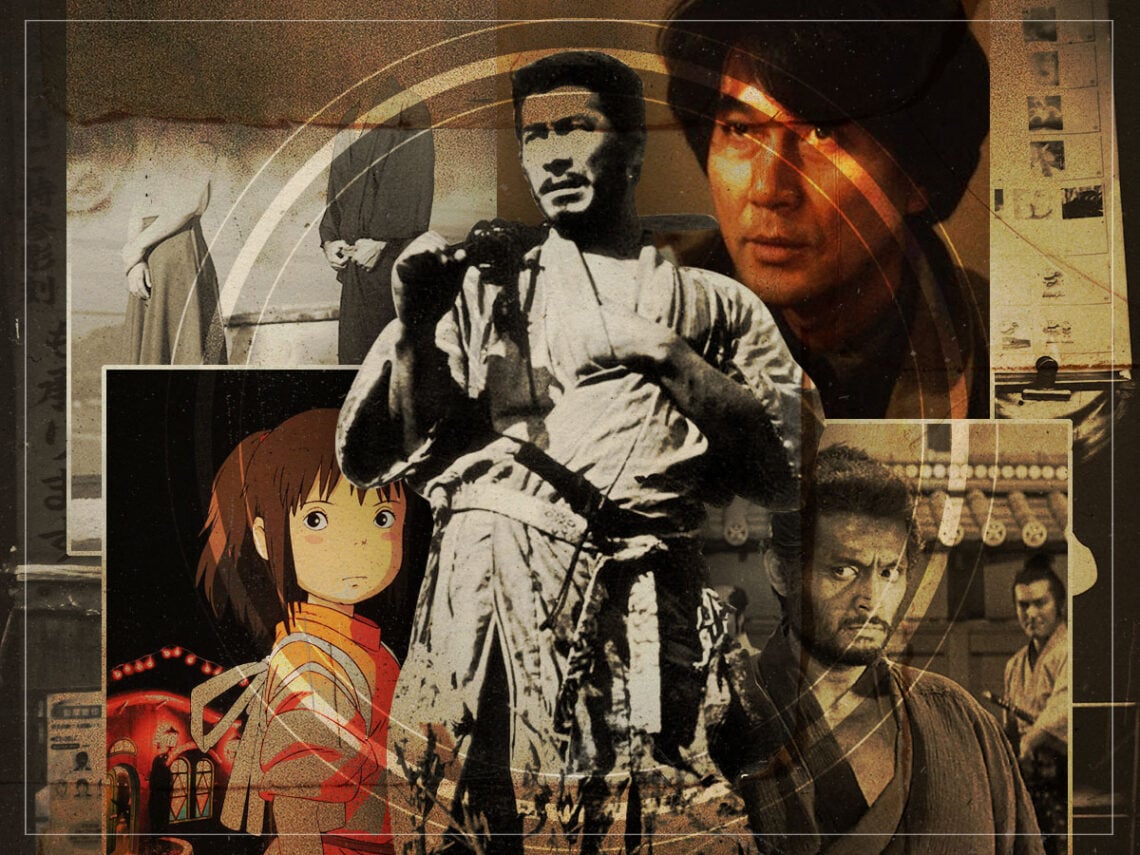
The 50 best movies of Japanese cinema

It’s often felt that Japan has perfected any culture it has assimilated throughout its modern history. Whether in cuisine or the arts, Japanese society has taken on the challenge of crafting genuine beauty with powerful meaning, and in almost no other medium is this more evident than in cinema.
Movies have been made in Japan since the end of the 19th century, and with a cinematic history extending well over 100 years, Japan possesses one of the most significant film industries in the world. It is the centre of some of the greatest works of cinema ever made and also boasts a seriously impressive contemporary scene to boot.
The Golden Age of Japanese cinema saw the likes of Akira Kurosawa’s samurai movies and Ishiro Honda’s monster films come to light. Elsewhere, Yasujirō Ozu’s family dramas are some of the most acclaimed and influential movies in the history of cinema, inspiring countless Japanese filmmakers of the preceding generations.
Japanese cinema is brimming with cutting-edge psychological horror, moving romantic drama, side-splitting comedy, celebrations of Japan’s rich cuisine, and historical epics that examine the key moments of the Asian country’s past. It reveals a nation with a broad interest in both culture and history.
We’ve compiled a list of the greatest movies in the history of Japanese cinema, including those from some of the most celebrated film directors to ever take up the camera to a handful of modern icons who have taken the medium into new artistic frontiers.
The 50 best Japanese movies:
50. Ichi the Killer (Takashi Miike, 2001)
We begin with perhaps the most visceral and shocking entry on this list of Japanese cinematic greats. Based on Hideo Yamamoto’s manga, Takashi Miike’s Ichi the Killer follows a deranged man who is forced into killing members of the yakuza and a sadomasochistic criminal who is looking for his missing boss.
Extreme violence runs through Ichi the Killer, which flirts between high-octane action and gruesome horror, details in a flashy and fast visual style. A cult following quickly arrived for the torturous and sadistic showing that was banned in many countries upon release. Still, that very violence makes Miike’s movie worth the painful trip.
49. The Animatrix (Various, 2003)
How could the Wachowski sisters ever make The Matrix even better? Well, by hiring some of the biggest names in Japanese anime to deliver an anthology movie set in its universe and telling some seriously intense sci-fi stories, of course. With 2003’s The Animatrix, the directing duo did just that.
The likes of Mahiro Maeda, Cowboy Bebop’s Shinichiro Watanabe, Yoshiaki Kawajiri, Takeshi Koike and Koji Morimoto all joined The Animatrix and wove the tale of how the Matrix was created by the machines and delved into what its subjects experienced within its simulated realities. An essential part of the wider Matrix puzzle, for sure.
48. Sex and Fury (Norifumi Suzuki, 1973)
In 1973, Japanese cinema got one of its best-ever exploitation movies with a heavy leaning into eroticism. Norifumi’s film Sex and Fury is a graphic film by the 1970s standards and takes place in the 20th century, focusing on a gambler and pickpocket by the name of Ocho Inoshika, who seeks out revenge against those who murdered her father.
Each moment of choreographed action is met with a flash of nudity, ramping up the dramatic and sensationalist qualities of the film. A classic in the exploitation genre and certainly one of the most stylish works in the cinematic category, Sex and Fury is a brilliant work that saw actor Reiko Ike transcend the gender norms of the mid-20th century.
47. Confessions (Tetsuya Nakashima, 2010)
Based on the Kanae Minato novel of the same name, Tetsuya Nakashima’s 2010 psychological thriller Confessions is a shocking tale of revenge. Teacher Yuko Moriguchi lives in trauma and grief after the death of her young daughter, but it’s slowly revealed that her death was a murder inflicted by two of her students.
Despite her profession, Moriguchi sets out on a quest for revenge, leading to an audience questioning her morality as her psychological manipulation takes effect. By using multiple perspectives, Nakashima delivers a striking piece of cinema that dives into the themes of guilt and vengeance and challenges viewers to consider their own morality in the light of tragedy.
46. Battles Without Honor and Humanity (Kinji Fukasaku, 1973)
If a bleak, cruel and violent yakuza movie is what you need, then Kinji Fukasaku’s 1973 film Battles Without Honor and Humanity is what you need. Kicking off the five-part film series that the director made in just two years, the first is an absolutely seminal work of yakuza cinema based on the real-life accounts of journalist Koichi Iiboshi.
The film focuses on Bunta Sugawara’s Shozo Hirono, an ex-soldier who has become wrapped up in the world of Hiroshima’s yakuza organisations. Fukasaku captures the violence and battle for power in an almost documentary-like authenticity, showing the dealings of the Japanese criminal underworld in a raw and unflinching style, a grit that departs from the genre’s early efforts.
45. In the Realm of the Senses (Nagisa Oshima, 1976)
Quickly the most erotic venture found on this list, Nagisa Oshima’s In the Realm of the Senses boasts the fact that it features unsimulated sex scenes. Based on the story of Sada Abe, a former sex worker who became involved in a murderous affair with a Japanese politician in the 1930s, Oshima’s film portrays the intense sexual relationship between Abe and Kichizo Ishida.
Naturally pushing the limits of censorship in the mid-1970s, sexuality runs rife through In the Realm of the Senses, although it’s not merely a pornographic work. Instead, the themes of desire, relationships and power are explored in the utmost earnestness, though a co-production with France was needed to get the erotic film released.
44. Sweet Bean (Naomi Kawase, 2015)
Well, after all that sex, violence and vengeance, perhaps it’s time for something a little sweeter to lighten the palette. Thankfully, Naomi Kawase’s 2015 drama film Sweet Bean is the perfect antidote to such harrowing cinema. It tells the story of a Japanese pancake shop owner and an elderly woman who helps him to improve his sweet bean paste recipe.
Kawase touchingly explores the themes of interpersonal connection and the kind of beauty that simmers underneath the banality of our everyday existence. A strikingly beautiful and patient work of Japanese film that enlivens the soul and brings warmth to the heart, Sweet Bean is not to be missed, having opened the Un Certain Regard section at the 2015 Cannes Film Festival.
43. Love Exposure (Sion Sono, 2008)
We’re used to films of the “epic” variety being sweeping historical dramas, but with 2008’s Love Exposure, Sion Sono delivered a modern comedy-drama with a huge four-hour runtime. A stultifying piece of cinema, Sono blends together all manners of styles and genres to issue a surreal tale of love and sin.
At its core, the film follows a young teenager who tries to appease his Catholic father’s wishes to confess his sins. With little to confess, he begins to engage in the crime of upskirt photography before finding himself at the mercy of a peculiar religious cult. If that all sounds strange, that’s because Love Exposure absolutely is, but its brave uniqueness is precisely what earns its place on this list.
42. The End of Evangelion (Hideki Anno, 1997)
The anime series Neon Genesis Evangelion was going down as one of the greatest of its kind. However, the final two episodes of the show were delivered in a strange abstract style, leading to a huge fan backlash. In response, creator Hideki Anno made and released the 1997 film The End of Evangelion to make amends and finish things properly.
As in the main series, Anno’s film focuses on protagonist Shinji Ikari’s isolation and emotional turmoil as he helps humanity battle for its existence against the strange and dangerous Angels. In detailing the Human Instrumentality Project, Anno not only made good on his legendary anime series but also tapped into the themes of existence and loneliness in equal measure. It is a fitting end to one of the all-time greats.
41. Perfect Days (Wim Wenders, 2023)
An absolute rarity for a non-Japanese director to make their way onto a Japanese cinema list, but considering the Japanese co-production of Wim Wenders‘ Perfect Days and the fact that it’s just so damn good, it’s no surprise to find the 2023 drama film here. A charming movie starring Koji Yakusho, Perfect Days explores how to find happiness.
Protagonist Hirayama is a Tokyo public toilet cleaner who spends his simple days reading, listening to rock music, and bathing at his local sento. While many of us would find this utterly dull, Wenders shows that there is beauty and joy in the ritual of the mundane. Perfect Days is a remarkable work that shows us the importance of accepting our little personal positions in the world and is genuinely essential viewing in the modern age.
40. Wife of a Spy (Kiyoshi Kurosawa, 2020)
Part espionage thriller and part relationship drama, Kiyoshi Kurosawa’s Wife of a Spy has a delicate tonal needle to thread but pulls it off masterfully.
Yu Aoi’s Satoko Fukuhara grows increasingly suspicious of her husband’s extracurricular activities, coming to the conclusion that Issey Takahashi’s spouse, Yusaku, is up to no good. Her concerns are hardly ill-founded, instigating a game of cat-and-mouse where both hide their true intentions.
Inspired by a true story and Hitchcockian in its execution, Wife of a Spy pits its two protagonists against each other without one of them even realising, echoing the uncertainty of wartime society through the lens of an enticing mystery.
39. Princess Mononoke (Hayao Miyazaki, 1997)
The legendary Hayao Miyazaki’s signature style is on full display in the alluring historical fantasy Princess Mononoke, which set box office records in Japan that wouldn’t be broken until the filmmaker did it himself four years later with Spirited Away.
Carrying strong environmental parallels that are just as resonant today as they were over a quarter of a century ago, young prince Ashitaka finds himself caught up in a struggle between the forest gods and humanity, who continue to lay waste to the natural resources of the land without concern for anyone else.
A thematically rich and visually breathtaking masterpiece, Princess Mononoke distils Miyazaki’s moral compass into 133 minutes of animated genius, making it one of the finest works from the legendary figure.
38. Pulse (Kiyoshi Kurosawa, 2001)
An early entry into the techno-horror subgenre, Kiyoshi Kurosawa’s Pulse turns the internet into a villain long before the dangers of being chronically online were as prevalent as they are now.
It would be a disservice to call it ‘Ringu, but online’, although it was easy to see how those parallels were drawn. Kenji Mizuhashi’s college student Taguchi commits suicide to instigate a number of Tokyo residents being traumatised by visions beamed across the internet, which becomes a hunting ground for nefarious spirits.
More concerned with the power of suggestion than splashing the screen with blood, guts, and gore, Pulse deftly capitalises on the great unknown of the early-2000s internet to exact trembling levels of tension from its inspired premise.
37. Tokyo Drifter (Seijun Suzuki, 1966)
The list of movies made about the yakuza is exhaustive, to say the least, but few – if any – have managed to unseat Seijun Suzuki’s Tokyo Drifter from its seat as arguably Japanese cinema’s most vibrant crime thriller.
Indebted to the classic Western, the filmmaker wears those inspirations on his sleeve both subtly and brazenly, whether it’s protagonist Tetsuya Hondo whistling like a classic cowboy as he goes about his business or a barroom brawl lifted right out of an Old West saloon.
Smart, stylish, and hinging on familiar themes of loyalty and tradition, Tokyo Drifter both embraces and subverts the familiar tropes and trappings of the yakuza film to present something that’s both intentionally archetypal and completely unique.
36. The Emperor’s Naked Army Marches On (Kazuo Hara, 1987)
A fascinating basis for a documentary, director Kazuo Hara doesn’t go as far as to either encourage or explore subject Kenzo Okuzaki but simply lets him go about his business of trying to heal old wounds and get the answers he’s been seeking since World War II.
It’s far from the standard template for a feature-length doc. The Emperor’s Naked Army Marches On thrives on the juxtaposition between its simplicities and complexities. The filmmaker isn’t an active participant but an observer, with Okuzaki’s mission engrossing enough to sink its hooks into the audience.
The former soldier, self-proclaimed anarchist, and staunch anti-monarchist blamed Emperor Showa for all of the suffering experienced during the war, leading him to track down ex-military personnel to try and find out what happened to a pair of soldiers in his unit who died an unexplained death. The fury is palpable, and his journey is jaw-dropping right until the final scene.
35. Hausu (Nobuhiko Obayashi, 1977)
A deranged horror-comedy, it’s become part of Hausu‘s legend that Nobuhiko Obayashi was initially approached by Toho to try and emulate Steven Spielberg’s Jaws, only for the filmmaker to have something completely different in mind.
What he had in mind was a stone-cold cult classic that’s captivated multiple generations thanks largely to the sheer volume of what-the-fuckery on display, with the kitchen sink approach to weirdness leaving no stone unturned in its pursuit of off-the-wall perfection.
Squirrelled away in a remote mansion, Kimiko Ikegami’s protagonist and her six friends find themselves plunged into the supernatural fight of their lives. Ridiculous in a thousand different ways and imaginative in many more, it’s a bonkers flight of fancy that’s as audacious as it is experimental.
34. Lady Snowblood (Toshiya Fujita, 1973)
So influential that Quentin Tarantino used it as the basis for the climactic showdown in Kill Bill: Vol. 1; Lady Snowblood delivered a roaring rampage of revenge decades before The Bride was a twinkle in Uma Thurman’s eye, and she may have just done it better.
Born in prison and destined to live up to her mother’s dying wish that she exact her vengeance on those responsible for her predicament, Meiko Kaji’s Yuki Kashima grows up to lay waste to anyone who gets in her way, regardless of whether or not they’re the culprits she’s dedicated her life to dismantling.
More than just a simple action flick, Lady Snowblood never loses sight of the tragedy that shaped its main character into the ruthless killing machine she became, while the set pieces themselves are orchestrated with ballet, blood-splattered precision.
33. Tetsuo: The Iron Man (Shinya Tsukamoto, 1989)
Another favourite of Quentin Tarantino’s, Tetsuo: The Iron Man melded sci-fi and body horror to an eye-popping extent, with nothing deemed off-limits for the vision of maverick filmmaker Shinya Tsukamoto, who never met a bad taste scenario he wouldn’t commit to celluloid.
Gloriously indescribable, the first instalment in what eventually became a trilogy pinballs from psychosexuality and fetishism to cyberpunk and back again, tossing in lashings of existential dread and stomach-churning moments for good measure. It’s a recipe that realistically shouldn’t work, but oh boy, it sure does.
It’s the sort of film nobody would be sold on if you explained the plot to them with a straight face, but some movies are so bizarre that they need to be experienced full-on, and the one-of-a-kind Tetsuo: The Iron Man fits neatly into that bracket.
32. The Face of Another (Hiroshi Teshigahara, 1966)
Part of the Japanese New Wave, Hiroshi Teshigahara’s The Face of Another ably adapts Kobo Abe’s novel of the same name into a social and societal parable that remains as potent now as it did in the 1960s.
The severe burns suffered by engineer Mr. Okuyama leave him feeling increasingly isolated and ostracised as he continues to wear bandages around his face before a session with his psychiatrist encourages him to literally try on a new face to see if his situation will improve.
It does, but there are consequences to Okuyama’s decision to accept his mask as the essence of his personality. In a world where personal identity and individualism continue struggling to stand out in a society of mass production, if anything, the message at the heart of The Face of Another only gets more powerfully prescient over time.
31. Mishima: A Life in Four Chapters (Paul Schrader, 1985)
Taxi Driver writer Paul Schrader’s biographical drama tracing the life and times of the multi-talented Yukio Mishima may boast some serious Stateside pedigree, but it’s far from being anything approximating a standard Hollywood biopic.
Francis Ford Coppola’s Zoetrope Studios and George Lucas’ Lucasfilm backed the production, but it’s very much reflective of Schrader’s vision. It might be a biopic in the truest sense of the word, but Mishima: A Life in Four Chapters takes an approach to its storytelling every bit as enigmatic as the subject.
Using incidents from Mishima’s life interspersed with dramatized passages from several of his books to blur the lines between fact and fiction, the unconventionally-structured experiment finds Schrader at his most avant-garde directorially, with his passion for the film’s focal point shining through in every frame.
30. Onibaba (Kaneto Shindo, 1964)
Japanese cinema has long been championed for its contributions to the world of horror, with Kaneto Shindo’s 1964 film Onibaba being one of the country’s very best offerings. Celebrated across the world, the movie tells the story of two women who kill samurai and sell their wears for money, a dodgy trade that goes wrong when one of the criminals comes face to face with a strange figure in the tall grass wearing a demonic mask.
A key folk horror text, Onibaba is a surprisingly eerie film that has endured the test of time with incredible durability. Still relevant in contemporary cinema, Hollywood star Willem Defoe recently stated that he’d love to remake the classic.
29. Happy Hour (Ryusuke Hamaguchi, 2015)
While the majority of movies on this list are classics from the 20th century, contemporary Japanese cinema has also offered up a number of gems. Ryusuke Hamaguchi’s 2015 masterpiece, Happy Hour, is one such great example, with the film being a slow-burning drama concerning the lives of a group of women in a seaside city as they grow together and apart with the winds of changing friendships.
An emotional, deeply sensitive drama about the psychological challenge of growing older, Happy Hour unfolds across the course of five hours but leaves you thinking that you could stay with the group forever.
28. Kwaidan (Masaki Kobayashi, 1964)
Recognised as one of the very best horror movies ever made, Masaki Kobayashi’s 1964 film Kwaiden is an anthology tale that delves into several short horror stories from the pages of historic Japanese folklore. With a creepy, haunting style, Kwaidan is a timeless piece of cinema that feels raw and distinctive, as if it has come from the very earth of Japan, setting itself wildly apart from the flashy genre flicks of Hollywood.
Adored across the world of cinema, fellow horror director Ari Aster went as far as saying that Kwaiden was “the most breathtakingly beautiful horror film ever made,” adding that it was “ethereal and haunting and possessed of a totally devouring commitment to artifice”.
27. Godzilla (Ishiro Honda, 1954)
Of all the films on this list of incredible Japanese cinema, the monster movie Godzilla may be the most influential of the entire bunch. Sparking an interest in colossus cinematic creatures across the globe, Godzilla was born from the devastating nuclear bombings of Hiroshima and Nagasaki during the closing stages of WWII, telling the story of a humongous lizard-like beast who wages terror across Tokyo while scientists try to figure out how to handle the creature.
While in contemporary cinema, Godzilla is better known for shooting lasers out his mouth, in the original film, the titular colossus was a poignant reminder of the devastating destruction of nuclear weapons and that which is beyond human comprehension.
26. Ringu (Hideo Nakata, 1998)
Throughout Japan’s modern history, horror movies have proven wildly popular and influential. Few works have become as inspiring or memorable as Hideo Nakata’s 1998 supernatural psychological horror movie Ringu, undoubtedly one of the most notorious pieces of the country’s cinematic endeavours.
Starring Nanako Matsushima, Miki Nakatani and Hiroyuki Sanada and based on the 1991 novel by Koji Suzuki, Ringu follows a journalist in a race to discover the mysterious truth behind a strange videotape. The tape curses anyone who watches it, making them die exactly seven days after they do so.
Ringu, along with Kiyoshi Kurosawa’s Cure and Takeshi Miike’s Audition, helped popularise J-horror, and naturally, a series of American remakes followed. However, the original is undoubtedly the best of the lot. It should be championed for its influential qualities and because it’s such a terrifying and realistic horror movie.
25. Nobody Knows (Hirokazu Koreeda, 2004)
Undoubtedly one of Japan’s greatest contemporary filmmakers, Hirokazu Koreeda is responsible for creating some of the most tender portrayals of the family dynamic ever put to celluloid. His 2004 film Nobody Knows was one of his earliest successes, with the remarkable drama telling the story of a young boy who is forced to look after his siblings after their mother leaves abruptly and without a trace.
Ever able to effortlessly access the innate beauty of a tale through delicate camerawork, Kore-eda’s 2004 film is one of his finest achievements, speaking to the loss of innocence and the bonds of family that tether us together in mind, body and soul. More than any other, Koreeda has the ability to bypass any needless cinematic flourishes and take us to the very heart of a protagonist, where he meticulously explores them trait-by-trait.
24. Hana-bi (Takeshi Kitano, 1997)
Most people will recognise actor and director Takeshi Kitano from the beloved action flick Battle Royale, championed by Quentin Tarantino, but his best work has been achieved from behind the camera. One of his best works came in the form of 1997’s Hana-bi, a crime drama that oozes style in its story of Nishi, a man who leaves the police force and finds himself in a state of depression that leads him to make several odd choices.
Using an evocative visual style, Kitano tells a story which focuses deeply on the protagonist, breaking down themes of mortality and the authenticity of human existence. The movie exceeded initial expectations by becoming far more existential than one had previously thought.
23. All About Lily Chou-Chou (Shunji Iwai, 2001)
Authentically representing the next generation of adolescents has never been an easy task, yet Shunji Iwai does impeccably well in this task in his 2001 film All About Lily Chou-Chou. Exploring the lives of contemporary teenagers amid the steady rise of technology, Iwai’s film focuses on a group of students who consider the music of real-life artist Lily Chou-Chou the only way to escape the oppressive violence and alienation of society.
An extraordinary piece of cinema that transports you into the mind of several teenagers living on the border between dreams and reality, All About Lily Chou-Chou offers both answers and more questions about how one should go about navigating the jungle of 21st-century life.
22. Woman in the Dunes (Hiroshi Teshigahara, 1964)
Surrealism pervades much of Japanese cinema, with Hiroshi Teshigahara’s 1964 film Woman in the Dunes being one of the finest examples across the entire landscape of the country’s rich cinematic history. Entomologist Niki Jumpei is the figure at the centre of the strange tale, with the character finding himself trapped in a village where he is forced to live with a woman who shovels sand, day and night, for a living.
An existential study of humanity’s relationship with nature, Teshigahara weaves a tale that floats in and out of the dreamscape, asking the audience to deepen their introspection into the philosophical quandaries of life itself. A distinctive piece of Japanese art, Woman in the Dunes is a spectacular oddity.
21. Ugetsu (Kenji Mizoguchi, 1953)
Exploring the complexity of human nature, Ugetsu is a magnificent odyssey that delves into the story of two couples whose lives are thrown into disarray during the Japanese Civil War that occurred in the 16th century. The elegant and haunting cinematic journey takes up just 90 minutes of your time but feels like it occupies your mind and soul for far longer, speaking to an innate mortal truth that is difficult to articulate.
Beloved by several acclaimed filmmakers, Martin Scorsese once said of Mizoguchi, “He’s right up there with Renoir and Murnau and Ford,” before adding, regarding the movie, “Ugetsu has the most powerful effect on me. There are moments in the picture, famous ones, that I’ve seen again and again, and that always takes my breath away.”
20. Shiki-Jitsu (Hideki Anno, 2000)
Possessing a truly mesmerising lineup of Neon Genesis Evangelion director Hideki Anno; actor, writer and daughter of Steven Seagal Ayako Fujitani; and Love Letter and All About Lily Chou-Chou filmmaker Shunji Iwai, Shiji-Jitsu is a visually mesmerising and narratively heart-breaking movie about trauma, loneliness and depression.
Based on Fujitani’s novella Tohimu, Shiki-Jitsu depicts a short-term relationship between a depressed anime film director and an enigmatic young woman, with Anno diving deep into the cruel nature of mental illness as the pair try to help one another out of their respective crises.
Anno, primarily known for his anime works, showcases a remarkable ability for shot-framing and cinematography with the help of cinematographer Yuichi Nagata. A poignant reflection on our modern psychological state, Shiki-Jitsu is an absolutely essential piece of contemporary Japanese cinema and should not be missed!
19. Battle Royale (Kinji Fukasaku, 2000)
Indeed, one of the most memorable and influential movies on this list, leading to the creation of The Hunger Games and Squid Game and the deepest admiration of Quentin Tarantino, Kinji Fukasaku’s Battle Royale is simply a film that can never be erased from the mind once it has been watched for the first time.
Based on Koushun Takami’s 1999 novel of the same name, written for the screen by the director’s son, Kenta Fukasaku, Battle Royale tells the story of a group of junior high school students who are forced to take part in a totalitarian government scheme designed to curb juvenile delinquency and halt an increasing crime rate.
The students are taken to a remote island and made to fight one another to the death, armed with a series of deadly weapons. There’s a shocking visceral quality to Fukasaku’s film that makes it a truly iconic work of Japanese cinema and one that has certainly transcended the cultural limits of its two-hour runtime.
18. Tampopo (Juzo Itami, 1985)
If there was ever a movie that serves as the most incredible celebration of the joyous experience of eating food, then it is undoubtedly Juzo Itami’s 1985 comedy film Tampopo. Considered the world’s first “ramen western” movie, a play on words, of course, of the “spaghetti westerns” of Sergio Leone et al., Tampopo is a true joy to behold.
At its core, the film is about two truck drivers who help a widowed owner of a rundown ramen shop into the best of its kind and turn it into a pinnacle of the “art of noodle soup making”. The trio set about visiting many of her competitors to understand the spirit of ramen making better, but there’s more to Tampopo than its primary narrative suggests.
Throughout the film, short vignettes about the sensual and socio-political qualities of food are delivered, leading to touching moments of comedy and drama. Humour and song touch upon the very nature of the human experience, making Tampopo well worthy of its high position amid its undoubted uniqueness.
17. Audition (Takashi Miike, 1999)
Alongside Ringu, the late 1990s saw a burst in popularity for the J-horror, and one of the most memorable and unique works is Takashi Miike’s 1999 film Audition. Based on Ryu Murakami’s 1997 novel of the same name, Audition might be the most peculiar film on this list, as expected of Miike.
The film tells the story of Shigeharu Aoyama, a widowed television producer who, longing for another wife, decides to stage mock auditions for a TV show with the real intention of finding a new partner. During the auditions, Aoyama becomes taken with a quiet woman called Asami Yamazaki, who is later revealed to be violent beyond comprehension.
It’s the pace of Audition that gives it its overall quality, though, toying with humour and romance before showcasing its horrific depravity as a result of Asami’s childhood trauma. Miike’s film serves as a damning critique of the power of the male gender role and features some of the most memorable torture scenes in the history of cinema.
16. Late Spring (Yasujiro Ozu, 1949)
It could have been all too easy to douse this list in most of the works of Yasujiro Ozu, so far-reaching has his legacy as one of Japan’s greatest filmmakers become. However, in the name of a broad appeal, we’ve stuck to a handful of Ozu movies, beginning with his 1949 classic Late Spring.
Based on Kazuo Hirotsu’s short novel Father and Daughter, Late Spring saw Ozu’s frequent collaborators Chishu Ryu and Setsuko Hara play in the first of the director’s ‘Noriko trilogy’. In the 1949 drama, Hara plays a 27-year-old woman called Noriko, whom many people urge to marry someone, but all she seems to care about is looking after her widowed father.
Many of Ozu’s movies concerned the Japanese nuclear family and its dissipation amid Japan’s urbanisation and modernisation, and Late Spring is the perfect summary of the director’s thematic ambitions. Widely celebrated as one of Ozu’s best-ever movies, Late Spring is a stunning work that explores the everyday lives of ordinary people.
15. Sansho the Bailiff (Kenji Mizoguchi, 1954)
Certainly one of the most underappreciated Japanese filmmakers of all time, Kenji Mizoguchi dominated the 1950s with a number of classic movies, including the 1954 drama Sansho the Bailiff. A beautifully shot work of cinematic artistry, Mizoguchi’s film follows the children who struggle to survive after their governing father is exiled, with much of the movie being a profound exploration that accesses remarkable emotional depth in relation to its young lead characters.
Filmed with long takes and a meticulous approach to cinematography, Mizoguchi turns this tale, adapted from a short story of the same name by Mori Ōgai, into a ponderous exploration of everything from human compassion to social oppression.
14. After Life (Hirokazu Koreeda, 1998)
Modern Japanese cinema legend Hirokazu Koreeda has shown his ability to conjure up salty eye water on many occasions throughout his career, leading to widespread recognition at the Cannes Film Festival. Even as far back as his sophomore effect as a director, 1998’s After Life, it was clear that Japan had a new master of film.
A truly stunning film that simultaneously celebrates the joys and sorrows of human life and the medium of cinema itself, After Life explores the choices people make at the midpoint between life and death. In a mid-20th century school-like building, the recently deceased are made to choose just one memory from their lives to take with them into the afterlife and experience for the rest of eternity.
It is then up to those who “work” at the way station to recreate the memory on film. After Life is a genuinely beautiful piece of art that invites us to reflect on what makes human life so important and strip away its superfluous details, with Kore-eda showcasing his prowess to pull at our heartstrings.
13. The Human Condition (Masaki Kobayashi, 1959-61)
A genuine monument of Japanese cinema, Masaki Kobayashi’s The Human Condition trilogy is a vital work that explores human morality against the backdrop of World War II Japan. Across nearly ten hours, the gruelling journey of the idealist pacifist Kaji as he is thrown into the brutal reality of war is detailed in the most harrowing of ways.
Split into three parts – No Greater Love, Road to Eternity and A Soldier’s Prayer – Kobayashi’s The Human Condition sees Kaji transition from a labour camp supervisor who tries to retain his humanity to an army soldier, where his pacifist ideals are put to the test. Finally, Kaji becomes a prisoner of war, completing his fateful journey into despair.
By detailing the horrors of World War II, Kobayashi showcases the preservation and spirit of human morality even as it endures the most harrowing events. In addition, the epic war trilogy provides a critique of totalitarianism and the belief in humanity’s endless resilience.
12. Rashomon (Akira Kurosawa, 1950)
The first of Akira Kurosawa’s movies to appear on this list, 1950’s Rashomon is certainly one of the Japanese auteur’s greatest works and perhaps one of his most unique as well. Giving birth to the ‘Rashomon Effect’, Kurosawa’s drama oscillates between the conflicting accounts of the suspected eyewitnesses to a forest murder of a samurai in Kyoto.
Starring regular Kurosawa collaboration Toshiro Mifune, plus Machiko Kyo, Masayuki Mori and Takashi Shimura, Kurosawa based the film on Ryunosuke Akutagawa’s short stories ‘In a Grove’ and ‘Rashomon’, with pretty much every facet of the movie being drawn from such works.
At the core of Rashomon, though, is the subjectivity and potential truthfulness of the suspected eyewitnesses, from a Kyoto monk to the samurai’s wife to the samurai himself via a Shinto psychic. While Kurosawa’s samurai action movies often receive plaudits as the director’s best, Rashomon is certainly one of his most important films in its treatment of subjective narrative storytelling.
11. Perfect Blue (Satoshi Kon, 1997)
Given the fact that Japan has indeed established itself as the king of animation, it’s no surprise to find more than a handful of anime movies on this list, and one of the best is undoubtedly Satoshi Kon’s psychological thriller Perfect Blue, which is by far the director’s most significant work and inspired Darren Aronofsky when he came to make Black Swan.
The 1997 film dives headfirst into the allure and dangers of a life of fame and the harrowing consequences it can leave on one’s identity and psychological makeup. By following pop star Mima, who leaves her group to become an actor, Kon charts her descent into madness as the boundaries of her reality blur.
Some stunning animation work helps to take a breathtakingly intense narrative to new artistic heights, while the editing style mirrors the fragmented nature of its protagonist’s troubled psyche. A vital work of anime that critiques the entertainment world and its objectification of women, Perfect Blue is a genuine masterpiece of Japanese film.
10. Drive My Car (Ryusuke Hamaguchi, 2021)
As far as modern Japanese cinema goes, few directors have captured the world’s attention quite like Ryusuke Hamaguchi. With a brilliant filmography already built up by the time the 2020s rolled around, Hamaguchi further cemented his artistic credentials with the powerful and tender drama film Drive My Car.
Based on the Haruki Murakami short story of the same name, Drive My Car sees Hidetoshi Takamasa play Yusuke Kafuku, a theatre director who directs a production of Anton Chekhov’s play Uncle Vanya in Hiroshima just a handful of years after the death of his unfaithful wife.
There’s a patience and moving quality to Drive My Car that led to a ‘Best Picture’ Academy Award nomination and allows an audience to understand the latent grief that hangs over Yusuke. Throw into account one of the greatest modern scores by Eiko Ishibashi and imagery that reflects the emotive yearning of the film’s characters, and Drive My Car is easily one of the greatest movies of Japanese cinema.
9. Harakiri (Masaki Kobayashi, 1962)
Yet another masterpiece from the legendary Masaki Kobayashi. 1962’s Harakiri, also known as Seppuku (the Japanese ritualistic form of suicide by disembowelment), serves as a striking critique of the samurai code of honour and an exploration of the unwavering social structures and values of the Edo period in Japanese history.
Narratively, the film focuses on Hanshiro Tsugumo, an ageing ronin who arrives at the house of a feudal clan’s estate and seeks permission to commit seppuku in their courtyard. However, the clan’s lord treats the request with suspicion and instead begins to hear the story of Tsugumo and how he arrived at such a predicament.
Throughout flashbacks, Tsugomo weaves a tale of tragedy and vengeance and exposes the flaws in the samurai way of life. With stunning cinematography and masterful use of quiet and space, Harakiri is considered one of the greatest movies ever made and well deserving of its position in the top ten best Japanese films ever.
8. Akira (Katsuhiro Otomo, 1988)
The first of three anime movies to make it into the top ten best Japanese films of all time, proving the importance of the genre to the country’s repertoire, is Katsuhiro Otomo’s eternally iconic cyberpunk classic Akira, which arrived on the screen back in 1998.
Based on Otomo’s 1982 manga of the same name, Akira takes place in the dystopian futuristic metropolis of Neo-Tokyo in 2019 and focuses on the Kaneda, the leader of a juvenile biker gang and his childhood friend Tetsuo, who suddenly acquires powerful telekinetic abilities after suffering a motorcycle accident, leading to a full-scale military operation to prevent him from destroying Neo-Tokyo.
There isn’t a frame of Akira that isn’t stunning to behold, and it’s more than easy to see why the film is heralded as one of the greatest anime movies ever made. Crafted with meticulous attention to detail, Akira is a genuine landmark of Japanese cinema and a further testament to the genius of the country’s manga artists and animators.
7. Sonatine (Takeshi Kitano, 1993)
Throughout his career, Takeshi Kitano made several brilliant contributions to the yakuza film genre. Still, few managed to leave an impression quite like this 1993 film Sonatine, a moving and harrowing subversion of the cinema categories many tropes and stereotypes that leaves the audience in a state of existential uncertainty.
Narratively, Sonatine tells the story of Murakawa (played by Kitano), a hardened and weary Tokyo yakuza member whom his boss sends to Okinawa to deal with an ongoing gang dispute. Upon arrival on the Japanese island, Murakawa begins to suspect that his superiors have sent him out to be assassinated.
Eventually, Murakawa and his men hide in a beach house, leading the yakuza boss to reflect on his life of crime and enjoy the pleasures of simplicity for a fleeting moment. Sonatine’s sparseness allows the audience to engage with Murakawa’s existential meditation, while the director’s deadpan humour and acting style elevate it into a movie of the highest poetic quality.
6. Ghost in the Shell (Mamoru Oshii, 1995)
It could have been a toss-up between Katsuhiro Otomo’s Akira and Mamoru Oshii’s Ghost in the Shell for the best cyberpunk anime movie ever. Still, Oshii’s masterpiece 1995 neo-noir action thriller has to take the plaudits. A genuinely monolithic achievement in animation, Ghost in the Shell leaves mouths agape.
Based on Masamune’s manga of the same name, Ghost in the Shell takes place in the fictional New Port City in 2029 and tells the story of a cyborg public security agent, Motoko Kusanagi, who tracks down a dangerous hacker called the Puppet Master. So far, so standard for a science fiction movie, but Ghost in the Shell possesses so much more.
Even beyond its brilliant animation, depiction of urban futurism and haunting score, the themes of Oshii’s film bring it to masterpiece status. For instance, how much of her remains human if Kusanagi is completely cybernetically enhanced? Questions like this plague Ghost in the Shell and prompt the examination of identity in a world of technology from its audience.
5. Ran (Akira Kurosawa, 1985)
Throughout his career, Akira Kurosawa consulted the works of William Shakespeare and brought them into a new light, masterfully transposing the Bard’s narratives into feudal and post-war Japanese settings. Few of his adaptations were as impressive as the 1985 epic action film Ran, based on Shakespeare’s legendary play King Lear.
Also including elements from the legend of Mori Motonari, Ran focuses on Hidetora Ichimonji (played by Tatsuya Nakadai), an ageing Sengoku era warlord who decides to abdicate his throne in favour of one of his three differing sons. Kurosawa expertly blends the story of King Lear into a Japanese historical timeframe and uses colour for the best time in his career.
Visually, Kurosawa has never been better. By charting the descent into madness of a ruler and his family’s actions of cruelty and betrayal, he delivers an intense cinematic masterpiece with all the visceral battle scenes expected of a film released under his name and landscape shots to rival even the greatest directors of the western genre.
4. Cure (Kiyoshi Kurosawa, 1997)
As stated above, Ringu and Audition helped set the scene for the future brilliance of Japanese horror. Still, Kiyoshi Kurosawa’s 1997 psychological terror Cure, starring Koji Yakusho and Masato Hagiwara, kicked the genre into gear in the East Asian country.
Undoubtedly a peculiar work of cinema that might not be to every cinema fan’s taste, Cure focuses on Detective Takabe and his investigation into a series of harrowing murders in Tokyo whereby each victim seems to be killed by a different perpetrator, with the only link appearing to be a strange drifter called Mamiya who leaves his interrogators in a hypnotic state whenever confronted.
Cure is a film that leaves a shiver on an audience’s spine with its slow pacing and eerie tone and mood. Japanese cinema has often explored the darker facets of the human psyche, but few films examined them with as chilling an effect as Kiyoshi’s masterpiece horror movie, undoubtedly one of the most disturbing and complex films in the Japanese canon.
3. Spirited Away (Hayao Miyazaki, 2001)
Now arriving at perhaps the most significant anime movie ever made, Hayao Miyazaki’s Spirited Away serves as the master statement of anime legends Studio Ghibli. Sure, plenty of Ghibli movies stand a shot at being amongst the greatest anime works of all time, but there’s something about Spirited Away that breathes perfection.
Visually, the anime medium has never looked as impressive, with its masterful animation and drawing, in which colour pops and fantasy comes to life. With a mesmerising score, Spirited Away follows a ten-year-old girl called Chihiro who discovers a magical world during a home move and must find a way to save her parents from the evil witch Yubaba, who has turned them into pigs.
The locations of Spirited Away are amongst some of the most iconic in the Ghibli oeuvre, most notably the legendary bathhouse for the spirit world where Chihiro inadvertently finds herself working. Mysterious and magic run amok in Spirited Away, and all things considered, it truly is the best anime movie ever made.
2. Tokyo Story (Yasujiro Ozu, 1953)
If there had ever been a director who charted the changing of society and culture in Japan from the late 19th century into the modern age, then it was Yasujiro Ozu. Known and championed for his family dramas of emotional weight and stunning artistic quality, Ozu’s 1953 film Tokyo Story is widely considered the iconic director’s best-ever film.
An exploration of the complexity of family relationships and the divide of belief that often occurs amongst different generations, Tokyo Story focuses on the plight of an elderly couple, Shukshi and Tomi Hirayama, who take a trip from their rural home to visit their grown-up children but find that they are primarily preoccupied with their own lives.
At the core of Tokyo Story’s brilliance is its simple visual composition, through which Ozu allows the performances of his actors and the depth of the family’s narrative to come to light. Melancholy and introspection douse the film in storytelling brilliance. At its core, Ozu delivers a striking mediation of the inevitability of the passing of time and the transition of tradition to modernity in Japan.
1. Seven Samurai (Akira Kurosawa, 1954)
Of course, though, there can only be one movie that holds the pleasure of being the most excellent movie in the history of Japanese cinema, and that has to be the absolute masterpiece of filmmaking that is Akira Kurosawa‘s Seven Samurai, a striking feat of artistry from the Japanese directing icon that has unduly become one of the most influential works of cinema of all time.
The epic samurai action classic takes place in the Sengoku era and features a group of desperate and exploited farmers who seek out a band of masterless samurai to protect them from a group of bandits who themselves have vowed to steal their crops after the next harvest. Each samurai assembled is different in psychology and mood, but they form a solid alliance to protect their farming employers.
Seven Samurai contains some of the most breathtaking action sequences of all time that seem remarkably authentic. Kurosawa masterfully captures each slash of the blade, whistle of the arrow, and stomp of the hoof. With themes of honour and sacrifice, Seven Samurai is seriously important as a work of Japanese cinema. For our money, it is the greatest of all time from the country’s excellent catalogue of films.
