


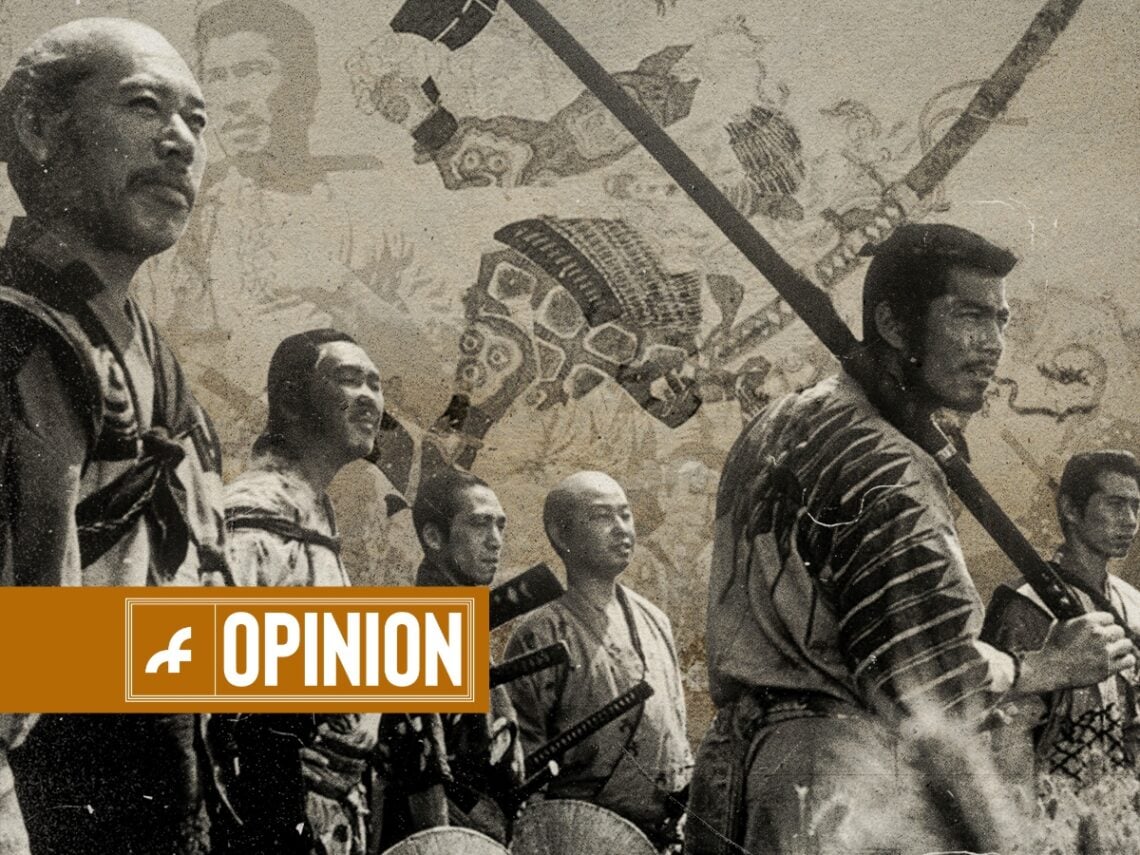
‘Seven Samurai’ features the greatest action scenes in cinema history

When it comes to naming the most significant work in Akira Kurosawa‘s catalogue, it’s hard to look beyond his 1954 epic film Seven Samurai, starring the iconic Japanese auteur’s frequent collaborator Toshiro Mufine. Seven Samurai is simply one of the best pieces of cinema ever made by Kurosawa or otherwise.
The film takes place in 1586 during the Sengoku period of Japanese history and tells of a village of lowly farmers who experience the tyranny of a group of bandits who persistently steal their crops. After the bandits ransack the village for the umpteenth time, the farmers decide to hire a band of masterless samurai, or ronin, to protect them from their next attack.
Seven Samurai laid down the foundation for the ‘assembling the team’ trope that has been found in so many cinematic works in the proceeding years. Eventually, seven ronin are brought together and learn to trust one another and set about defending the village from the bandits whilst also engaging in pre-emptive attacks on their camp.
The brilliance of Kurosawa’s movie is that it blends the societal issues of 16th-century Japan with some of the greatest moments of action ever committed to film. We see the kind of challenges that Japanese farming peasants faced during the period of widespread warfare in the East Asian country as warlords and clans fought for its control.
But it’s really the action that gives Seven Samurai its undoubted majesty. The film was, at one point, the most expensive ever made in Japan and took over a year to shoot, with several difficulties arising along the way. For instance, the climactic battle scene at the movie’s end, initially set for mid-summer, had to be shot in February in near-freezing temperatures. While these issues were undoubtedly at the chagrin of the cast, they also lend the final product an air of reality.
And that’s really the reason why Seven Samurai’s action is so damn good; because it’s truly believable. Perhaps that comes down to the fact that the movie was made in the 1950s when production primarily relied on cinematography, direction and performance alone, but it’s fair to say that Kurosawa absolutely nails down exactly what we want to see from action sequences, regardless of what circumstances they’re made under.
Take, for instance, a practice duel scene that occurs with the village peasants looking on. Kurosawa beautifully captures the two duellists on either side of the camera, and there is little dramatic build-up before the fighting commences. One samurai charges at another, screaming before he’s then blocked, and the duel suddenly ends. It’s a perfect introduction to what will come later in the film.
We eventually find the villagers and the samurai being battered down by rain as they wait to ambush the oncoming bandits, and it’s the weather itself that provides so much of the glorious reality. The truth is that combat is never a clean affair; in fact, it’s precisely the inverse, dirty and lacking composure, even if undertaken by the honorific samurai of Japan.
Nowhere is this more evident in Seven Samurai than in the chaotic moments of horseback combat, and Kurosawa wonderfully captures the true brutality of hand-to-hand warfare, free from the cowardice of modernity’s firearms. The rain pours down as the horses kick up the mud into the faces of the combatants, and the result is nothing short of intoxicating.
We really get the sense in Kurosawa’s masterpiece that what we see is actually happening, all the missteps and falls captured as though essential to the disorderly battle itself. The screams as the bodies hit the floor pierce through into the audience themselves, arrows flying through the air into the hearts of the enemy.
Of course, all these beautiful moments of action are further amplified by scenes of quiet reflection, giving them all the more purpose and weight. Each samurai’s death is meaningful because of Kurosawa’s very insistence on delivering it through realistic means. There’s no glorification of death, no final gasps, just the brutal truth of the end of life through combat.
Seven Samurai is a beautiful work in its own right in terms of its narrative, but it’s really the action that elevates it into being the masterpiece it undoubtedly is. It is Kurosawa’s attention to the movement that creates the intoxicating nature of the film; we’re always drawn to what’s happening physically rather than being solely concerned with the feelings of the village farmers and their samurai protectors.
Check out a scene of action from Akira Kurosawa’s 1954 samurai epic Seven Samurai below.
