


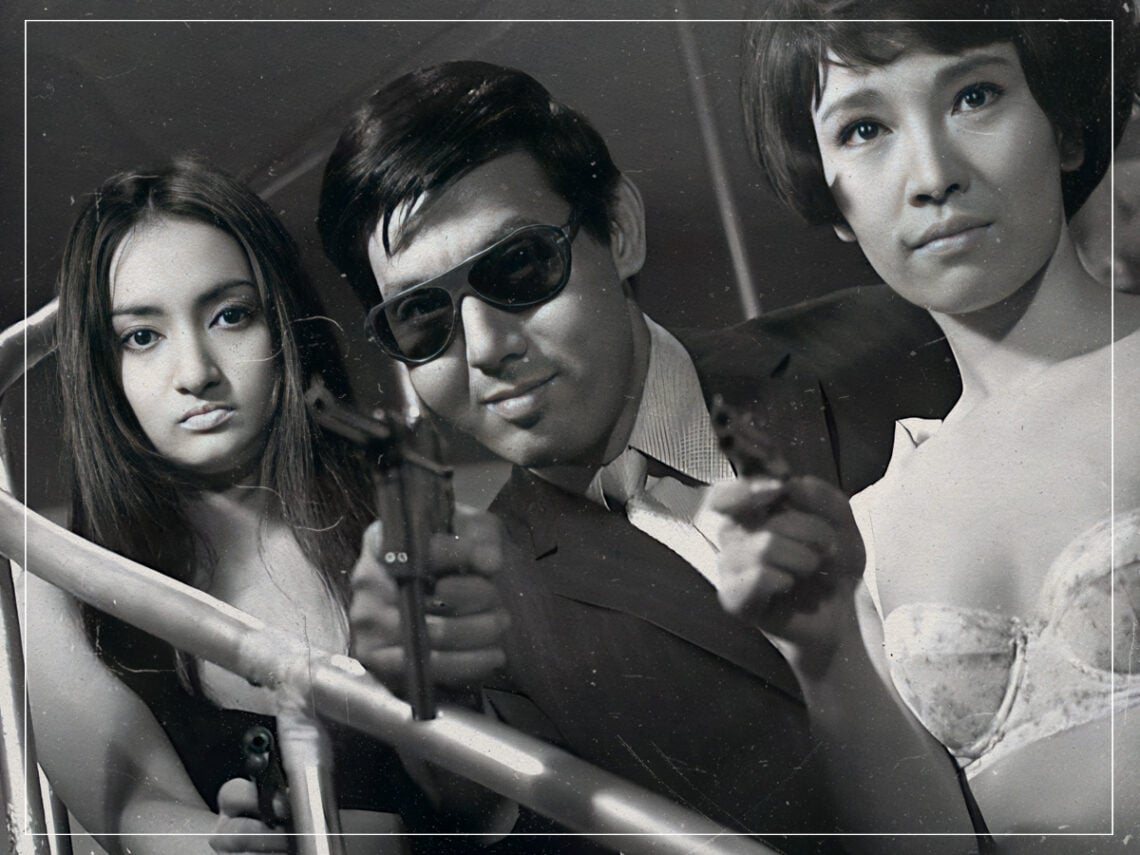
‘Branded to Kill’: the most surreal yakuza movie ever made

As far as the cinema of Japan goes, it’s clear that there are two genres that dominate the country’s cultural consciousness: the samurai and the yakuza film. Of course, Japan has thrown us countless moving dramas over the years, but Japanese cinema has always managed to detail traditions old and new throughout its rich and enigmatic history.
In terms of the yakuza film, we, of course, think of the likes of Kinji Fukasaku’s Battles Without Honor and Humanity, Takeshi Miike’s Dead or Alive and Ichi the Killer, and several works by Takeshi Kitano, including Sonatine and Hana-bi. However, one ought not to forget the surreal brilliance of Seijun Suzuki’s 1967 yakuza classic Branded to Kill.
Starring Joe Shishido, Koji Nanbara, Annu Mari and Mariko Ogawa, Branded to Kill tells the story of Goro Hanada, an unconventional hitman with a fetish for the smell of boiled rice. Hanada is initially hired by a strange woman called Misako to take on a seemingly impossible contract, and when the mission naturally ends in failure, the assassin is hunted down by the enigmatic Number One Killer, leading to a descent into surreal insanity.
Suzuki had originally been handed a pretty banal B-movie script for Branded to Kill, but after taking on the film, he infused it with some truly unique images and narrative plot points along with his collaborators. What arrived was a movie doused in satire and surrealism, and even though it was poorly received on both a critical and commercial basis, Branded to Kill ended up becoming a masterpiece of absurdist cinema, admired by many directors on a global scale.
While a failed hit is certainly a trope of the crime and yakuza genres, Suzuki gave his film a surreal visual edge that largely overshadowed whatever basis the criminal enterprise of the story originally has. With inventive filmmaking techniques, by the 1960s’ standards, such as abrupt cuts and bizarre imagery, Branded to Kill appears like an illogical fever dream, with a high-contrast black-and-white style amplifying not only a noir aesthetic but an overburdened sense of surreal tension.
Branded to Kill barely seems understandable, which inevitably led to Suzuki being blacklisted from making another film for a decade following his dismissal from production company Nikkatsu and a subsequent lawsuit. So in terms of it being a yakuza flick and following the accepted themes of revenge, redemption and honour, Branded to Kill is an utter failure. However, as a masterpiece of surrealism, it’s an undoubted winner, championed by the likes of Jim Jarmusch, John Woo and Quentin Tarantino.
The film is like a Takeshi Kitano movie if it was made by David Lynch during his most introspective nightmare, which can be no bad thing if you’re really in the mood. The characters all possess their own strange, unique quirks: for Hanada, it’s his boiled rice fetishist obsession; for Misako, it’s her love for the nature of death and imagery of a genuine grotesque quality.
As the boundaries of reality are broken and Hanada descends further into madness as he escapes the clutches of Killer Number One, Suzuki delivers a fragmented narrative that has an audience also question their own grip on their sanity. In doing so, the Japanese director transcended the yakuza film genre and delivered everything that a surrealist piece of cinema ought to be instead.
