


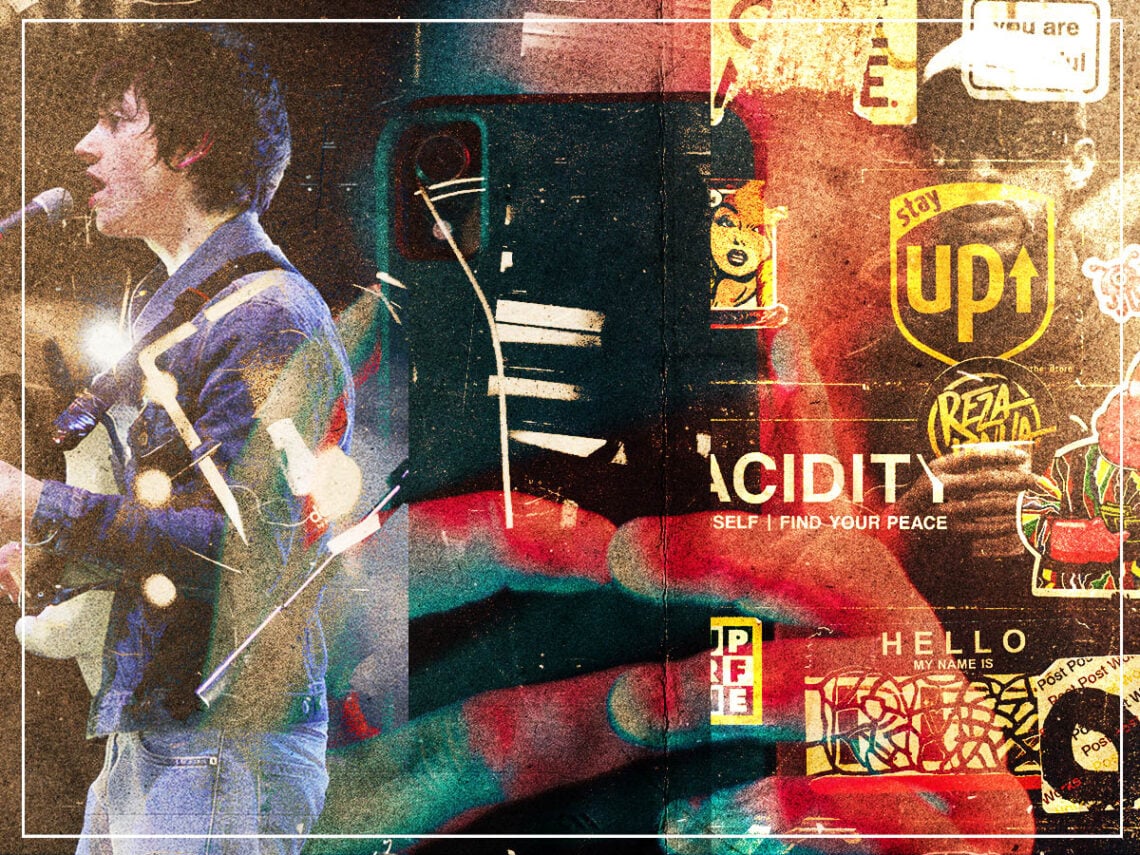
How the internet made music less tribal and more individualistic

The music industry is quite a cynical place these days. Acts are often scoffed at, rubbished and bitched about by online arbiters of nothing much but scorn. Only 15-20 years ago, when indie was riding high as the fad of the zeitgeist, that didn’t really seem to be the case. While there was a perfunctory sense that there was, indeed, class and crap coexisting in the ‘scene’, there was also an overriding sentiment that, at worst, bands were just kids trying to have some fun.
Now, however, a wedge has been driven between ‘scenes’ creating a greater sense of individualism—individualism that has, in turn, hamstrung the industry at large and made music more of a cynical realm of culture. The wedge in question is, of course, the internet.
While by no means am I implying that everything was lovey-dovey and everyone took a laissez-faire view to the spectrum of alternative music a few decades ago – recollections of Radiohead fans scoffing at less ‘sentimental music’ spring to mind – there was undoubtedly a greater sense of collectivism.
There is an argument for SoundCloud rap or grime being the crowned today’s dominant tribes, but they haven’t achieved anywhere near the ubiquity of other trends in their heyday. Although some might affirm that these things become clear once time has rolled over and lifted the fog of noise, history seems to defy this assertion. By all accounts, there wasn’t a soul around in the 1960s unaware that they were in the zeal of a particularly powerful zeitgeist. Now, it’s hard to put your finger on what exactly the zeitgeist is.
Some 15 years ago, it was side-fringes and the Arctic Monkeys. The reason I single out the Sheffield band is that the universal mainstream backing they got allowed them to transcend the fad of the era and sustain their success so that they could find themselves as Glastonbury headliners these days. Since then, they have evolved, and the current divisive reaction to their most recent set is indicative of the struggle bands face these days, begging the question: which act has emerged in the last decade with enough clout to headline Glastonbury?
The fact that this is a bit of a head-scratcher proves that we are in a period where backing en masse is a near impossibility. In part, this is because of a more diverse range of cultures, and that is both a blessing and a curse. The requiem for consistent youth culture was ultimately served up when everything moved online. There was no longer any need to conform to that which surrounded you or to seek out a niche of your own.
The internet came along and blurred the milieu of culture-defining microcosms and dispersed them into the insignificant macrocosm of the world wide web. And it’s not that little fads or pockets of very individualistic sub-genres didn’t exist in the 2000s. It’s just that, back then, if you were deep into Dutch Gabber or an early convert to krautrock, then you wouldn’t find many people to talk to about it, so you had to broaden your tastes and hope that the indie DJ at your local dive bar heeded your request.
Now you can log online, surf the lonely highways, and eventually find any number of keyboard chins to wag, which is all well and good on paper. Discovering the ridiculous joys of music in its rich and varied guises is what it’s all about, but the asterisk to this blessing is that it has also led to scenes becoming increasingly marginalised and encamped in their positions. Youth culture has broken up and moved online, resulting in once-treasured venues closing, longstanding publications going out of print, and musicians’ pockets feeling the pinch. Of course, there’s a swathe of other factors involved in this, not least the bastard government’s lack of funding and increasing commercialisation of the scene.
However, there is also a more nebulous sense that collectivism, even in the world of music, has been diminished by the internet. As the playwright, podcaster, and former DJ Danny Robins recently told me: “Once you get two people in a room together, it’s very hard to hate each other. Just as it’s very hard to change people’s minds in 140 characters, but when you do get together and talk about stuff, you do feel that people’s positions are less hardened than even they themselves thought.” In music, that shines through when you see a live act or hear someone out.
The online world often does allow for that to happen. Algorithms entrench us. So, music, as a result, has become more individualistic to an ever-deepening degree. Ironically, even today’s emerging mega-stars prove this. Bad Bunny is both one of the most popular artists in human history and an unknown entity. There was a time when you would be able to dismiss this phenomenon as Western ignorance of foreign cultures. However, Bad Bunny has far surpassed the level where language barriers shelter him from English-speaking regions of the world—in this regard, he defines the changing cultural landscape of modern times.
2022 was yet another massive year for the star. He claimed the most streamed spot for a third consecutive year, the first in history to do so. The Puerto Rican rapper was reportedly streamed an absolutely absurd 18.5 billion times. To put that into context, there are only 7.8billion people on the entire planet, so that’s the equivalent of everyone listening to him 2.3 times. When you consider that there are only roughly 500million Spanish speakers in the world, the duality of Bad Bunny’s ridiculous popularity and relative anonymity become even more head-scratching on the surface.
These are heights that, numerically, nobody has ever hit. Why, then, does my mother seem to think that Bad Bunny is Roger Rabbit’s nickname? And why is the flipside equally true as there are no doubt Bad Bunny fans reading this piece wondering why I am inexplicably claiming that there are everyday people out there who somehow haven’t heard of the most famous man in music? His official standing as the most heard unknown artist in history has revealed not only that the divide between the internet and mainstream culture has never been clearer but that the internet has overtaken the mainstream. And the final point on that when it comes to music scenes is that we just about always access the internet alone.
We might feel like we have a constant connection, but that facade has made us lonelier than ever. In a recent UK survey, 40% of young people said that they felt lonely “often or very often”. Perhaps the closure of indie bars and punk clubs is tied in with this, as we drift away from the tribal bindings of the past, floating down an endless stream of great music but on our own little coracles where the unfamiliar isn’t given the time of day.
