


Ritual, routine and happiness in Wim Wenders’ ‘Perfect Days’

Sometimes, it feels as though we pin our prospective happiness on certain external factors, and though they might appear as elusive as the Holy Grail itself, we wait for someone or something to enter our lives and quell our inherent worries. The same cannot be said for the protagonist of Wim Wenders’ stunning Japanese drama film Perfect Days.
Tokyo toilet cleaner Hirayama, played with striking expertise and patience by Kōji Yakusho, is a man who fills his own cup of contentment rather than longing for anyone else to fill it for him. Living a relatively meagre existence and working a job many individuals would consider beneath them, Hirayama breathes happiness, though this state of mind is one he undoubtedly strives for with intention, which is diametrically opposed to mere the satisfaction we aim for as a result of personal achievement, growth and material gain.
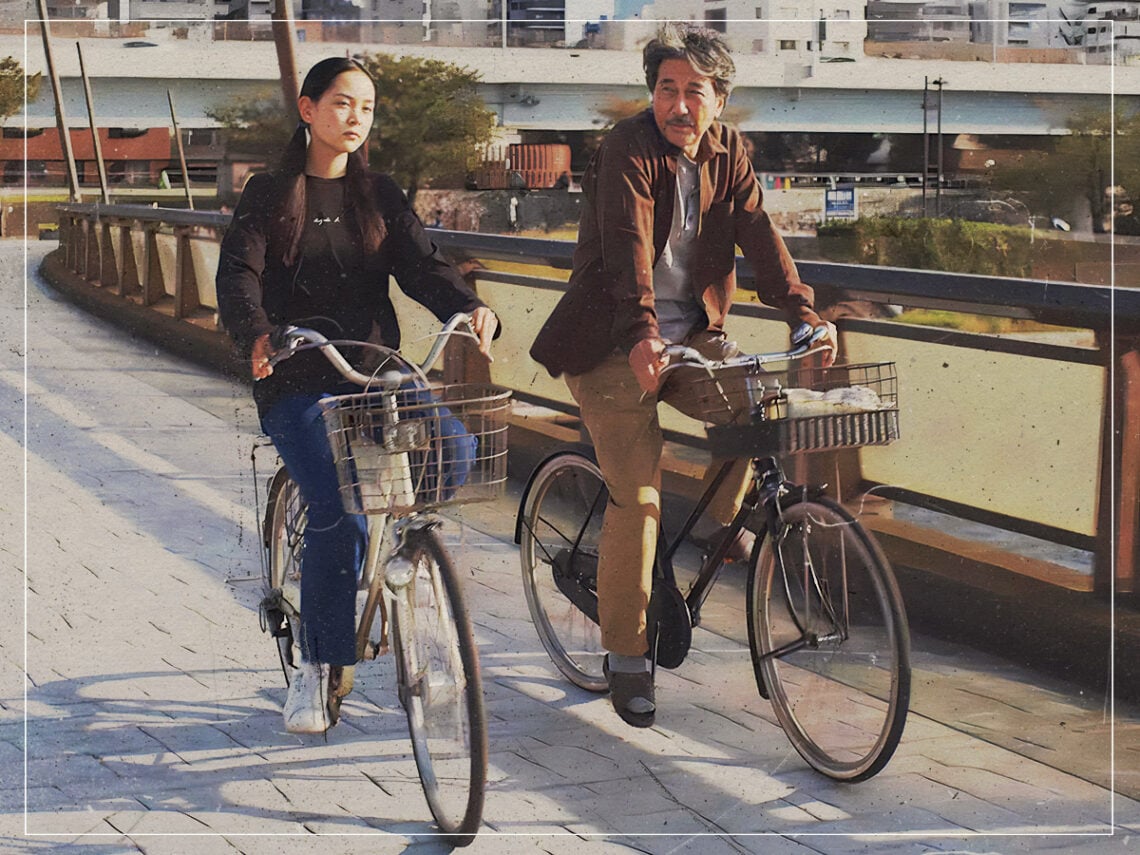
Perfect Days is one of those films where not an awful lot happens, yet its poignancy is arguably life-changing. Hirayama’s life is defined by his simple and humble routine; he wakes up each morning, puts away his bedding, brushes his teeth and gets the same can of coffee from the same vending machine. The two halves of the day cleaning toilets and listening to his favourite rock music in his van are dissected by eating a sandwich in the park and taking a photograph of one of its trees. Then, Wenders’ protagonist finishes off with a clean at the public bath, dinner at the same restaurant, the odd weekend drink at his local bar, and a session of reading in bed before starting it all over the next day.
This kind of borderline-monotonous lifestyle might seem to many, locked in an endless oblivion of streaming, social media content, advertising and immense, constant choice, like hell on earth, but it’s this precise ritual that afforded Hirayama, who favours listening over speech, his immediately recognisable and charming sense of happiness.
“His daily routine [is] the backbone of this story,” Wenders had told Hammer to Nail of Hirayama’s daily ritual. “He’s a man almost living like a monk but happy, content and living a life of service. I thought it was a worthwhile story to tell. That was the genesis of the film.” To Frieze, the director also noted, “Hirayama is the master of his life. Everything he does, he does it because he wants to do it.”
In a modern world, where life seems preordained by negative habitual behaviour, anxiety, obsession and addiction, the way Hirayama lives seems like the perfect antidote to our societal ills. Let’s not forget this is a seemingly completely content man who cleans toilets for a living – a rather obvious metaphor for his being willing to withstand the shit that life throws at him. It’s equally important to consider that Hirayama’s life is not actually perfect. Rather, he’s only human; he seems to have a somewhat emotionally tumultuous extended family life, gets internally pissed off when his employers take advantage of his good nature, can cry and hide from his problems, and feels the occasional temptation of alcohol and cigarettes. At one moment, he seems to even feebly reach out to a woman in the park in the hope of connection (perhaps a glimmer of his loneliness and fear of its admittance?)
Regardless of Hirayama’s potential inner turmoil, which we are rarely, if ever, made privy to, it’s his precise daily ritual that allows him to slow down time and savour each second, even if those exact seconds are spent doing pretty much the same thing all day. Not only is Yakusho’s character capable of noticing how the light creates shadows of the trees’ branches and leaves, but he can do the things he loves the most with intention, or, as Wenders’ notes, “because he wants to do” them.
In conversation with the AFI about the film’s origins, Wenders had explained how he’d thought that people would start living their lives differently following the Covid pandemic, perhaps with less want for abundance, just like Hirayama. “Little did I know it was more reckless afterwards than before,” he said with a laugh. “I realised there was a chance to say something about that, to make a movie about somebody who didn’t want to own more, who didn’t believe in growth. He would buy one book in order to read that book and finish it before he bought another book.”
By adhering to a “less is more” philosophy, Hirayama finds abundance within limitation, beauty in the ordinary, and happiness within his everyday life. In that light, Perfect Days is a crucial piece of cinema, one that reminds us of the true importance of the human experience and the imperative to live our lives with focus, dedication and love, and details the simple ritualistic way in which we might begin to live with a better understanding of ourselves and, therefore, the people around us.
