


Kiyoshi Kurosawa’s hypnotising ‘Cure’ is one of the most haunting crime dramas of all time

True crime stories have been whetting the appetite of western audiences for many years now, with the morbid curiosity of serial killers, sadistic cult leaders and acts of unspeakable violence becoming popular viewing for Netflix viewers, both young and old. These shows are mere documentary retellings, however, offering little insight into the actual mystery and fear of such cases, with such being left to the work of David Fincher’s Seven and Zodiac, as well as Kiyoshi Kurosawa’s haunting late 1990s masterpiece, Cure.
Known for his moody, atmospheric chillers, the Japanese filmmaker had only meddled with middling TV work and hack-job horrors before the release of Cure in 1997. Balancing on a tightrope that oscillates between reality and fantasy, Kurosawa’s film is a horror gem that pierces through your retinas and infects your mind like a smoggy, viral paranoia.
Opening with one of the most interesting introductory scenes of modern cinema, Kurosawa welcomes us into his unstable world. We are greeted by the fanfare of a spritely tune that resembles a jovial children’s TV intro, with the sound heavily contradicting the sight of a man savagely beating a woman over the head with a metal pole. Sirens blare, and we see our first sight of the police officer and protagonist, Takabe (Kōji Yakusho), who stares blankly at the road in front of him as the titles fly in like a Powerpoint presentation.
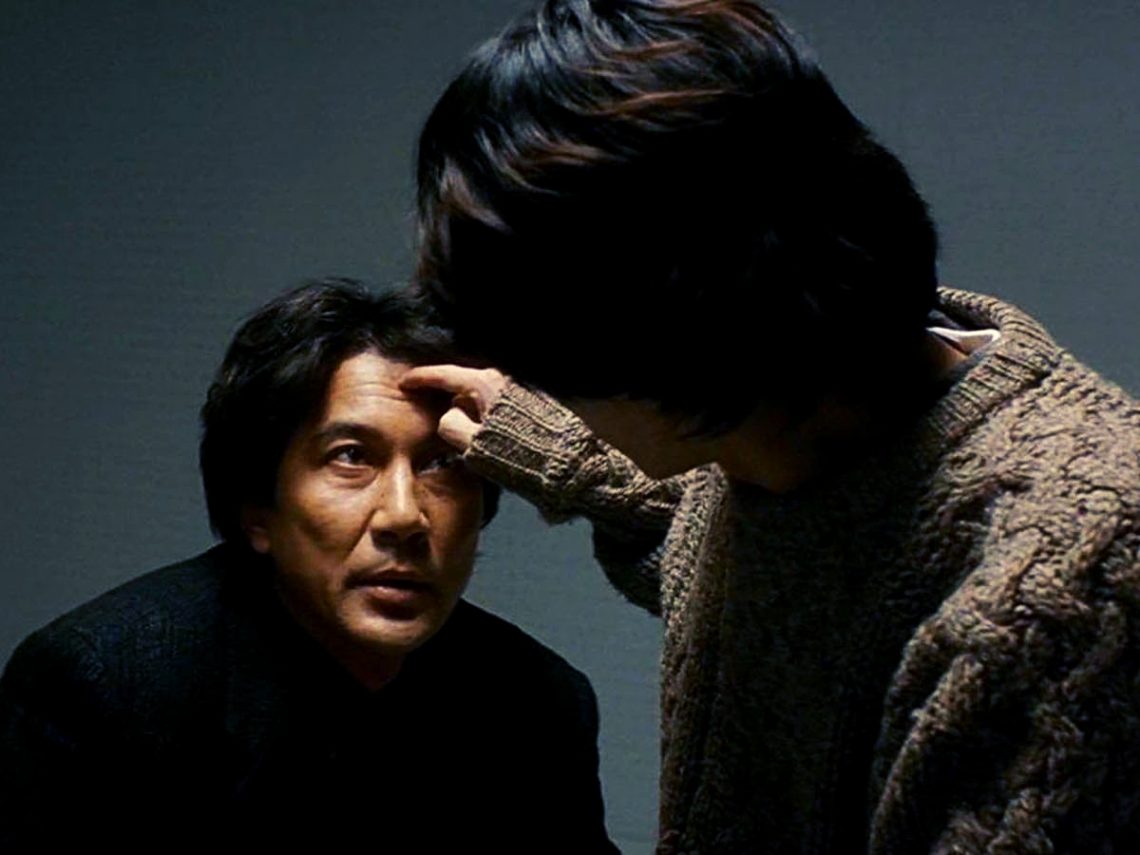
Is this a comedy? Kurosawa certainly wants to make us think it could be, if only for a moment before we are plunged into a crime drama that shuffles with discomfort under the omnipotent glare of the enigmatic villain Mamiya (Masato Hagiwara). The deeper we are dragged into the mystery, the more it becomes clear that the bizarre introduction was one of Kurosawa’s many misdirections, constantly shifting the perspective of the viewer in order to manipulate their understanding of everything they see in front of them.
Discovering new details alongside Takabe, who seems to struggle as much as the viewer to pin down exactly what is going on, we are steadily drip-fed clues, with Mamiya travelling across the city, seemingly hypnotising people to kill their most burdensome friend or relative. Himself struggling with almost a complete case of memory loss, the mysterious individual asks a series of befuddling questions to people, leading them to kill shortly afterwards.
Effortlessly creating an atmosphere of horror, Cure exploits the fear and trepidation that exists in the shadows of everyday life, extracting a deep-rooted fear of the unknown that lurks in the corner of every scene. Much like Jonathan Glazer’s contemporary sci-fi masterpiece Under the Skin, Kurosawa utilises every tool at his disposal to withdraw the viewer from the real world and into a newly constructed reality where the boundaries of reality are eerie and undefined.
Enforcing involuntary tinnitus, the film utilises incessant sound, from the diegetic whirring of a faulty washing machine to the strange low-frequency notes of a bubbling soundtrack that feels like you’re floating unconscious around the neurons of your own mind. It creates a constant sense of unease that can all too easily simmer over into panic. Just like the victims, we are hypnotised.
Under the hold of not only a master filmmaker but also a sinister ethereal presence that is impossible to grasp, Kurosawa’s deeply disturbing trip is a psychedelic nightmare without the gaudy visuals. Upon the film’s extraordinary climax, it’s difficult to know if we’ve learned anything at all from the 1997 crime movie, with much left undisclosed. How is Mamiya forcing his victims to kill? What are his motives? Who, or what is the titular ‘Cure’?
To experience Kiyoshi Kurosawa’s Cure is to witness an utterly mesmerising enigma of modern cinema; just don’t go scrambling your notes for a definitive answer. After all, as uttered by Takabe’s colleague, “People like to think a crime has meaning. But most of them don’t”.
