


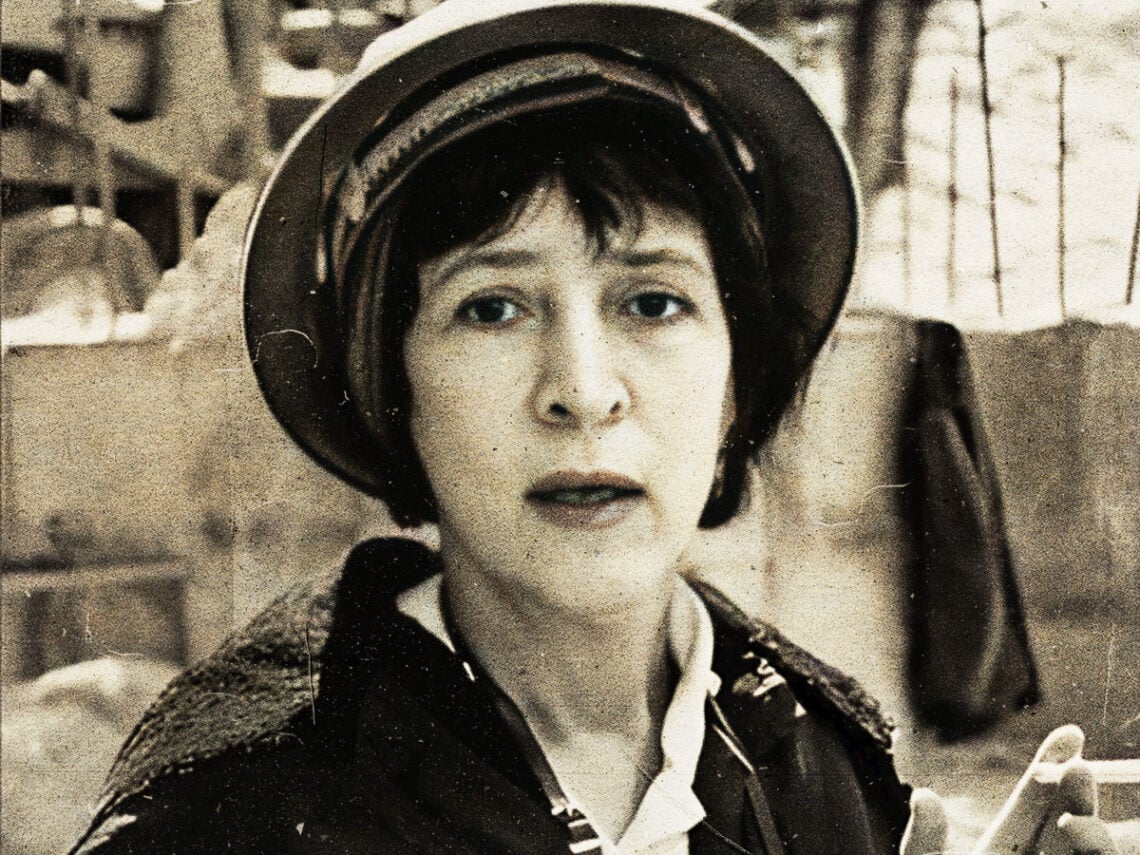
Helen Levitt’s groundbreaking street photography

Street photography has been a popular medium for decades, standing in direct contrast to posed, commercial images. Often making a statement about the beauty, absurdity or horrors of everyday life, street photography captures the human condition in its purest form.
In her essay collection On Photography, Susan Sontag compared the street photographer to the “flâneur”, describing them as “adept of the joys of watching” and “connoisseur[s] of empathy”. Equipped with a camera and a unique sense of seeing the world, street photographers often capture the changing of a social or physical landscape, creating a time capsule of images through their work.
One of the greatest yet often overshadowed street photographers was Helen Levitt. Born in 1913 in New York, Levitt’s love for the vibrant city never faded, and she managed to capture its vivaciousness even when she shot in black and white. In the early 1930s, Levitt began working for J. Florian Mitchell, whose commercial photography practises allowed the young photographer to learn skills such as darkroom development.
However, she soon realised that this style of photography wasn’t for her, and after discovering the work of Henri Cartier-Bresson, she decided to take to the streets to capture images. While working as an art teacher, Levitt found herself fascinated by children’s culture, how they played on the streets, and the styles of chalk graffiti they stencilled on walls.
The photographer regularly took her camera on walks around the city, where she would snap images of these interests, mainly depicting children playing without regard for their own safety, absent of parental supervision. She also photographed adults, and her work often highlighted social issues that were prevalent in New York at the time.
In the book Helen Levitt from the Photofile series, Jean-Francois Chevrier writes: “Levitt captured the vitality of the street as an unofficial playground – and place of interaction – in working-class neighbourhoods. She had seen the way that different ethnic minorities coexisted – sometimes peacefully, sometimes contentiously – in the Brooklyn of her childhood, or on the Lower East Side and the neighbourhoods of Upper Manhatten – Harlem, Spanish Harlem – where most of the images from 1936 onwards were taken.”
Levitt’s images were never obtrusive or exploitative, and her subjects were photographed with care and interest. Whether Levitt was focusing on tired subway users or crowds of children adorning the pavements with chalk, the photographer painted a picture of a New York that no longer exists in the same state. As she got older, Levitt exclaimed: “I go where there’s a lot of activity. Children used to be outside. Now the streets are empty. People are indoors looking at television or something.”
She took inspiration from Surrealism, which might not be obvious at first glance since her images focus on the unedited realities of everyday life. However, she was often preoccupied with taking an absurd angle, finding natural instances of surrealism in people, places and their relations to one another. One of Levitt’s most striking images features two children, one leaning against a tree and another straddling the trunk from quite a height. The latter is wearing a white mask and is looking directly into the camera, despite the distance, giving the image an uncanny, almost horror-like sensibility.
Levitt’s forays into colour photography were rich and almost dream-like, the vibrancy of the tones giving even the most run-down scenes a sense of innate beauty. Levitt’s ability to imbue the most banal locations with interest made her an extraordinary photographer, and she deserves more recognition for her contributions to the medium.
Not only was Levitt a skilled photographer, but she was also interested in filmmaking. She worked on several projects, including the documentary The Quiet One, which she co-wrote and co-filmed. It was nominated for ‘Best Documentary Feature’ and ‘Best Original Screenplay’ at the Academy Awards, making Levitt one of the first few women to earn recognition from the prestigious organisation in a non-gendered category.
Check out some of Levitt’s photos below.
