


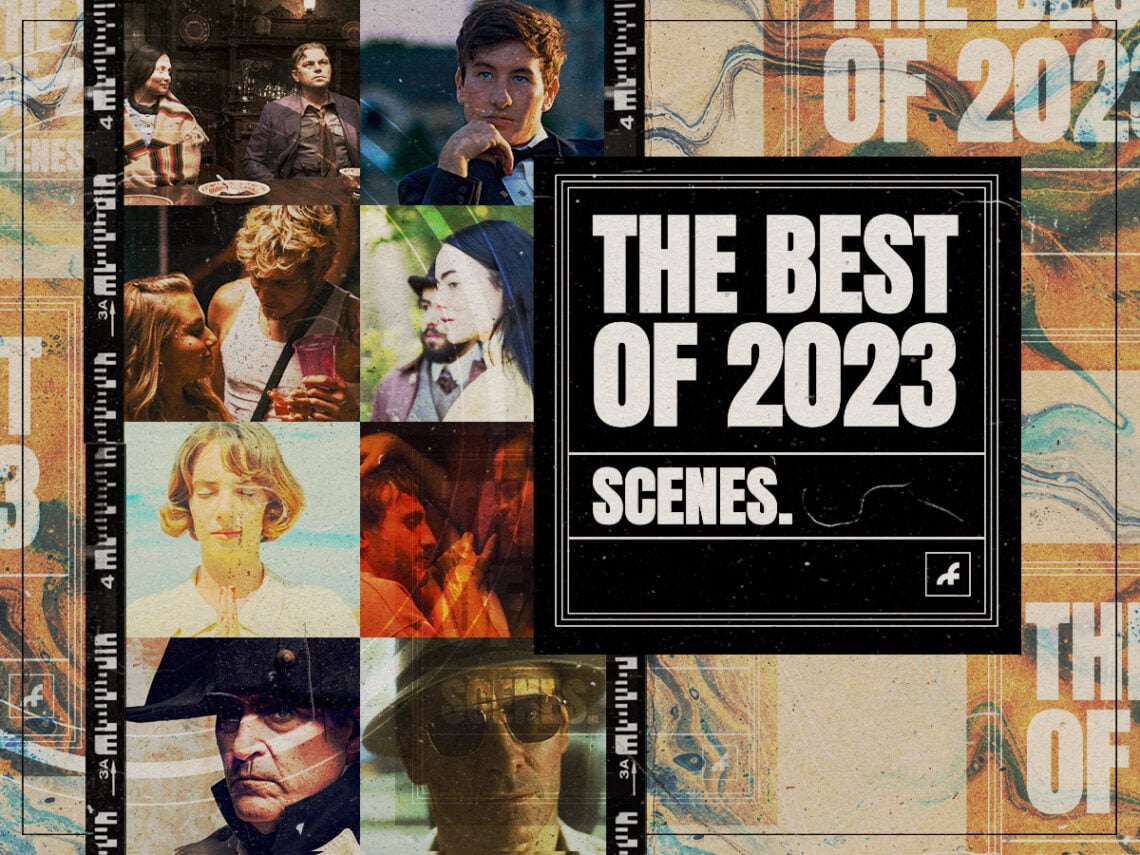
The 20 best movie scenes of 2023

Once December rolls around, it is the duty of cinephiles across the world to look back on the last 12 months and decide upon their favourite movie of the year. No matter whether it’s the Martin Scorsese film Killers of the Flower Moon, Wes Anderson’s Asteroid City, or, indeed, Celine Song’s Past Lives, one thing you can be sure of is, when you recall its brilliance, often your mind goes to just one moment.
Of course, the very best movies of the year will be excellent in every facet, with barely one scene at all being out of place, but, nonetheless, there is always one scene that sticks out, whether it’s the final fight scene from an action flick or the moment when the romantic leads finally lock lips in a romance. So, when you cast your mind back over the last year in movies, which scenes will you recall?
This question is exactly what the following list will explore, with the following 20 picks putting the best indie films of the year together with the biggest blockbuster hits, creating a carnival of cinema that celebrates the most bombastic moments, as well as its quieter moments of tender beauty.
Take a look at the list below, which includes some of the best films of the year from directors such as David Fincher, Emerald Fennell, Ridley Scott, Ari Aster and Greta Gerwig.
The best movie scenes of 2023:
20. The Battle – Napoleon (Ridley Scott)
Ridley Scott directing historical epic guarantees spectacular battle sequences, but nobody was expecting Napoleon to be anywhere near as darkly funny as it proved to be, with Joaquin Phoenix’s petulant and short-tempered performance as the ambitious soldier generating plenty of unexpected laughs.
Seeing an advantageous rise to the top, Napoleon is tasked to oversee the Siege of Toulon, which he does by deploying his mastery of military strategy. It’s not without incident, though, considering what should have been a rallying charge into battle ends up with his horse being blown almost in half before he can even get close to his target. He dusts himself off and plunges back into the fray regardless, with Scott’s keen eye for sweeping action beats, laced with a deft combination of practical effects and CGI all shot through with a rich vein of situational deadpan combines to serve as Napoleon’s standout instance of on-screen bombast.
19. ‘I’m Just Ken’ – Barbie (Greta Gerwig)
Having had his eyes opened to the patriarchy by his trip into the real world, Ryan Gosling’s Ken stages a hostile takeover of Barbieland in 2023’s cultural phenomenon from Greta Gerwig, and no good coup is ever truly complete without a rousing musical number.
With the Kens facing infighting of their own, Gosling wakes up in a reflective mood, launching into stirring power ballad ‘I’m Just Ken’, that segues into a brawl against Simu Liu’s opposing faction in a fight to the death to see who can beach the other off once and for all.
The ludicrous scrap then snowballs into a sprawling dance-off that finds the warring Kens mending fences through the medium of song and dance. Hilarious without descending into parody and completely on-brand with the rest of Barbie’s candy-coloured lunacy, it’s incredible to think that Gerwig had to fight to keep it in the movie.
18. The Final Performance – Theater Camp (Molly Gordon, Nick Lieberman)
If you’re looking for the feel-good film of 2023, look no further. Molly Gordon and Nick Lieberman’s Theater Camp is the modern equivalent of Richard Linklater’s School of Rock, telling the story of a bunch of unlikely outsiders who spend 90 minutes demonstrating their beautiful originality. The mockumentary, which follows a summer camp of theatre kids, culminates in a predictable but utterly gorgeous final performance that might even bring a tear to your eye.
Although it currently isn’t a viral hit, it’s likely that ‘Camp Isn’t Home’ will soon become an online sensation, with the tune providing the soundtrack for the spine-tingling final number of the film that ties everything together with utter rhapsody.
17. The Parade – La Chimera (Alice Rohrwacher)
In a year in which Indiana Jones returned to our screens, only to give fans one of the worst movies of the year, Alice Rohrwacher’s La Chimera took to the stage and stole the famous archaeologist’s limelight. Rohrwacher’s special film told the story of an eccentric group of archaeologists trying to hunt down some of the world’s strangest historical artefacts, having mighty fun while doing so.
Much of the film’s sheer energy can be demonstrated in the parade scene, in which Josh O’Connor Arthur is dragged down the streets and plonked on the back of the cart while Rohrwacher engulfs the viewer into the world of the film. Indeed, one of La Chimera’s greatest strengths is its rustic authenticity, and this scene does well to reflect its sheer will to entertain, albeit idiosyncratically.
16. The Bar – Blue Jean (Georgia Oakley)
Georgia Oakley’s take on Margaret Thatcher’s Section 28 Britain in Blue Jean manages to navigate all the nuance, pain, conflict and joy of queer identity in a homophobic world. Set in the northeast, following PE teacher Jean as she navigates keeping her sexuality hidden in the workplace, the huge emotions that come from being closeted are tense and gripping. Boiling over in this centrepiece scene as Jean sees one of her students at a gay bar, infiltrating her one place of freedom and respite, the ensuing argument manages to portray all the complexities of authority and identity.
“What makes you think she has a place in this world?” Rosy McEwan delivers the line like a devastating emotional grenade. As her character tries to handle being forced to be a role model for a young queer student while unable to proudly wear her own identity without fear, Blue Jean’s personal look at politics is a tender masterpiece.
15. The Woodland Play – Beau Is Afraid (Ari Aster)
After back-to-back horrors of a very different bent in Hereditary and Midsommar, Ari Aster expanded his cinematic horizons with the surrealist dramatic comedy Beau Is Afraid, finding Joaquin Phoenix on fearless form as the anxiety-riddled protagonist embarking on a turbulent odyssey to return home to his mother.
As part of his journey, Beau ends up stranded in the wilderness, happening upon a travelling repertory of actors who’ve dubbed themselves ‘The Orphans of the Forest’. What follows is an entrancing, semi-animated, dreamlike sequence that sees the title character become swept up in a world of whimsy. Created using a green screen, hand-painted backdrops, rotoscope animation, and diorama-style sets, the jarring combination of maximalism and existentialism is eventually shattered in a way that underpins just how far Aster is willing to push the boundaries of cinematic convention.
14. The Singers – Enys Men (Mark Jenkin)
Following the release of his acclaimed feature debut Bait, Mark Jenkin returned with Enys Men, set on a sparse island near the Cornish coast. Mary Woodvine stars as a woman sent to monitor the wildlife, although she soon finds fruticose lichen growing all over her body. Inspired by classic folk horror, Jenkin takes an experimental approach to depict the female protagonist’s descent into terror, allowing minimal dialogue and action to be exchanged for abstract forays into grief and isolation, led by a haunting score.
In one standout sequence, the unnamed central character witnesses a group of children, all dressed in white, singing and holding plants in front of the moss-covered house. She watches them with a look of recognition on her face, although we can’t be quite sure what she is coming to acknowledge. Then, a woman who looks just like her appears in the doorway, directly addressing our protagonist by saying, “Who’s there?” It’s a haunting yet mesmerising scene, perfectly conveying the character’s uneasy mental state and the film’s captivating idiosyncracies.
13. Afterlife – Killers of the Flower Moon (Martin Scorsese)
Martin Scorsese delivered a remarkable chronicle of deception this year with Killers of the Flower Moon, with phenomenal performances from the likes of Robert De Niro, Leonardo DiCaprio and Lily Gladstone. Most of Scorsese’s films examine the nature of faith in one way or another, usually his own Catholicism, but the director is on untrodden ground here with his Native American tale.
Rather than go excessively on tribal ritual and practice, though, Scorsese expresses a state of restraint, particularly in a scene in which an Osage elder dies and finds themselves in their version of the afterlife. It’s a truly peaceful moment of the beauty of nature that’s often depicted in Native American religions, in which Scorsese shows his genuine respect for the Osage people. Where Killers of the Flower Moon is short of set pieces, this scene in particular serves long in the memory.
12. ‘Murder On The Dancefloor’ – Saltburn (Emerald Fennell)
Sophie Ellis-Bextor factoring into one of 2023’s most memorable scenes wouldn’t have been on anybody’s bingo card at the beginning of the year, but Barry Keoghan dancing in the nude to ‘Murder on the Dancefloor’ makes for a suitably unhinged conclusion to Emerald Fennell’s outrageous Saltburn.
Having laid his cards on the table and revealed himself as the orchestrator and master manipulator behind all of the tragedy to have befallen the titular estate and its inhabitants, Keoghan’s Oliver luxuriates in the mayhem that he’s caused, doing so in a fashion entirely befitting the increasingly malicious and murderous masterplan that he managed to pull off.
Integrating himself with a well-to-do family and ending up with everything after burning them to the ground from the inside out, it’s easy to see why Oliver would be so keen to cut loose and boogie, having succeeded in his ambitious aim.
11. The Dance – Poor Things (Yorgos Lanthimos)
The Greek filmmaker Yorgos Lanthimos is one of the greatest comedic directors of contemporary cinema, making such celebrated modern releases as The Favourite, starring Olivia Colman and The Lobster, with Colin Farrell. His latest effort, Poor Things, may just be his most beautiful movie, however, telling the story of a mad scientist who creates a woman with the mind of a child.
One of many excellent scenes comes when Emma Stone comes into her own as Bella Baxter, the newly created science experiment, and takes to the dancefloor in a truly erratic style alongside Mark Ruffalo’s Duncan Wedderburn. Perfectly illustrating the strength of Stone’s performance and the vigour of the film itself, the moment radiates energy, liberation and pure joy. It really is an ode to the actor’s physical presence on screen.
10. Ending – Rotting in the Sun (Sebastián Silva)
A daring indie movie in every sense of the word, Sebastián Silva’s film is a wondrous feast that takes on the individualistic nature of contemporary TikTok culture. Starring Silva as a suicidal artist, the film follows his travels to a nudist beach where he meets Jordan Firstman, the real-life social media star, who convinces him to join him in his artistic project, a screenplay for a reality show all about his own life.
The ingenious satire of modern life takes several twists and turns, with the audience genuinely having no idea where the plot will take them. It all culminates in a final scene where Firstman leaves Silva’s apartment, unaware that he has been killed by the housekeeper, Catalina Saavedra, only for her to confess to her crimes on a translation app on his iPhone. The final scene plays this voice note in full as a final flourish of dark comic magic.
9. Arrival – Asteroid City (Wes Anderson)
Wes Anderson dabbling in sci-fi was never going to be conventional, with Asteroid City’s introduction of its intergalactic interloper wrapped up in the meta absurdity of a live production of a documentary about the production of a fictional play, putting an inventive twist on the filmmaker’s signature style.
The alien might be physical in appearance – at least within the context of the scene in which it appears – but it acts as a metaphor for the struggles faced by Asteroid City’s characters, both in and outside of the in-universe play. Jake Ryan’s Woodrow doesn’t find the conclusive answers on extra-terrestrial life that he wants, along similar lines to how Jason Schwartzman’s Auggie might never reconcile with his grief, with the actor’s dual role as Jones Hall also leaving the latter seeking his own truth as an actor. It’s peak, existential Anderson.
8. The Opening – Anselm (Wim Wenders)
The opening shots of Anselm will floor you. Wim Wenders takes all the majesty of German artist Anselm Kiefer’s dress sculptures and pours it into his stunning 3D tour of the works, somehow meeting Kiefer’s artistry by weaving delicately through the world his creations sit in.
He makes you work to admire them, dragging the camera through trees, lingering on the dresses just enough that you notice the pools of water that gather in the fabric, but then pulls away, obfuscating them behind the sun’s glare, making Anselm instantly gripping. With three-dimensional force, these sculptures arrive perfectly, notably introduced before the artist, in a subtle reminder of the scale and importance of Kiefer’s work. The enormity of his 200-acre art studio should be the most visually arresting, and while that comes later, the sweeping simplicity of those dresses sticks with you.
It was a fitting opener for a portrait of an artist whose work continues to stick in the public consciousness.
7. Failed Assassination – The Killer (David Fincher)
In an introductory scene that finds Michael Fassbender’s protagonist proving himself to be every bit as meticulous as its director’s reputation has determined him to be, The Killer by David Fincher opens with one of the most precision-engineered and impeccably crafted sight gags to be found on screen in a long time.
The monotone voiceover finds Fassbender’s assassin informing the audience of his methodical preparations, the lengths to which he goes in order to become the best at his chosen profession, and the painstaking days he’s spent staking out his latest target. Of course, all of that turns out to be for nothing, with his bluster proving misguided in jet-black comic fashion when he lines up the kill shot and misses as Fincher exacts maximum tension from such an ice-cold and laborious setup, all for the sake of a glorious punchline.
6. London Streets – Rye Lane (Raine Allen Miller)
It is, indeed, tricky to pick out just one scene from Raine Allen Miller’s magnificent debut Rye Lane, with the entire film singing from the same hymn sheet. Set in the heart of London, the tale is a modern romance following Dom and Yas, two recently heartbroken singletons who set out on a journey across the city to find themselves again and enjoy the frivolities of young life.
Thanks to the excellent central performances of David Jonsson and Vivian Oparah, Rye Lane bounces with an organic life, with this coming to the forefront when they are simply strutting down the street, taking in the sights and sounds of the city. One of the best examples of the film’s vibrancy comes when they are walking around Brixton village, and Miller simply flexes her filmmaking muscles.
5. Daniella Carter – Kokomo City (D. Smith, 2023)
There’s no doubt that D. Smith’s fabulous documentary Kokomo City, which gives a voice to four black trans sex workers across America, is one of the year’s finest films. An honest, raw film where it’s clear that the documentarian forged a powerful relationship with their subjects; while each person is fascinating in their own right, it is Daniella Carter who steals each and every scene she’s in, being an utterly magnetising voice.
There are, indeed, several scenes where Carter bursts out in an inspiring speech, giving sagacious advice to others who are going through similar hardship as herself while also speaking to modern society in a passionate plea for acceptance. She is the shining gem of the movie that makes Kokomo City such an important film, and with multiple memorable moments, it would be impossible to choose just one.
4. ‘The Power of Love’ – All of Us Strangers (Andrew Haigh)
It’s about time the British director Andrew Haigh was considered one of the greatest living filmmakers, with his 2023 adaptation of Taichi Yamada’s novel Strangers being one of the year’s most powerful movies. Starring Paul Mescal and Andrew Scott, the film tells the story of a screenwriter who returns to his childhood home, where he finds the ghostly presence of his mother and father despite them both passing away when he was a child.
With several memorable moments throughout the entire movie, the very best moment comes at the film’s powerful conclusion, where it’s revealed (spoilers ahead!) that his friend and neighbour is also a ghost, passing away shortly after their first encounter. While Scott’s character cradles the spirit of his deceased neighbour, the camera pulls up and out of the apartment with Haigh pairing the moment with ‘The Power of Love’ by Frankie Goes to Hollywood for an utterly sensational cinematic statement which even finds time to mimic the artistry of the song’s music video.
Words, indeed, don’t do the moment justice – it’s a truly magical piece of cinema.
3. The Airport – How to Have Sex (Molly Manning Walker)
Loud, expressive moments of emotion are fairly easy to capture in movies; after all, the performer does most of the work. But in Molly Manning Walker’s magnificent indie drama How to Have Sex, subtly is king, with the final scene being a testament to this, delivering a terrific final note of the devastating movie.
It all comes when friends Tara, Skye and Em are on their way home from their ritualistic ‘girls holiday’ following their GCSE results, but Walker’s story isn’t an Inbetweeners-style comedy, but rather a tragedy, speaking of the sexual assault that often occurs at such teenage getaways on an annual basis. Instead of speaking of her assault, Tara bottles up her experience until one heart-wrenching moment when she tells her friend. What makes the moment so good is that it’s not a Hollywood burst of emotion; it’s a disturbingly realistic unfolding realisation.
2. The Recorded Conversation – Anatomy of a Fall (Justine Triet)
Anatomy of a Fall, Justine Triet’s intoxicating courtroom drama, is like a cinematic onion, being a
dense and layered work that only gets better and better the deeper you go. As well as a flawless marriage of great acting, directing and screenwriting, Triet’s Palme d’Or winner at Cannes is a gripping thriller that shows off some of the finest courtroom drama ever put to film, rivalling Sidney Lumet’s 12 Angry Men and last year’s Saint Omer.
No scene better exemplifies its strengths than the recorded conversation scene, when the protagonist Sandra and her husband Samuel, whom she’s accused of murdering, engage in a wild argument. Triet’s subtle yet powerful direction, the exceptional dialogue and the brilliantly authentic performances make this one of the best dialogue scenes of the year. Comparisons with Marriage Story’s legendary argument scene would, indeed, be more than justified here, with the scene being one of the many ways Triet brings the court case to life in a uniquely cinematic manner.
1. Separate Paths – Past Lives (Celine Song)
Each of the three acts in Celine Song’s modern indie classic Past Lives takes place during a different period in the life of Greta Lee’s Nora, with the first unfolding during her last days in Korea before her family moves to America. Seung Ah Moon plays the younger version of the character, with Seung Min Yim starring opposite as the youthful iteration of Teo Yeo’ Hae Sung.
Best friends seemingly on the precipice of romance, their paths diverging in both a figurative and literal sense at the end of the first is a gut-punching foreshadow of the decades-long internal conflict to come. Although they occupy the same frame, Past Lives paints their initial dissolution as being more akin to entering different worlds altogether.
Nora walks up a set of stairs towards the top right-hand corner of the frame, while Hae Sung travels down a different alley into the bottom left to tear them apart physically and emotionally, a forced separation that goes on to inform the rest of the narrative and their lives. It’s a simple moment told with the same elegant, poetic touch as the rest of Song’s modern masterpiece.
