


Wim Wenders – ‘Anselm’ movie review: a brilliant 3D documentary

In 1967, Jewish poet and Holocaust survivor Paul Celan wrote a poem after briefly meeting with philosopher Martin Heidegger, a high-profile intellectual and Nazi sympathiser. The significance of this meeting is essential to both Wim Wenders and the subject of his latest 3D documentary film, Anselm. The meeting of Celan and Heidegger triggered retrospective debates about forgiveness for the atrocities of the Second World War, a thread Anselm Kiefer’s art ruthlessly tugged at until it unravelled into accusations of neo-Nazism.
Celan touches all of Anselm because he touches all of Kiefer’s work. We get an insightful look at Celan, a reading of his Todesfuge poem, and a retrospective of his meeting with Heidegger. Celan is Wenders’ vehicle into Kiefer’s guarded thoughts. The insightful look at the poet’s experiences becomes almost shared because so little of Kiefer is. His public persona is bound in controversy, having created colossal sculptures and installations, paintings, and books, many of which had a focus on fascism and the Holocaust.
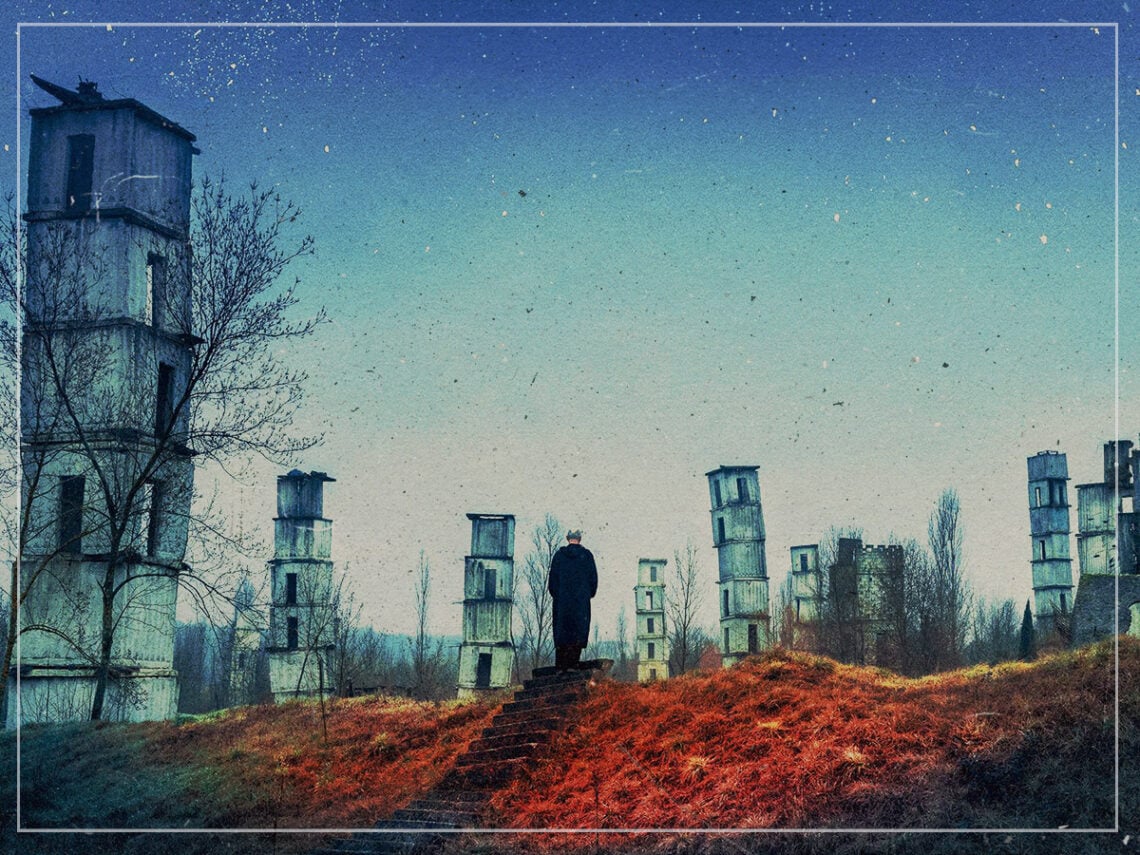
The scale of Kiefer’s 40-hectare studio site, La Ribaute in Barjac, is almost surreal. In his previous 3D outing, Pina, Wenders captured dances choreographed by Pina Bausch, and in much the same way, the camera weaves delicately through a tangled dance of Kiefer’s creations. We glimpse Kiefer’s series of dress sculptures in a gorgeous opening sequence. You see clumps of leaves and water pooled in the folds of their draped material, and then you’re fighting to catch glimpses of them through the woodland as the camera pans.
Later, we fight to see Kiefer in the same way. He walks through his studio, and Wenders makes you almost desperate for some intimacy as your eyes chase his shadow. Shots of Kiefer cycling through the expanse of his studio jarred initially because the aim was too overt. The camera swings round bends in tandem with the artist, but it felt too cold and clinical a way to capture him. He whistled as he cycled, periodically pausing by a painting to inspect it, and it drifts from a documentary to an overtly choreographed scene. It was too polished, too aesthetically preconceived – but I warmed to it in the end.
As we learn throughout the film, Kiefer uses Nazi iconography not to sympathise but to redirect attention. In archival footage, we see him explain the utility of his dystopian creations. In school, he recalls, he only spent three weeks learning about the Holocaust. He was determined to make people remember it. In between shots of him massacring his creations with a blowtorch, footage of wartime rubble is layered amid plumes of smoke, the sheer physicality of his work crystallised in three-dimensional force.
That’s when the bicycle shots and heavy-handed Celan passages made sense. Everything Kiefer does is by design. The refusal to denounce that his work was fascist, touring Europe to take photos of himself performing the Sieg Heil Nazi salute, everything. The premeditated intelligence is almost shocking, so it makes perfect sense that his documentary be a choreographed, stylised dance.
Despite plumbing his childhood with a boyhood version of himself, there’s considerable distance between Kiefer as a man and as an artist. Dialogue is sparse. The hushed female vocals throughout his art sequences feel like the closest thing to his inner dialogue. Even in quiet moments of reflection that see Kiefer leafing through books, the quiet hum of crickets rings out, pulling him back to his need to create huge landscapes.
Welders has masterfully mirrored Kiefer, creating a fragmented story that allows the sheer sight of the sculptures to shine. The Anselm experience goes beyond immersive, and Kiefer’s haunting figures are that much more breathtaking to be presented in 3D. Although a seemingly reluctant subject, Kiefer’s involvement in the documentary had done exactly what he set out to do in the 1960s: draw public attention back to the horrors of the Holocaust. By creating clinical distance between his personal life (none of his collaborators, family, or otherwise speak), the focus is honed in exclusively on the art and the sheer scale of it, and by extension – the horrors of war.
