


‘Poor Things’ movie review: a delirious and giddy descent into Victorian fantasia

It’s been 22 years since Greek auteur Yorgos Lanthimos made his directorial debut, but even ardent film aficionados wouldn’t know of him until 2009. Global mainstream audiences would only discover him almost ten years after that, in 2018. Nevertheless, for over two decades, Lanthimos has been slowly and steadily forging a style that has become more distinct, singular, and unmistakably his – culminating with the 2023 triumph that is Poor Things.
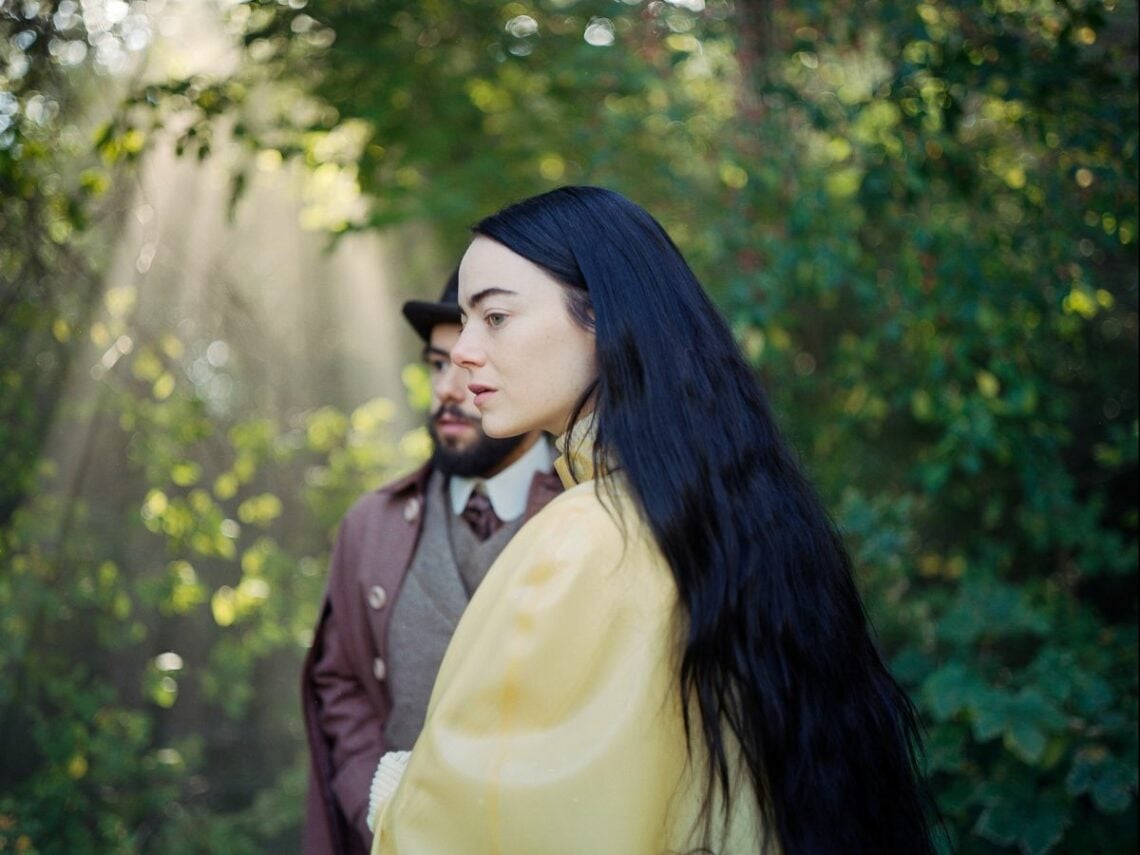
Lanthimos’ eighth feature overall, but seventh as a solo director (his debut, Kinetta, shares a co-directing credit with Lakis Lazopoulus), is based on the 1992 novel of the same name by Scottish author Alasdair Gray. Set in an alternate fantastical version of Victorian history that runs adjacent to our own, Poor Things follows Bella Baxter, a woman who, despite successfully attempting suicide, is brought back to life by an eccentric scientist.
Her reanimation isn’t without its hiccups, however. First and foremost is her ‘new’ brain, which results in a severely infantilised mind. Baxter is far from the well-to-do and dutiful Victorian wife who flung herself out of the window. Instead, she is effectively an entirely new person, one who is experiencing the world around her for the first time – just like the audience. This is convenient (ingenious) because it means as Bella embarks on her journey of exploration, discovering and questioning this uniquely rendered world teeming with flying airships and mutated animal hybrids, we tag along with her.
With Lanthimos’ early films, his filmmaking style was harnessed by observing and reconstructing the very limits of human behaviour. Similar to Swedish director Ruben Östlund in his fascination with how incredibly normal and unbelievably strange different people can be, his 2005 movie Kinetta documented the bizarre and mildly disturbing union between three strangers in an off-season Greek resort, brought together by their shared passion for recreating grisly real-life murders.
With Dogtooth, released four years later, Lanthimos took this distinct approach to storytelling and elaborated on it further. The conceit this time was this: a wealthy Athenian family have chosen to raise their three children solely within the confines of their large estate, choosing to tell them that there is no ‘outside world’ beyond their walls save for a barren, dangerous and terrifying wasteland. Why? That’s not the point. Like Kinetta, the intrigue came from seeing how these incredibly complex and specific social rules were implemented. It was about how, not why.
The 2011 follow-up, Alps, cemented Lanthimos’ visionary brand of movie-making – but it marked the end of an era. Whereas the Greek auteur’s trademark had previously been showing bizarre people and head-scratching scenarios grounded in the real world, they were now about to be set in weirder and weirder realities. It was 2015’s The Lobster that signified the director’s shift into English-language cinema and was also the first in his new chapter – one where the worlds in which the events took place were not our own but ran parallel.
It was a universe where people would be turned into animals (of their choice, at least) if they failed to find a romantic partner within an allotted time frame. Two years later came The Killing of a Sacred Deer. This astonishing horror/thriller channelled strong elements of Kubrick and depicted a world where a chillingly insidious Barry Keoghan could curse Colin Farrel’s family, bringing down upon the children an ambiguous but very lethal illness. Then, the Oscar-winning The Favourite came in 2018, bringing Lanthimos global stardom and audiences an incredibly heightened and stylised version of 17th-century English royalty.
It’s essential to track the evolution of his films and filmmaking style because when looked at as part of a bigger picture, the exquisitely strange and almost Gilliam-esque world of Poor Things makes sense. It’s a logical next step for the Greek director, but he grapples with it rather than trundle dutifully along into his next ‘aesthetic’ phase. He interrogates it until it makes sense to him and, therefore, feels satisfying for us. Having worked with some Hollywood heavy-hitters before, Poor Things ups the ante in a major way, pairing the director with Mark Ruffalo, Willem Dafoe, Ramy Yousef and Christopher Abbott.
Of course, at the heart of it is Emma Stone, playing the pivotal Baxter, and it’s clear that the very fact this movie exists is almost entirely down to the fact that Yorgos and Stone have found in each other a genuinely like-minded collaborator. Their work together is fruitful and compelling – reminiscent of a director/actor duo from a more creatively free and classic time of Hollywood, like Shelley Duvall to Robert Altman.
As Bella Baxter defies her purpose and reason for being revived, abandoning Dafoe’s Dr Godwin Baxter and running off with Ruffalo’s sleazy lawyer, Duncan Wedderburn, she begins to experience a social, sexual and psychological revolution and reawakening that could never have occurred to the woman she was in her past life. The actual story is more than engaging enough, but with the aid of Robbie Ryan’s cinematography and genuinely Oscar-worthy production design, an expansive and mind-bogglingly original world of Victorian fantasia is brought to life and used as a vibrant canvas upon which to tell it.
