


Hear Me Out: Saltburn is classic gothic literature for the modern age

The latest film from writer and director Emerald Fennell is out and causing a scandal. Proving to be cinematic Marmite with viewers either obsessed with Saltburn or disgusted by it, the divisive movie is taking the world by storm either way. From the audience reaction alone, filling cinemas with gasping crowds and even audible responses of outrage in the screening I attended, Fennell is immediately and deeply connected to a whole lineage before her. From minute one to the finale, Saltburn is gothic literature for the modern day in all its shocking, sickly and stunning glory.
Starring Barry Keoghan and Jacob Elordi as Oliver and Felix, Saltburn focuses on the friendship between two students on two widely different ends of the class spectrum. Oliver is introduced as an underdog, connected to the gothic trope of the antihero. The audience roots for him as he finds his way into Felix’s orbit, clearly becoming obsessed with his incredibly wealthy new friend.
I should state here that this piece will deal with spoilers. It would be impossible to dive into the wild world of Saltburn without peeling back the dark veil of its twists and turns. So, if you haven’t seen the film yet, proceed with caution.
From the film’s first moments, Fennell places Saltburn firmly in the gothic genre. Even with details as simple as the typeface used in the opening credits, this is an outright gothic movie. The settings solidify this with two major settings: Oxford University and Saltburn, the vast estate owned by Felix’s family. As gothic as the other, the two settings perfectly merge wealth with castle-like eeriness. They’re dusty, wooden and dark, just as you’d imagine a gothic setting. Even in the film’s bright moments, where the protagonists might be listening to modern music or simply hanging out, the staging that looms around them always maintains a level of haunting in the scenes.
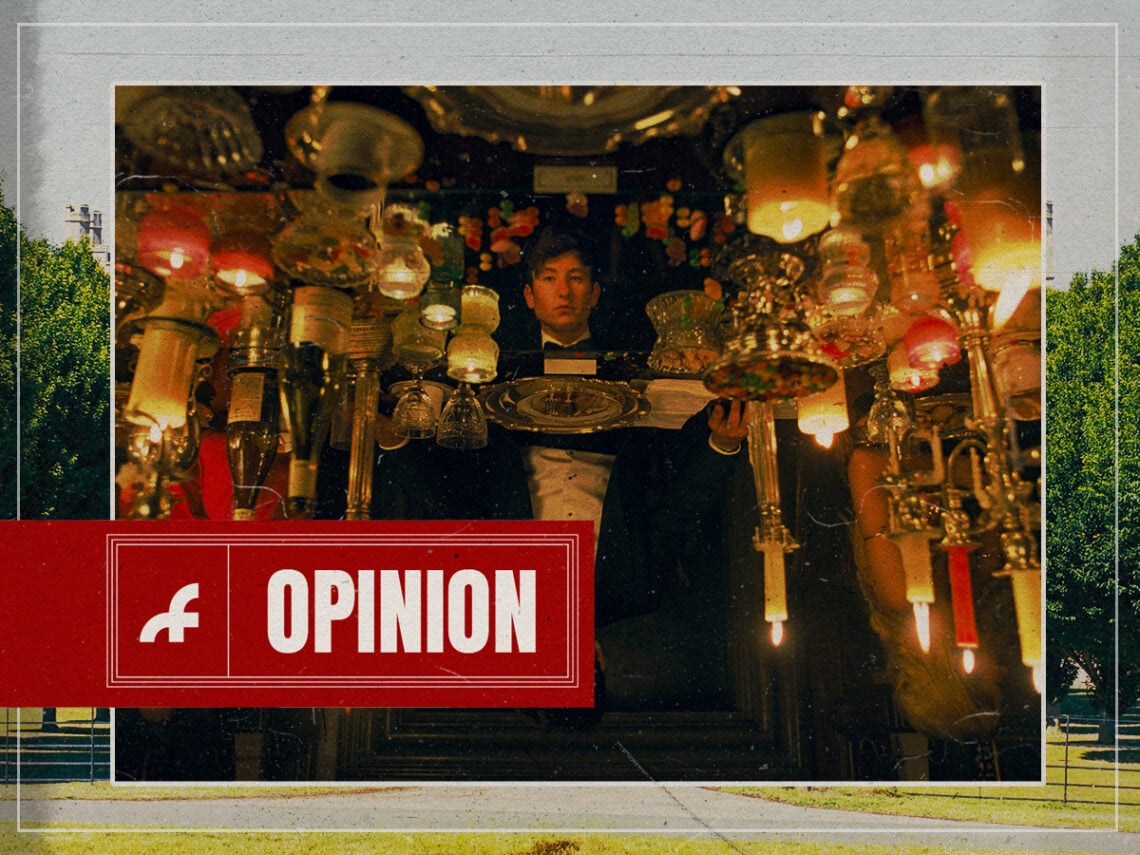
But never more so than when the movie finds its feet at Saltburn. Using the real-life setting of Drayton House in Northamptonshire, the manor was built in 1328, providing a classic gothic backdrop. As Oliver arrives at Saltburn, he’s greeted by a typically unfriendly butler, another commonplace character in gothic literature. Like Dracula’s Renfield, Joseph from Wuthering Heights, or even Lurch in The Addams Family, the unfriendly butler acts as a warning sign or kickstart the off-putting feeling surrounding our gothic setting. In Saltburn, the butler Duncan does that perfectly, immediately making the viewer know somewhere in their gut that something sinister will go down here.
This was all intentional, of course. Once describing the film as a “vampire movie”, a classic gothic genre, Fennell instead appeared interested in a more distinct style. To Fennell, Saltburn was “taking this subgenre of the gothic, the country house summer” and running with it. In one interview, she lists the texts she used as references, calling upon Evelyn Waugh’s Brideshead Revisited, Thomas Hardy’s Jude The Obscure and Daphne du Maurier’s Rebecca, to name just a few. “It’s such a rich British tradition,” she continues, “That feeling of cabin fever you get in a house like this.”
The cabin fever Fennell refers to is tied into the rich gothic trope of the uncanny. A phrase used to describe that feeling when something is familiar but not putting a name to unnerving or uneasy energy. Especially when considering the gothic tradition of haunted houses, or the subgenre Fennell refers to of sinister happenings at country houses, the curious feeling comes from something terrible happening in a home, a place which is supposed to be familiar and safe.
Throughout Saltburn, uncanny is really the only word able to describe the feelings it brings us. The film keeps its viewers in a constant state of to and fro, leaving them totally unsettled. In moments, you like Oliver and root for him; you want to believe the best in him, and you especially want to support the working-class underdog in this strange upper-class world. But then, in moments where he lurks outside bedroom windows spying on his friend, or in the repeated mirror scenes where his reflection is multiplied and, in turn, distorted, you can’t shake the feeling that something is up. The viewer is meant to feel utterly conflicted and, in parts, even confronted by their own evil desire for Oliver to win.
The entire film plays on this intersection, oscillating the viewer between states of stress and soothing. Jacob Elordi’s character is vital here. Just as the tension swells and the feeling of discomfort hits a peak, the viewer waits for his character of Felix to blow up and become the upper-class villain he is set up to be. But instead, he says something kind or forgiving, or even something distinctly normal and subtly funny, like pointing at Victorian paintings on the house’s wall and addressing his “dead relly”. Saltburn tosses its viewers around, using the gothic tropes we all know as bats, hitting us back and forth between conflicting and unsettling feelings. Mixing in modern music, moments of humour and grounding technology like TVs and phones, Saltburn’s current-day approach to the classic trope is masterful in simply making the viewer feel a little off.
It’s incredible how long Fennell can keep this up. Sure, throughout, there are moments of total shock as she weaves in further gothic elements of the grotesque with some pretty grim and gory moments of seduction, such as the now infamous bathtub scene. But the tension isn’t boiled over until Keoghan’s character, Oliver, is revealed as a total fraud and the true evil in the film. When we learn that his character isn’t working class at all and has lied his way into the Saltburn family’s home, Oliver is revealed to be a modern-day take on arguably the most famous gothic figure: Heathcliffe.
The similarities between Oliver and Heathcliffe are striking. The ultimate gothic antihero, Emily Brontë’s character from Wuthering Heights enters as a working-class underdog before being revealed to be the villain, enacting a generations-wide punishment on an upper-class family – sound familiar? To add to the similarities, in the end, Heathcliffe’s revenge is never really about class or his treatment. It entirely comes down to unrequited love, much like how when Oliver is revealed to actually come from a middle-class family, his further violence towards Felix and his family all comes down to Felix not reciprocating his obsession.
One of the film’s most shocking moments, prompting audible cries of outrage from members of my screening, is the grave scene. For those who have seen the movie, the image of Barry Keoghan humping a fresh grave mound is probably burnt into your brain. The perfect example of the gothic grotesque that combines not only aesthetic and body horror with social and political taboo, this scene draws clear reference back to Wuthering Heights.
After Healthcliffe’s beloved Cathy dies, he digs her coffin back up and lies with her, prompting outrage from his maid, “Were you not ashamed to disturb the dead?” It doesn’t seem to matter to Heathcliffe, who responds selfishly, “I gave some ease to myself”. As Oliver quite literally pleasures himself on Felix’s grave, you can see where Fennell got the inspiration for her most scandalous scene.
Buying into all the biggest tropes of the gothic genre; spooky settings, uncanny feelings, grotesque depictions, a complex underdog and outright violence – Saltburn is gothic literature at its finest. Imbued with modern takes on class, using the viewer’s preconceptions of generational wealth and the world’s general distaste for the super-rich, Fennell adds new layers to the film’s traditional core, creating a gothic masterpiece for the modern age.
