


‘Saltburn’ movie review: Barry Keoghan shines in raucous contemporary costume drama

British cinema was long overdue for a contemporary costume drama, away from the courteous rigidity of Brideshead Revisited or The Remains of the Day, with Emerald Fennell, herself an Oxford University being the perfect filmmaker to update the genre. Fresh from her Oscar-winning debut Promising Young Woman, which fizzed with frenetic pace and popped with saturated colour, Fennell takes the same sentiment to Saltburn, a raucous film of tremendous vigour that bathes in its embrace of style over substance.
Indeed, when a film’s style is so gorgeous to behold, one begins to feel a bit gluttonous for even thinking that substance is necessary, with Fennell channelling her former university experience to bring an excruciatingly accurate vision of Oxford in 2006. In the haunting, historical walls of the institution, cliques quickly form, forcing the introverted Northerner Oliver (Barry Keoghan) to latch onto Felix (Jacob Elordi), the biggest and most popular name on campus.
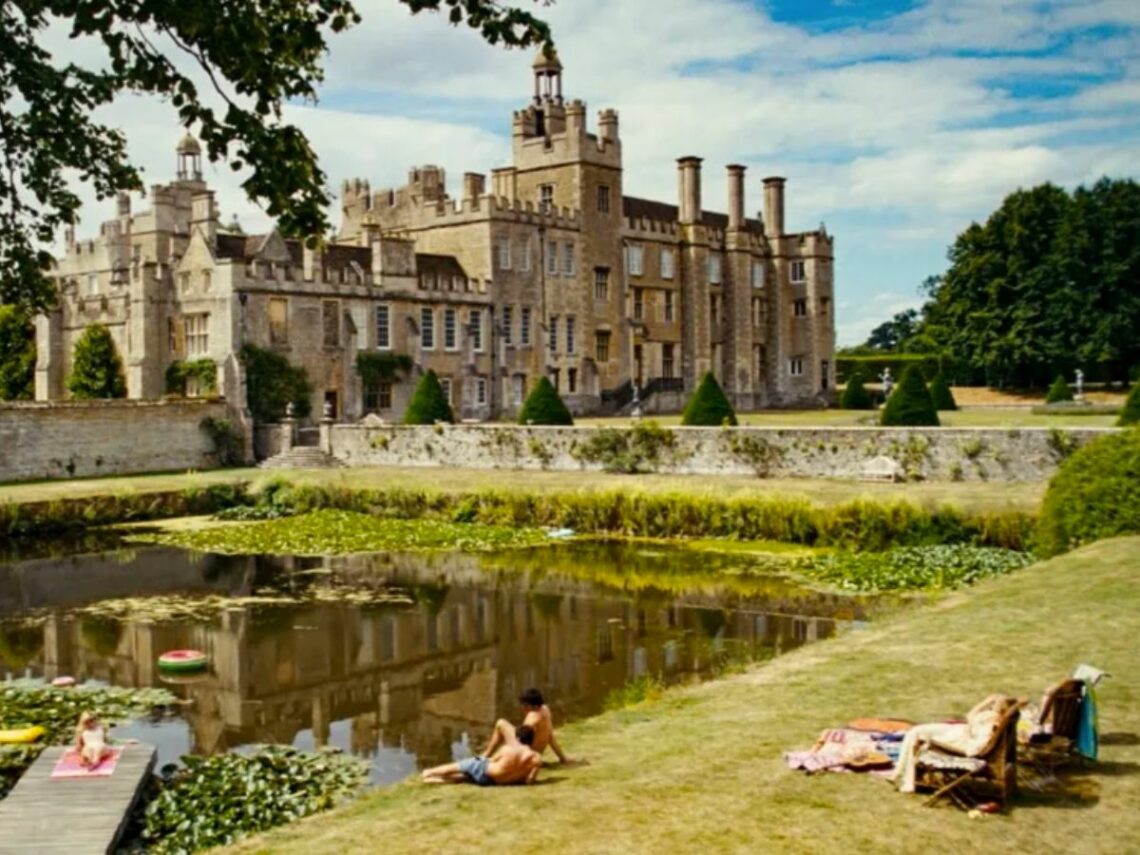
Worming deeper into his life, Oliver eventually receives an invite back to Felix’s house for the summer, a grand, almost insultingly-sized manor house named Saltburn. Here, he is introduced to a who’s who of British talent, with such creeping slightly into sitcom territory, as Carey Mulligan shows up in a cartoonish supporting role beside Rosamund Pike and Richard E. Grant, who play Felix’s mother and father.
From the outside looking in, it may seem like a two-man show where Keoghan and Elordi effectively battle it out for the ‘Leading Actor’ Oscar with equally fierce ostentatious performances, yet the whole film relies far more on its magnificent ensemble. Undoubtedly, Keoghan’s Oliver leads the film as an omniscient parasite who flits between a best friend and a malevolent villain, yet, just like any great costume drama, he would be little without the likes of Pike and Grant, who joyously steal the attention as superficial, toxic caricatures.
This can all feel a little pantomime at times, with Felix’s family fulfilling the roles of upper-class stereotypes, but it is when this camp melodrama is mixed with genuine Shakespearean tragedy that the film truly excels. Despite being very different in tone, it’s not far off from Yorgos Lanthimos’ Killing of a Sacred Deer in substance, with both telling tales that toe the line between contemporary farce and classical literary catastrophe.
Strutting around the house and across the grounds of Saltburn, often bearing very little clothes, the young characters are like majestic mythical statues come to life, posing their beauty without much necessarily going on beneath the surface. It is very much their movie, too, with Keoghan and Elordi being joined by Felix’s sister Venetia (Alison Oliver) and their cousin Farleigh (Archie Madekwe), the latter of whom being an enigmatic lord of drama who commands the scene as if a chaotic Shakespearian jester.
As cocaine-snorting, fashionable consumerists, they are the modern-day royalty that line painted on the walls of Saltburn. Keoghan’s Oliver is very much aware of this, too, and doggedly attempts to remain amongst the elite ala The Talented Mr. Ripley, playing a sneaky, unhinged maniac who has as much fun as possible whilst trying to dismantle the system. It’s a frenetic carnival of cinematic vision and dramatic joy, and even if there’s not much beneath the surface, it’s simply a joy to participate in the party.
