


The way over Yondr: A few words in defence of phone-free concerts

After what feels like an eternity, Phoebe Bridgers is back in the spotlight this year, both in the studio and on the stage, but before she finally released the lead single from her first album in six years, all anybody seemed to be talking about was the fact that her shows this year are going to be phone-free.
The response to the news that Bridgers wants her fans to experience her shows in the moment, and not either after the fact or through the screen of someone standing in front of them, has driven certain sections of her fanbase into hysterics.
Some fans have suggested that the concept of a phone-free show is ‘classist’ (no, me neither), while others have raised (more understandably) accessibility concerns. With that in mind, Bridgers’ team have announced that there will be medical exemptions made in compliance with ADA laws on the American swing of the tour; though these exemptions will not apply to all of the fans who have cried wolf.
For instance, the fan who suggested that they needed to be allowed to film the whole concert because they have trouble remembering every moment of the shows they go to all of the time and that Bridgers was therefore ableist for not allowing them to do so, probably won’t be granted a special dispensation to use their phone at the concert. Personally, I think it is worse to use the legitimate needs of the disabled community as a trojan-horse for your own mobile-phone addiction than to have to forget a song or two at a Phoebe Bridgers show.
Others have suggested that a knock-on injustice of her decision is that anyone who didn’t get a ticket will miss out on the shows, as they won’t be able to watch clips on YouTube after the event, and those inside the room won’t be able to FaceTime their friends and bring them into the room with them.
Then there was a whole host of fans who suggested that their purchase of a ticket entitled them to the right to do as they pleased at a venue, and that their money didn’t just pay for their access to the arena, but also gives them carte blanche to film as much footage as they pleased.
But that’s just not true, is it? When we buy a ticket to a show, we are buying a ticket to witness an artistic performance presented to us in whatever way the artist in question wants to present it. We’re not buying into a share of the tour’s ownership or authorship. We’re not buying the opportunity to decide which songs are played, what order they’re played in or what key they are played that night or how the lighting should look on the stage.
In fact, so much of the reaction to Bridgers’ phone-free announcement perfectly distilled and encapsulated the exact kind of entitlement which has led her to speak out on numerous occasions about toxic fan culture, the overstepping of boundaries and increasingly parasocial relationships that modern fans exhibit towards their favourite singers, both within her own fan community and in the wider culture.
There is not much difference or distance between the kind of fans who harassed Phoebe Bridgers in a Los Angeles International Airport terminal when she was traveling to her father’s funeral and the man who recently attempted to break into Sabrina Carpenter’s house and those who complained about the phone-free aspect of the tour, and neither is it there between the bizarre need to film everything that some people increasingly seem to feel and the insidious nature of surveillance capitalism which is creeping into our day-to-day lives, where our every move is being tracked and monitored.
Meta hadn’t started producing their creepy camera glasses by the time that Stewart Lee described the terminally online youth as being “the Stasi for the Angry Birds generation”, but the current levels of entitlement to film and photograph people in public have gone beyond parody and satire into pure and simple invasiveness and intrusion on our ability to simply exist freely in public.
Somebody who knows all too well about fans overstepping the mark is Bob Dylan. In the 1960s and early ‘70s, fans used to break into his house and comb through his rubbish bins; they’d follow him in the streets and harass him wherever he went. Though we have calmed down as a fanbase more recently, he has long been strict on the use of personal cameras and phones at his concerts, with requests that audiences don’t take photographs of his shows dating as far back as the 1970s.
More recently, repeat offenders and those who ignore the requests of security guards around the venue have often been ejected from his concerts without hesitation or refunds. In fact, Dylan went so far as to stop a particular show in Vienna in 2019, singling out one particularly photo-happy audience member, and scolding them by saying, “Take pictures or don’t take pictures. We can either play or we can pose. OK?”
Famously, for the last four years, Dylan has gone one step further and made all of the shows on his Rough and Rowdy World Wide Tour phone-free, utilising the services of the magnetic phone-pouch events company Yondr, to ensure that fans experience the show in the moment, and not through their phone screens.
Personally, I attended 29 of those phone-free Rough and Rowdy Ways World Wide Tour shows, including concerts in London, Oxford, Bournemouth, Dublin, Amsterdam, Paris, Carcassonne, Prague, Tokyo, Orlando, Philadelphia, Newark, Nashville, Memphis and Tulsa. All around the world, there were only minor grumbles from uptight and entitled audience members, but it was never a logistical problem and never caused any delays to proceedings.
At each show, the Yondr team were highly efficient at both locking your phone into the pouch (which you keep hold of yourself, never truly losing contact with your phone at any point) at the start of the show and releasing it at the end. Whether it was in Tokyo, Memphis or Bournemouth, there was never any delay to the start of a show or people stranded outside while a concert started, or any lag in getting out of the venue at the end, owing to additional queues or confusion brought on by the mechanics of the operation.
In fact, only a few times did I hear complaints of any kind, anywhere. One loud-mouthed American who seemed hell-bent on ruining everybody’s enjoyment of the concert in Newark, NJ, loudly and drunkenly complained about not being able to film the performance, and one man at the London Palladium seemed to believe that it was the fault of the bar-staff that he hadn’t brought either any cash or his bank cards with him, and that he couldn’t use his Apple Pay to purchase a drink while his phone was secured in the Yondr pouch.
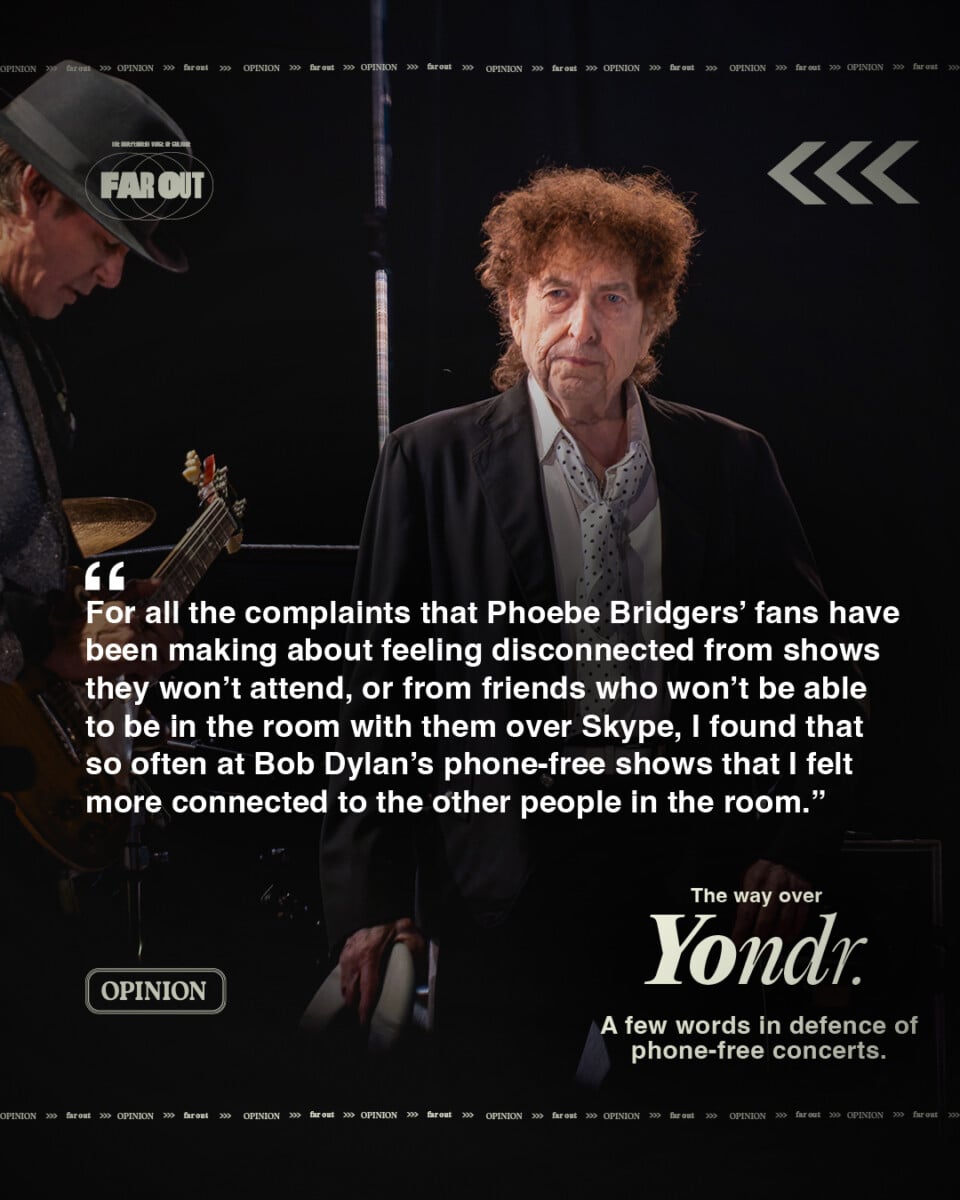
But for all the complaints that Phoebe Bridgers’ fans have been making about feeling disconnected from shows they won’t attend, or from friends who won’t be able to be in the room with them over Skype, I found that so often at Dylan’s phone-free shows that I felt more connected to the other people in the room. In Orlando, I got talking to the elderly couple sitting next to me who were at their first Dylan show since 2001. I found out that they’d travelled up from Key West and were hoping to hear him play his song of the same name, and so the enjoyment of sitting next to them as they lost their minds at hearing their favourite song felt all the more special for having had the conversation first.
Ahead of the shows in Prague, Nashville, Philadelphia, and Tulsa, I had extensive, illuminating and fascinating conversations with people that I had never seen or met before, and wouldn’t now recognise in a crowded room, but who I would never have spoken to if we’d all had our noses buried in our Twitter or Instagram feeds. In Paris, though, there wasn’t much conversation before the show around me, but in a beautifully French way, there were plenty of people reading in the low light of the pre-show auditorium. I myself was working my way through the copy of Herman Wouk’s The Caine Mutiny, which I’d picked up earlier in the day at the famous Shakespeare and Company bookshop by the Seine.
And you know what? You remember the shows just as well without having taken a grainy video from the back of the room. Maybe more so. You remember how you felt, and how it impacted and affected you more than what you saw, though of course, you can remember that as well, for the most part. You can take in more of what’s going on up there on stage and really get lost in the music and the moment when you don’t have it in the back of your mind that now would be a good time to sneak a quick snap or a snippet of your favourite song. More importantly, not only does your own phone not take you out of the moment, but neither does anybody else’s.
Recently, my partner and I caught the tail-end of Hayley Williams’ triumphant Hayley Williams At A Bachelorette Party tour at London’s Roundhouse, where, about halfway through the night, the Paramore singer thanked the crowd for “being here with me in the moment”. Presumably, she wasn’t speaking to the people who were standing around us and spent most of the night with their phones, capturing poor-quality videos of her performing her latest album.
Desperately trying to focus on the music and her flawless performance of this latest collection of songs (which, to my ears, sounds like a 21st-century update on Alanis Morissette’s Jagged Little Pill), it became increasingly difficult to do so with so many phones either shoved in your face or blocking the view of the stage. When I should have been thinking about the quality of the performance, I instead found myself wondering about the quality of the footage that some people were capturing and why they were bothering with such a bad phone camera.
When I could have been thinking about what guitar Williams was playing now, what she was playing on the piano or what effect it was having on her voice to be singing through an amplified bull-horn, I was actually thinking things like, ‘Huh, that guy’s phone is so incredibly square. I wonder what make that is. I wonder if it hurts when his phone is in his pocket, and it digs into his leg?’ or, ‘Oh, geez, that person is holding their phone up, and they’ve forgotten to hit record’.
At least at the Hayley Williams show, the phones were facing away from us. Some of the worst offenders I’ve ever sat near came during concerts on Taylor Swift’s record breaking Era’s Tour. On the second night I went to, two young fans sat directly in front of us spent the entire night filming themselves as they shouted and screamed and gave the sound system of Stockholm’s Friends Arena a run for its money in testing the top limits of their volume. But it also made the show incredibly uncomfortable for being in the back of their shot the whole night long, and subsequently dragged out of the spectacle of the show by the thought of whether we were inadvertently being live-streamed somewhere on Twitch or TikTok.
A quick look around the room revealed that they weren’t the only two with the cameras trained on themselves, rather than the world’s biggest pop star parading on the stage in front of them.
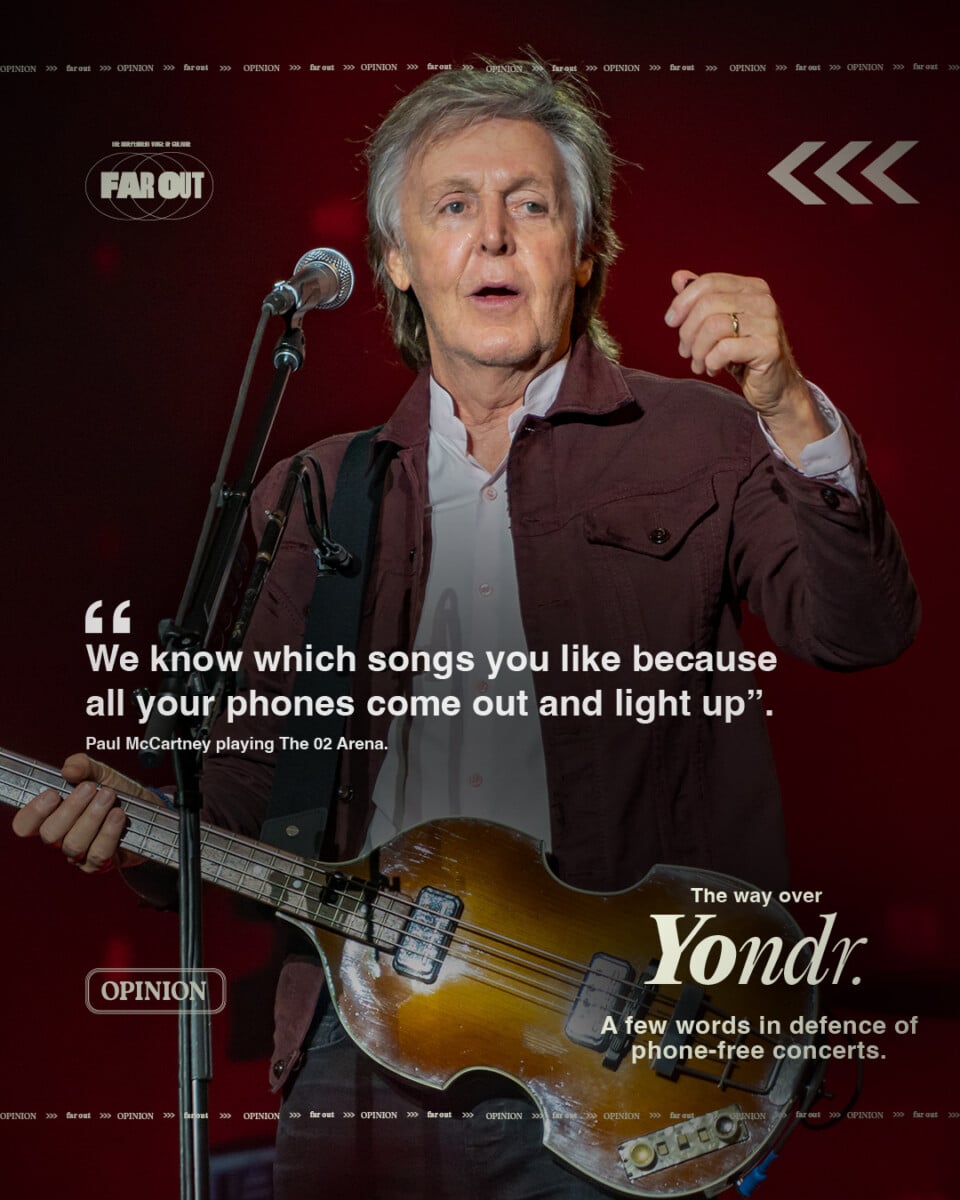
A few years before that, I was in the crowd in London’s O2 when Paul McCartney half-joked that “We know which songs you like because all your phones come out and light up”. Presumably, the rest of the songs he played that night (a staggering 40 in total) were performed for his own entertainment, rather than the ungrateful assembled masses.
I’m going to see Bob Dylan again in a couple of weeks, and was actually almost a little disappointed to see that Yondr are no longer going to be employed at the event, although Dylan is still requesting that fans don’t use their phones during his concert. By the time I get to see Phoebe Bridgers on her Lost Tour in London in December, I’ll not only be looking forward to the couple hours of music, being in the moment and part of a common collective who are experiencing a singular event together, but also simply looking forward to a couple of hours of being in a phone-free environment.

Never Miss A Tale
The Far Out Bob Dylan Newsletter
All the latest stories about Bob Dylan from the independent voice of culture.
Straight to your inbox.