


“You can’t bring that in”: Diary of a gig-going diabetic, and how venues should be doing better

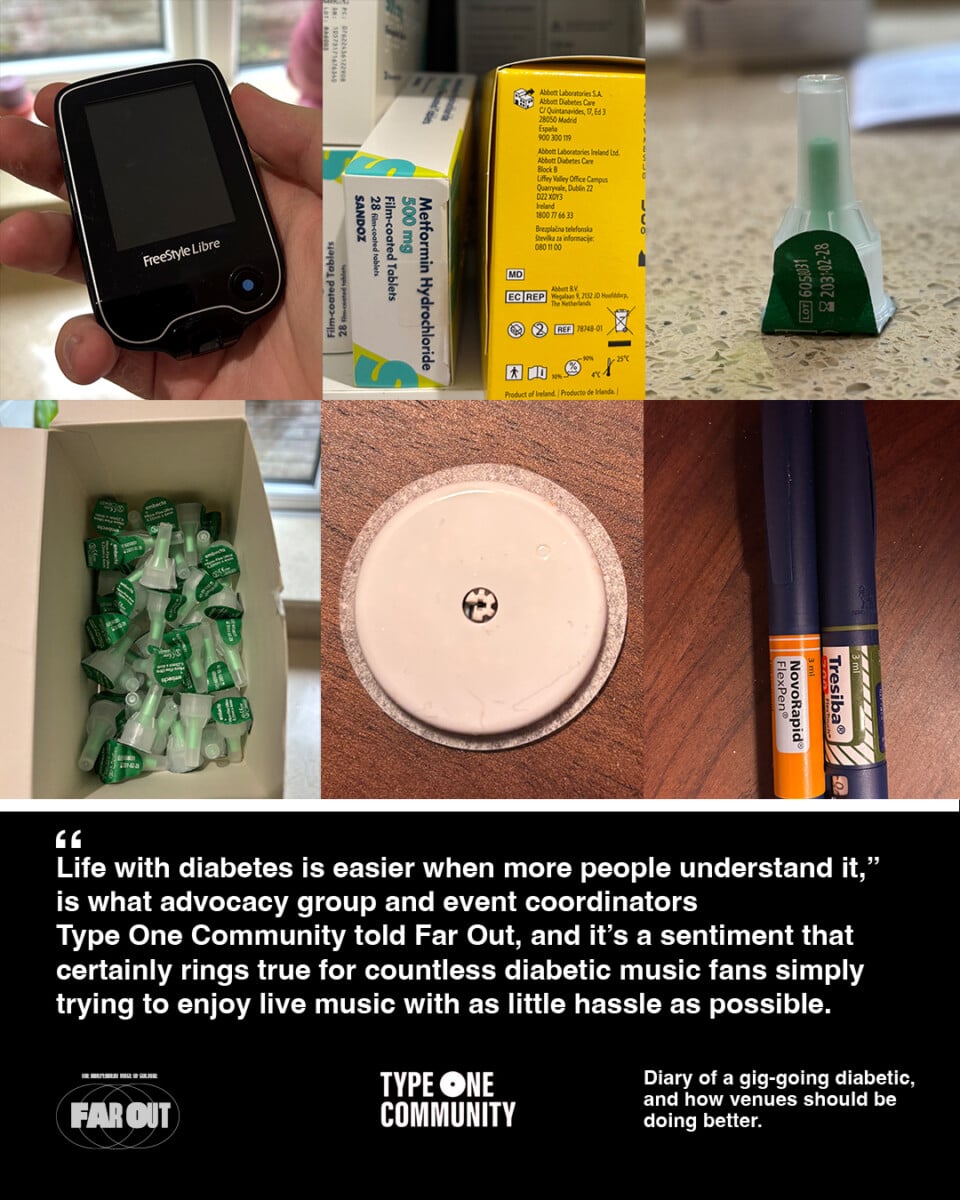
“You can’t bring that in” is a phrase I have grown accustomed to hearing during my days as a gig-goer, along with its counterpart “what is that” when presenting the venue staff with a handful of needles, pills, and medication after a pat-down.
No, I am not a drug pusher, though the reaction I have seen from security staff and, indeed, fellow gig-goers might suggest as such. I am, in fact, a diabetic, type one, to be specific. You may think, ‘So what? Diabetes is a relatively common condition’, and you would be correct; according to data from Diabetes UK, there are approximately six million people living with diabetes in the UK, of which around eight per cent are type one.
Presumably, the vast majority of those people are arriving at concerts, festivals, theatre performances and other live events with the same equipment as me. Why, then, does every security guard and bouncer look at me as if I’m some sort of trouble-making undesirable?
“If you’d have waited a few more days, you wouldn’t be here,” was the phrase my local GP used to inform me that I had developed type one diabetes at the age of 15, after a month or two of inexplicable illness and constant dehydration. I don’t doubt that being diagnosed with a chronic illness at such a formative period in my life has had some profound effect on my development, mental health, and general outlook on existence. In most cases, though, diabetes is merely an inconvenience.
It is, by its very definition, a disability, but for those of us who manage to control our blood sugar levels well, there is no reason that diabetics cannot live a full and fulfilling life, albeit one with a far more extensive list of repeat prescriptions. In fact, there are a multitude of artists and musicians who themselves are type one diabetic: you can even see Este Haim’s CGM (continuous glucose monitor) in the music video of Haim’s ‘Summer Girl’. The illness is chronic, but it shouldn’t be life-ending.
It does, however, add an extra layer of admin to everyday life, in terms of checking blood sugars, keeping something sugary to hand at all times, and, in the days before CGMs, fingers that gave the impression of being in a fight with a sewing machine. One particularly frustrating and inescapable aspect of that admin, however, has precious little to do with sugar levels or insulin injections, and it is the fact that, by and large, education about diabetes is severely lacking.
This is the prevailing reason that, upon being diagnosed, fellow school pupils asked if they could ‘catch’ diabetes from me, why I am constantly hounded by the infuriating question of ‘Can you eat that if you’re diabetic?’, and why venue security staff seem so baffled when presented with insulin pens, needles, and an emergency supply of Haribo’s (other hypoglycemic treatments are available).
One of the first concerts I attended as a newly diagnosed diabetic was Arctic Monkeys’ Tranquility-era show at Manchester’s AO Arena, and as an already anxious, introverted teenager, the extended wait and forced explanation of why I needed insulin and why my Haribos shouldn’t be confiscated was an extra layer of panic that, frankly, I did not need.
It didn’t ruin the show, and the extra 10 or 15 minutes at the security queue probably didn’t seem that drastic to either passers-by or, indeed, the security staff. It was, however, a sense of discomfort that has since become a constant in my gig-going experience.
That is not an overly unique experience for diabetics, either. Type One Community, an advocacy group that organises club nights and events aimed at making “life with diabetes better”, told Far Out, “The biggest issue we hear about is access to essential medication and treatments. People with diabetes often carry insulin, glucose treatments, sensors, pumps and other medical supplies, but security staff don’t always recognise these as necessary medical items.”
“The other major challenge is managing low blood sugar, or a hypo, in a busy event environment,” the organisation’s co-founder, Jessica Unger, continued, “If someone needs sugar urgently, delays caused by security processes, a lack of understanding, or difficulty accessing food and drink can quickly become a safety issue.”
She added, “For many people, it’s not just the practical risk. It’s the anxiety of wondering whether they’ll be challenged for carrying the things that keep them alive”.
I have been to hundreds of gigs, big and small, since that night at Manchester Arena, and it should be stated that the vast majority of experiences I’ve had, in terms of my diabetes, have been fine. Smaller, grassroots venues are particularly adept at understanding diabetic medical equipment, and I have even had staff at venues like Belgrave Music Hall, Wax Bar, and Hyde Park Book Club in Leeds, along with Manchester’s Albert Hall, provide me with free soft drinks to counteract low blood sugar.
Nevertheless, it is those other, less helpful experiences that tend to stick in the mind. Before a show at Leeds’ O2 Academy, for instance, the security’s revelation that I was diabetic caused them to split me up from my friends, to be sent to the St John’s Ambulance, where I was informed that the venue did not sell any full-sugar drinks, and that if I suffered a hypoglycemic episode, the venue was not liable. From a legal standpoint, the venue was simply covering itself, but it instilled a horrific sense of ‘othering’ in me that overshadowed the entire night.
Far Out reached out to the Academy Group for comment on their security policy with regard to diabetes, but received no response.
It is that sense of othering, along with the baseline of anxiety that comes with attending any event as a diabetic, that Type One Community are attempting to eradicate. “We bring people together through events, festival activations, radio shows and community projects that celebrate living with type one diabetes,” they told us, “Alongside that, we work with venues, festivals and brands to make nightlife and live music safer and more accessible for people with diabetes.”
“We started Type One Community because living with a chronic condition can be incredibly isolating,” the organisation continued, “Diabetes is something you manage every minute of every day, but most people around you never see that work. We wanted to create a space where everyone could celebrate that resilience, meet others who understand what they’re going through and feel less alone.”
“Life with diabetes is easier when more people understand it,” is how T1C summarised that message, and that manifesto is something that should definitely be explained to venue security staff. “Most improvements are actually quite simple,” they affirmed, “Better training for security and front-of-house teams would make a huge difference. Staff should understand what diabetes is, what medical equipment people may be carrying, and why items such as insulin, glucose tablets and hypo treatments must always be allowed into a venue and remain on the person.”
What’s more, the organisation added, “Clear policies would also help. People with diabetes shouldn’t have to negotiate access to life-saving medication every time they attend an event. More broadly, venues can create safer environments by ensuring staff know how to respond if someone experiences a hypo and by making food, soft drinks and water easy to access when needed.”
Luckily, for future 15-year-old diabetics navigating the added anxiety of attending gigs alongside managing their newfound and ever-changing chronic illness, Type One Community is on the offensive, organising events in which diabetic attendees don’t have to worry about having to explain the intricacies of their medical history to hi-vis strangers at the door, or accessing hypo treatments when needed. “The thing we hear most often is that people feel understood,” they said.
As already mentioned, diabetes has certainly not stopped me attending gigs or live events, and nor should it. Diabetes is a serious chronic illness, but it also isn’t a barrier to living a normal life and enjoying all the fruits of life as a music fan. Just as with a multitude of disabilities, though, venues need to be doing more to make life easier for attendees.
Almost a decade on from explaining why I need sugar tablets with me to the security staff of Manchester Arena, though, there is still a part of me that is struck with anxiety and othering when asked to empty my pockets before a show, willing the security staff to know somebody with or at least be aware of diabetes.
Until venues start to take more notice of that fact, diabetic gig-goers will still have to go through the constant rigmarole of ‘No, sorry, I actually need these sweets for medical reasons’, or, in the worst cases, the nuclear option of ‘Look, if you take this off me, I might die’.
