


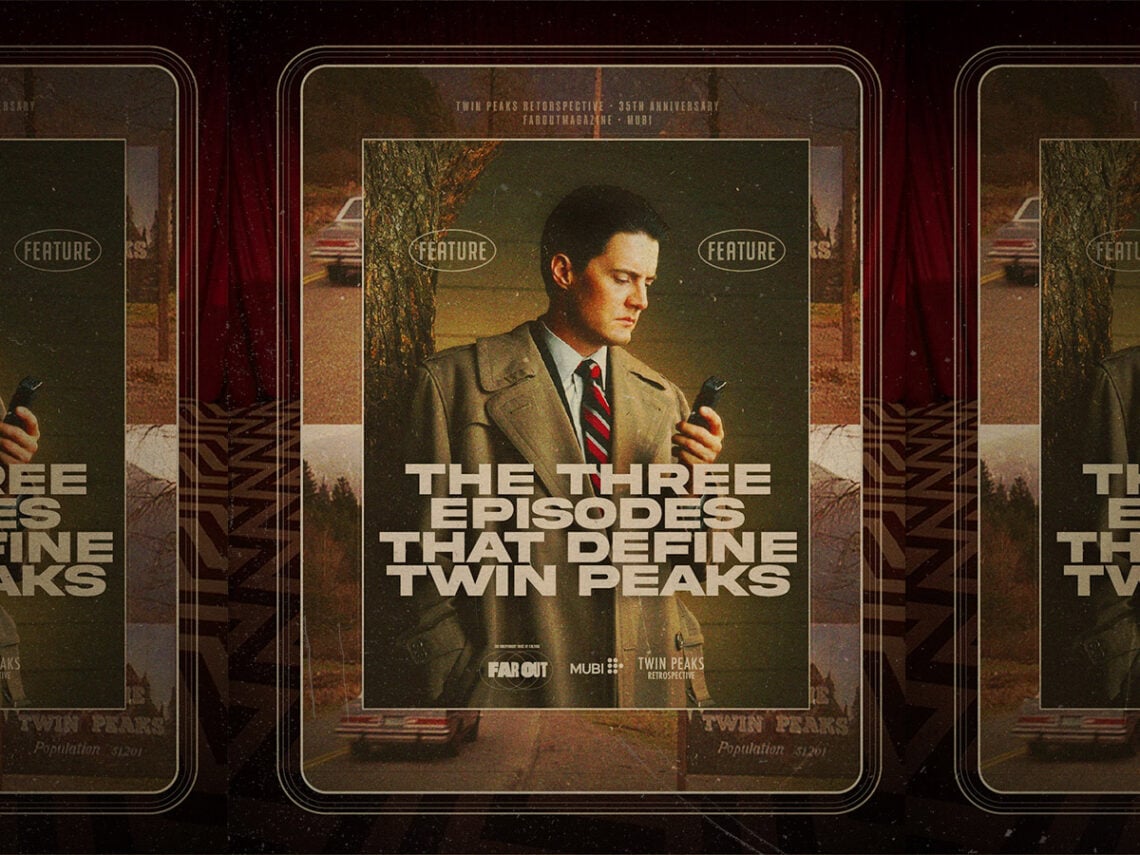
Three voices, one masterpiece: the episodes that define ‘Twin Peaks’

For a series that only had two seasons initially, Twin Peaks punched well above its weight in terms of legacy. There are few shows that are as fiercely loved as David Lynch and Mark Frost’s genre-bending mystery set in a sleepy logging town full of secrets.
The starting point is the body of a popular high school student, Laura Palmer, but from the very first episode, it’s clear that that is just the tip of the iceberg. When FBI agent Dale Cooper cruises into town armed with a voice recorder and an abundance of goodwill, he finds a web of secrecy and darkness that will require more of him than the FBI’s usual playbook.
“While we were making the show, I kept telling everybody, ‘We’re trying to make something here that will last,’” Frost told Far Out in a recent interview. “Our feeling was, what if we just intentionally make this as something that people need to pay attention to, that they’ll get more out of it the more they put into it? And I guess it worked.”
35 years after the first episode aired, Twin Peaks is more popular than it has ever been. As new generations discover the mist-shrouded town and fall under the spell of its ever-evolving, ever-surprising story, those who have already seen it time and again are still there, lost in its comfort and mystery.
There are many episodes in that initial 30-episode arc that you could choose as emblematic of the whole series. There are episodes that lean into the horror and tragedy of Laura Palmer’s murder, ones that plunge deep into Red Room abstractions, and ones that lovingly explore the eccentricities of the characters.
We at Far Out have opted for three that touch on all of these aspects in one way or another, the episodes that have stuck with us a little more than the others.
Aimee Ferrier: ‘Northwest Passage’
When the world was locked down five years ago, I was suddenly pulled away from my university studies and left with no choice but to move back home. Away from the late nights, seminars, and library sessions, I now had a lot more time on my hands. It was finally time for me to start watching Twin Peaks.
While I’d already become a David Lynch fan through movies like Eraserhead, Blue Velvet and my favourite, Mulholland Drive, I approached Twin Peaks with slight intimidation. It was a show shrouded in mystery, and I wondered if I was quite ready for it. I knew it was iconic in every sense of the word, and that I’d most likely love it, but part of me worried that I’d find myself out of my depth.
When I loaded up the first episode, also known as ‘Northwest Passage’, I was slightly shocked to discover that it was the length of a feature-length film. I wasn’t used to television like this. Sure, I was into TV dramas, but at this point in time, my go-to small-screen watch was typically a sitcom. Yet, Twin Peaks was a gateway for me, highlighting the potential for television to become something cinematic and boundary-pushing.
The atmosphere that Lynch and Mark Frost established in the pilot had me immediately hooked, and I think it’s perhaps one of, if not the best, first episodes in television history. It perfectly blends the offbeat nature of the story and the characters with addictive mystery and soap opera drama, with a web of interconnected characters instantly drawing audiences in. The warm colour palette and the small town, paired with Angelo Badalamenti’s gorgeous jazz-influenced score, create an inviting sensibility, although once we’re reeled into this enigmatic world, it soon becomes apparent that darkness lingers beneath it all.
When the show opens, we discover the body of Laura Palmer “wrapped in plastic”. The popular high-schooler’s death is a turning point for the town; not only does her washed-up body emerge, but so does the threat of the town’s secrets unravelling. It’s a haunting introduction to a world that looks like it should otherwise be comforting and familiar, and I was left desperate to discover exactly what happened to Laura Palmer.
The first episode introduces us to FBI Special Agent Dale Cooper, played by Kyle MacLachlan, as he drives into Twin Peaks while speaking into his recorder. He addresses a woman known only as Diane, telling her, “11:30 am, February 24th. Entering the town of Twin Peaks. Five miles south of the Canadian border, 12 miles west of the state line. Never seen so many trees in my life”. Monologuing about his plans, including his excitement over cherry pie and coffee, we get a perfect sense of Cooper’s eccentricities.
‘Northwest Passage’ gives us great insight into the relationships between key characters in the show during the pilot, but it doesn’t simply feel like a mere establishing episode. This is more than just Lynch and Frost setting the scene; the episode fully immerses the audience in an uncanny world with various indelible images to boot—Ronette walking in a daze over the bridge, Leland and Sarah Palmer’s reactions to discovering their daughter’s death, Donna’s sobbing in the classroom, and the flickering lights as Laura’s body is examined and a letter is pulled from underneath her fingernail.
This is also the episode where we get one of the series’ most quotable lines from Pete: “There was a fish in the percolator”, a testament to the more bizarre and humorous side of the show. These comedic moments act as a perfect balance between the darker moments of the series, allowing its tone to feel distinctively human despite its oddities. As Frost told me during a recent interview with Far Out, “Life is all of these things. It’s not just one thing all the time. It’s completely changeable from day to day, from hour to hour.”
Twin Peaks soon became my favourite show, one that I’ve since revisited with even more admiration. The pilot episode couldn’t be a better introduction for a series as groundbreaking as this, pushing the boundaries of the episodic television format and marking the start of a TV phenomenon that would change the medium forever.

Lily Hardman: ‘Zen or the Skill to Catch a Killer’
Stepping into the world of Twin Peaks for the first time is daunting. There is so much lore surrounding it that I felt almost self-conscious in the beginning, as if I was having to unlearn everything I had heard and seen about it in order to encounter it on my own. The first and second episodes set the scene, introduce us to the central mystery, to Agent Dale Cooper and his love of pie and coffee, and reveal that this sleepy backwater is overflowing with chilling secrets. But the first time I really felt like I ‘got’ Twin Peaks was episode three, also known as ‘Zen or the Skill to Catch a Killer.’
This is when Mark Frost and David Lynch let themselves get really weird. It’s where they set aside all the world-building and character-establishing and say, ‘Buckle in. We’re about to take you down a road you’ve never been down before’. This is the episode that takes its time with humour and hints at the supernatural. It takes us inside the Red Room for the first time, gives us a glimpse of Bob for the first time, and lets us know that we have absolutely no idea what anything means and that that frame of mind is absolutely exhilarating.
The episode begins when the Hornes’ silent family dinner is interrupted by Ben’s brother, Jerry, who comes bursting into the room with an armful of baguettes. Like many of the best moments in the show, this scene takes its sweet time. The brothers exclaim over the sandwiches while the rest of the family looks on sullenly. It’s awkward and funny and a little sad, and it feels too trivial to be taking up so much time. And yet, it pulls you in.
The central point of the episode involves Agent Cooper showing off his singular powers of deduction to the Twin Peaks sheriff’s department. Somewhere in the woods, under those delicious Douglas firs, a table is laden with doughnuts, a blackboard is at the ready, and Lucy pours Agent Cooper a mug of fresh coffee. “Damn, that’s good coffee!” He exclaims after spitting it out. He asks his colleagues to take a seat, and then flips the blackboard around to reveal… a map of Tibet.
“Following a dream I had three years ago,” he says after providing a quick rundown of the country and its history, “I have become deeply moved by the plight of the Tibetan people and filled with a desire to help them. I also awoke from the same dream, realising that I had subconsciously gained knowledge of a deductive technique involving mind/body coordination operating hand-in-hand with the deepest level of intuition.” The method involves throwing rocks at bottles.
Lynch called Kyle MacLachlan his alter ego, of sorts, and nowhere is that clearer than in this scene. The filmmaker was known for his deeply intuitive creative process, seizing his imagination and acting upon it even (and especially) when he didn’t understand it. “Life is filled with abstractions, and the only way we make heads or tails of it is through intuition,” Lynch wrote, adding, “It’s emotion and intellect going together. That’s essential for the filmmaker.”
This woodland scene is wholesome. It provides a deeper insight into Agent Cooper’s reverence for the softer skills of policework and into Sheriff Truman and the deputies who are so willing to give his strange methods the benefit of the doubt. But it also sets us up for the final scene in the episode, our first encounter with the Red Room, when Agent Cooper falls asleep and meets Laura Palmer and The Man From Another Place dancing and speaking backwards.
The Red Room was one of those unexpected ideas that Lynch accepted without question and followed where it led. All he saw in the beginning was the room, and The Man, and the reversed dialogue. “So I had this idea, these fragments,” he wrote, “and I fell in love with them. That’s how it starts.”
In many ways, ‘Zen or the Skill to Catch a Killer’ feels like its own sort of beginning. It’s a much more lighthearted episode than many of the others, beginning with that absurd dinner scene and ending with a level of cryptic surreality that is absent from the first two episodes. It leaves you bewildered and, whether you realise it right away or not, bewitched. It was the first episode where I began to build my own connection to the show, to daydream about it and ponder it. In Lynch’s words, it was the first one I fell in love with, and it made me see the rest of the series, including those first episodes, completely differently.

Emily Ruuskanen: ‘Arbitrary Law’
“Maybe that’s all Bob is—the evil that men do. Maybe it doesn’t matter what we call it”.
The town of Twin Peaks is a world between worlds: it’s both natural and unnatural, a place of solace and grave danger. The threat is evasive and ever evolving, spinning in new directions as each episode unfolds and forces us to reckon with the unknown, reframing familiar evils through mystical entities. From the first episode of the series, we sense a danger just lurking beneath the surface, with Lynch often drawing attention to the hidden horrors that exist around us. But Twin Peaks changed television forever by articulating human evils through supernatural entities, an idea that came to the surface through one particularly haunting episode.
Arbitrary Law, the ninth episode of season 2, was arguably the moment that changed everything for Twin Peaks, and one that most sticks out in my memory when reflecting on the simultaneous beauty and madness of the show. Until this point, the characters were consumed by solving the murder of the beloved prom queen, Laura Palmer, forming a disjointed web of facts that only added to the mystery as universal truths and laws slowly unravelled and created more unanswerable questions. As a result, nothing was more shocking than the reveal of her killer, with the much-awaited answer plunging us into a new era as a different type of darkness began to take over. It saw the spirit of Bob finally coming to the surface through the unmasking and death of Leland Palmer.
The episode begins with usual moments of light-heartedness and tomfoolery, a specific tonal disconnect that is key to the success of the show, as darkness is interlaced with light. Lucy informs Dick and Andy that either of them could be her baby daddy, while Ben kisses Catherine’s feet in jail. But in between these moments, Agent Cooper and Sheriff Truman are intently working against the clock to piece together the missing links between Maddy and Laura’s murders, leading to a stormy gathering at the Road House as Cooper revisits his dream to unearth the killer, once and for all.
We are soon confronted with the horrific truth that Laura was killed by her own father, with Leland revealing that he had been possessed by the spirit of Bob since childhood, also alluding towards sexual abuse. He becomes consumed by a fit of madness as he thrashes and screams in a prison cell, slamming his head into a wall and bleeding out on the floor. The sprinkler system is accidentally triggered, and water starts to spatter across the room, drowning in a pool of water while Cooper cradles his lifeless body, urging him to move towards the light.
It is only then that he is truly free of Bob’s spirit, with Ray Wise offering a devastating performance as he finally faces the demons that have torn his life apart, leading to an outpouring of shame, terror and guilt as his agonising cries pierce the sound of cascading water. The Twin Peaks police department might have solved one mystery, but it is now just the first of many, grappling with the idea that the world they know is crumbling apart, and nothing they know can solve it.
The logic and universal truths that have cushioned their perspective start to fade away, ushering in an unfamiliar darkness as the show expands into a new realm. The episode ends as the men silently reckon with the one truth that remains—that regardless of who causes it, tragedy always goes beyond our understanding. Arbitrary Law is the first that ventures into the darkness and plunges us deeper into it, leaving us in a nightmarish dreamscape of the unknown and pushing us to make peace with its presence.

All episodes of Twin Peaks launch on MUBI on 13 June in the US, UK, Latin America, Germany, Turkey, Italy, Netherlands and India.
