


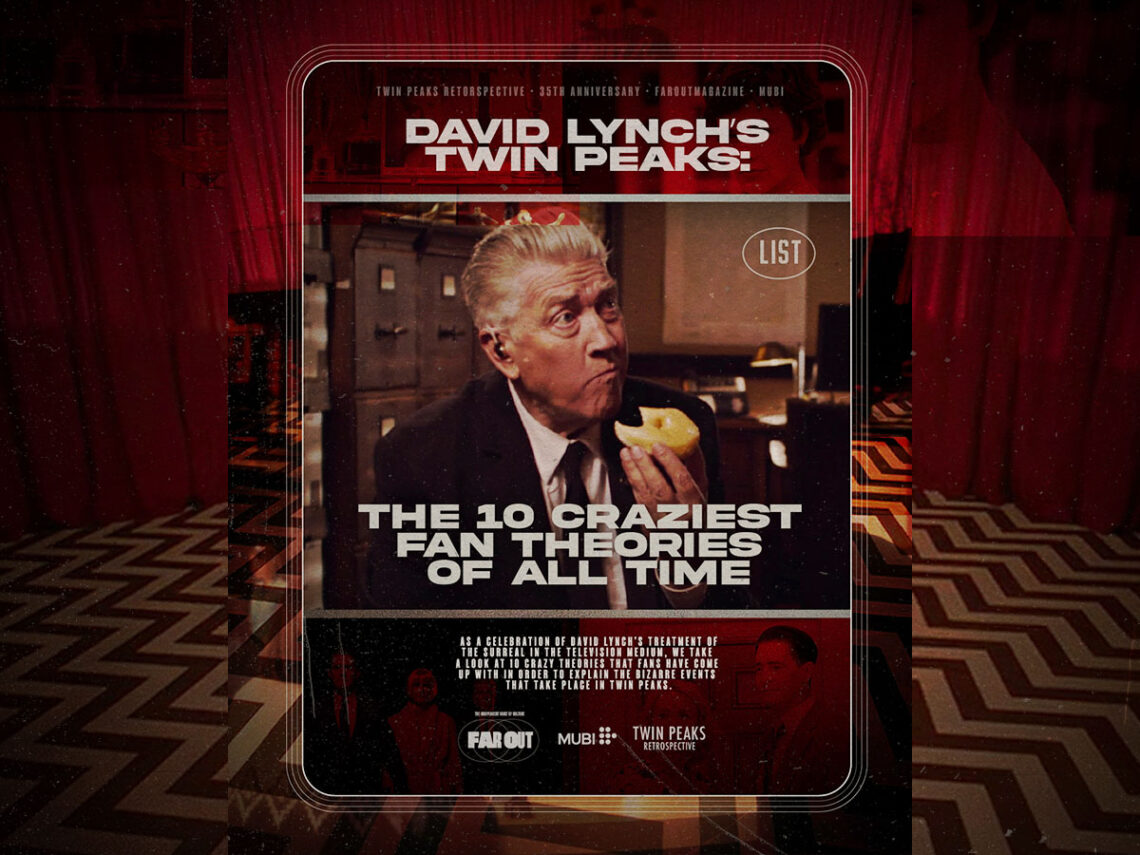
David Lynch’s ‘Twin Peaks’: The 10 craziest fan theories of all time

Considered by many to be one of the most influential TV shows ever made, David Lynch’s Twin Peaks found the filmmaker in his natural habitat of enigmatic surrealism, upending the conventions of the murder mystery and crime thriller to create something truly unique and decidedly Lynchian.
The filmmaker was famous for never explaining the motives, meanings, or reasoning behind his artistic and creative decisions, and Twin Peaks was no different. With more material than ever to chew on, audiences decided to view Lynch’s tight-lipped refusal to spell it out as a positive, drawing their own conclusions on what exactly went down in the fictional titular town and beyond.
“I don’t ever explain it,” he stated. “Because it’s not a word thing. It would reduce it, make it smaller. A film or painting, each thing is its own sort of language, and it’s not right to try to say the same thing in words. The words are not there. The language of film, cinema, is the language it was put into, and the English language – it’s not going to translate. It’s going to lose.”
Instead, Lynch encouraged viewers to conjure their own perspective: “If there’s 100 people in the audience, you’re going to get 100 different interpretations, especially when things get abstract. It’s beautiful.” In the case of Twin Peaks, some of those readings were a lot more abstract than others.
35 years on from Twin Peaks premiering on the small screen and with a brand new audience about to discover its peculiar charms on MUBI, even more fan theories are guaranteed to emerge in the coming weeks, some of which might even have left Lynch scratching his head.
However, it remains to be seen if any of them will be bizarre enough to beat the following ten, which cover the craziest theories to emerge from Twin Peaks.
The 10 wildest ‘Twin Peaks’ fan theories:
The government had it cancelled

Was the United States government responsible for Twin Peaks being cancelled after two seasons? According to one far-fetched theory, of course it was.
Mark Frost did confirm that the Gulf War was the reason why the show was moved out of its regular timeslot “for six weeks out of eight” in early 1991, but one intrepid viewer was convinced that “sooner or later people will draw parallels between the TV show that prompts so much discussion and the events in the Gulf.”
Posing another pertinent question, it was asked if it was “possible that the abrupt elimination of this show, featuring this particularly moral philosophy at this particular time, could be political? Could the American network have received orders to pull the show until the Gulf War is over?” The short answer: no.
If anything, Twin Peaks was too mystifying for its own good, and after failing to capture a wide audience outside of its devoted core fanbase, declining ratings were the final nail in the coffin. Or were they?
Everything happened in Laura Palmer’s head

It’s one of the most overused and often irritating tropes in storytelling, but could the explanation behind Twin Peaks really be as simple as a Lynchian twist on ‘it was all a dream’?
A perfect example of oneiric media, the series transports the viewer into the bowels of multiple dreamscapes. In many ways, Twin Peaks is an episodic breakdown of the structure of dreams; a philosophical incursion into the logic of dreaming that urges the audience to explore the hidden recesses of their own mind.
It’s not as outlandish as some of the other theories found here, but one that’s been endlessly dissected is the possibility that the entire show takes place inside Laura Palmer’s head, supported by a reminder of the third season’s end.
When “Carrie” screams in the final moments, a faint voice can be heard calling Laura’s name, which resembles the voice of her mother, Sarah Palmer. It’s a popular theory, and one that suggests Twin Peaks has a circular structure that leads us right back to the start.
The Red Womb

Undoubtedly one of the most mysterious creations in the entirety of Twin Peaks, the Red Room is a place that exists outside space and time, immune to the laws of physics, creating an eerie and haunting liminal space where all kinds of disturbing phenomena unfold.
One theory has even compared it to the uterine walls of Laura Palmer, conceptualising the Red Room as a surreal womb and Agent Cooper as a giant baby. According to the theory, this interpretation “brings Dale Cooper into the womb of Laura Palmer (the soft velvet curtains could very well be associated with the intra-uterine lining of a birth canal).”
Thanks to Cooper’s skin being “wrinkled somewhat,” it’s posited that his visage is “as if he himself were not ready to be born, not ready to leave the uterus until completion (of his dream, perhaps? Of solving the mystery, perhaps?)” It’s not without merit, but it’s certainly out there.
Trapped in an alternate dimension

Due to the complicated narrative structure of Twin Peaks, it’s extremely difficult to distinguish between the show’s reality and the illusions that populate the Lynchian labyrinth.
As a result, many theories have considered the possibility of alternate universes linked to the main reality of Twin Peaks due to the law of causality. Among the most popular is the belief that “Judy” didn’t let Laura Palmer escape her destiny.
Instead, it suggests that an alternative world was generated due to Cooper’s intervention, which saw Laura consigned to another dimension by Judy. In addition, all traces of her identity were erased from the history of Twin Peaks.
Is Bob really Pennywise?

Pennywise, the demented clown who struck fear into the hearts of millions as the antagonist of Stephen King’s It, has become an indispensable part of pop culture, doing absolutely no favours with the general perception of evil clowns.
Much like Pennywise, Frank Silva’s Bob is an interdimensional malevolent entity of mysterious origin who can adopt various physical guises to feed on the pain, fear, and suffering of his victims. Also, in the book, Stephen King’s creation said his name was Robert ‘Bob’ Gray.
There are enough dots to be joined to ensure it isn’t completely outside the realms of possibility, for Twin Peaks anyway, but it would be fair to say that Lynch and Mark Frost intentionally crafting a secret crossover with one of King’s most iconic characters feels like a stretch.
Is Laura Palmer really Dale Cooper’s mother?

Probably one of the more preposterous claims out there, Eileen G Mykkels was fervently convinced that Laura Palmer was actually Dale Cooper’s mother all along.
Mounting an extensive explanation, Mykkels defended her claim by comparing the similarities between the two characters, ranging from their mutual dislike of asparagus to their identical dreaming habits.
“Connecting Dale and Laura in such a way would certainly be within the confines of previously established thematic elements and only serves to strengthen that message,” she elaborated. “Laura’s strength passed down to Dale, both victims of the same demonic entity, and both, ultimately stronger than he, protecting and saving each other.”
Bob’s secret function

An interdimensional antagonist who haunts the world of Twin Peaks with an existential drive to terrorise humanity and feast on the pain and suffering he induces, it’s an understatement to say that Bob is one of the show’s most memorable creations.
Characters so perplexing and peculiar open themselves up to a wide array of interpretations, and one theory claimed that ‘Bob’ was the nickname Leland Palmer had for his dark side, since he was possessed by the entity when he committed his most heinous acts.
Lynch wanted the individual to experience Twin Peaks in their own unique way, but one absurd theory specifically trying to tie Bob and Leland together by saying “it could have been a name for his penis” hopefully isn’t a sentiment shared by many.
The legend of DB Cooper

In November 1971, a man using the alias of DB Cooper seized control of a Boeing 747, demanded a $200,000 ransom, parachuted out of the plane in midair and vanished off the face of the planet, creating one of the United States’ most famous unsolved cases.
Three decades later, Kyle MacLachlan debuted as Agent Cooper in Twin Peaks. Coincidence? No, because Lynch confirmed that Dale Bartholemew Cooper was indeed named after the airborne criminal who disappeared without a trace.
Does that make them the same person? Also no. Then again, Dale Cooper does jump into the bizarre world of Twin Peaks to make sense of its unsolvable mysteries, much like how nobody has ever been able to figure out what happened to DB Cooper.
A simultaneous finale

In trying to make sense of the last two episodes of Twin Peaks: The Return, enterprising theorists came to the conclusion that watching the 17th and 18th instalments simultaneously helps smooth out the complex timeline that confused many members of the audience.
The evidence was that the moment Naido turns into Diane in the penultimate chapter matched up with the return of Diane and Cooper from the Richard and Linda dimension in the finale, which sounds ridiculously experimental, even for Twin Peaks.
It would severely overcomplicate the already complicated, so the best answer for whether or not the theory held any water came directly from Lynch. His response when asked? “Bullshit.”
Does Dale Cooper actually hate coffee?

The most egregious of all. It’s a well-known fact that Agent Copper loves his coffee; it keeps him going as he navigates alternate dimensions and grapples with the existence of otherworldly entities.
So much so that it forms the backbone of his life motto: “I’m going to let you in on a little secret: Every day, once a day, give yourself a present. Don’t plan it, don’t wait for it, just let it happen. It could be a new shirt in a men’s store, a catnap in your office chair, or two cups of good, hot, black coffee.”
And yet, one blasphemous theory put forth that he actually hated his favourite piping hot beverage, with his alleged love of coffee being part of an act he only put on in order to get close to the Twin Peaks locals. Based on the evidence, it’s a completely unprovoked attack on his character: nobody can pretend to like anything that much.
All episodes of Twin Peaks launch on MUBI on 13 June in the US, UK, Latin America, Germany, Turkey, Italy, Netherlands and India.
