


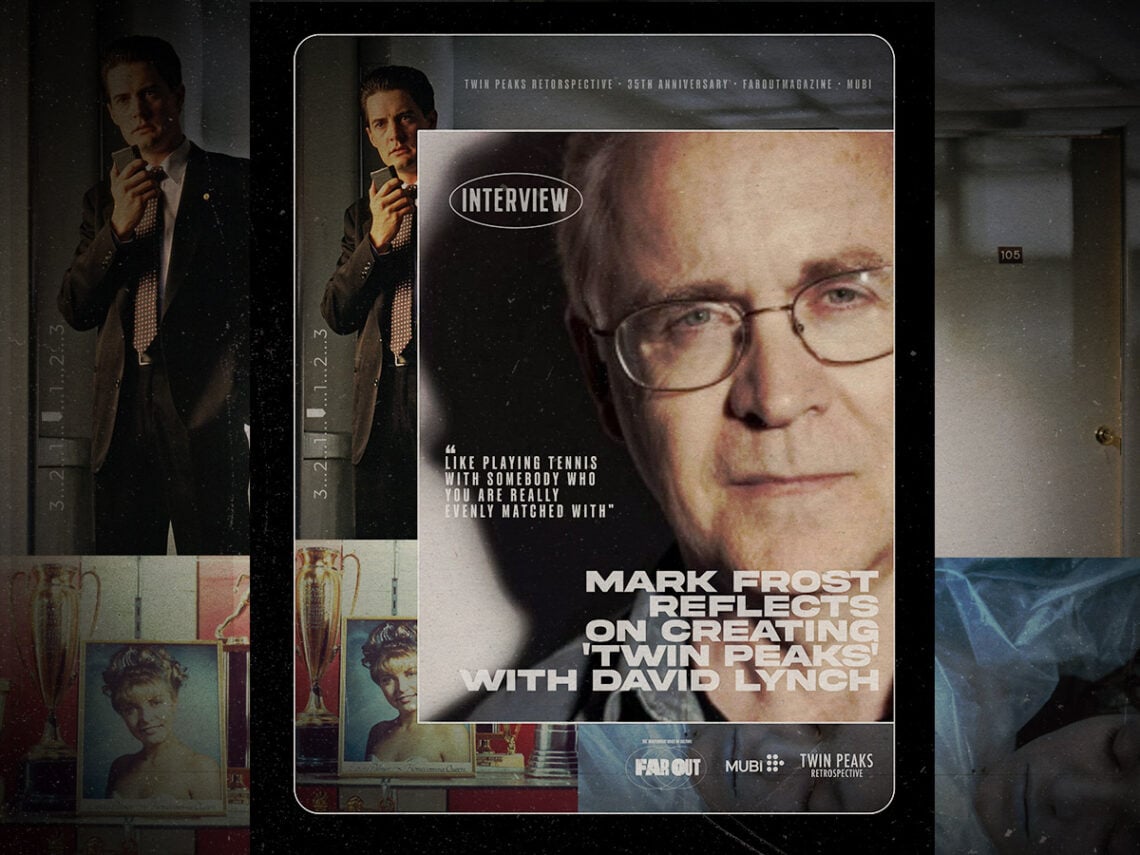
Mark Frost reflects on creating ‘Twin Peaks’ with David Lynch: “Like playing tennis with somebody who we were really evenly matched with”

Few television shows have endured with such cult adoration as Twin Peaks, which debuted on screens 35 years ago and is looking to captivate a new generation of fans when it premieres on MUBI on June 13th.
In the years that have passed, new generations have continued to fall in love with the surreal world conjured up by David Lynch and Mark Frost, enamoured by its bizarre blend of mystery, soap opera, and outright horror. With its intricate web of characters and complex plotlines, where abuse, infidelity, demonic entities, mythology, and alternative dimensions converge, Twin Peaks changed television forever.
In the first episode, we discover the body of high-schooler Laura Palmer, washed up and wrapped in plastic, and it’s her tragic murder that leads to the town’s unravelling. As Twin Peaks unfolds, you have to wonder how Lynch and Frost were able to pen such a haunting, poignant and complex tale. One can only imagine that it was like figuring out a 1000-piece puzzle, with the pair designing the pieces and subsequently slotting them together, and luckily for Frost (unlike Lynch), he had previous experience in television, which helped him get to grips with mapping out the town of Twin Peaks.
Discussing the creation of such a vast array of characters, Frost explained to me that “these were the pixels that made up the picture of Twin Peaks. We had built it out to over 60 characters by the time we were done, and that hadn’t been done very often in television at that point, so it made it a little different.”
The process of fleshing out these characters and story ideas came from endless conversations between Frost and Lynch – “We would talk for weeks, sometimes months, and in the case of The Return, really for a year” – as they planned out every minute detail of the plot: “It was always like playing tennis with somebody who we were really evenly matched with.”

Lynch and Frost were incredibly lucky to have found each other, and while they had their disagreements on ideas at times, everything had to be settled upon by both before it made it into the final script. “We’d have a lot of laughs, and we had the ability to let each other ruminate and think about what they wanted to inject, and then we’d give everything a very thorough vetting before we would let it go, almost line by line,” he said.
“We didn’t go on to the next line till we had the one before it sculpted the way we wanted,” Frost continued. “So it was a very painstaking process, but it was a lot of fun, and neither of us had ever worked that closely with another writer before, and I never have with anybody else.”
Frost knew that the pair had struck gold once they’d written the pilot, which is undoubtedly one of the best episodes of television ever made – and something Frost believes is up there with the finest pieces of work Lynch ever directed. “When we sat down to write it, it only took three weeks. [We] printed it, read it, and said… I think we hardly changed a word, right into the network. It was that quick.”
Lynch and Frost wanted to intentionally create something with real longevity, with the writer explaining, “While we were making the show, I kept telling everybody, ‘we’re trying to make something here that will last.’” He knew that “a lot of television is utterly disposable, and it’s sort of designed that way”, but Twin Peaks had to be something different. “Our feeling was, what if we just intentionally make this as something that people need to pay attention to, that they’ll get more out of it the more they put into it. And I guess it worked.”
So, while he admits that “you’d have to be a little crazy to think it would go on this long with this kind of intensity and this regularity over the years,” Frost and Lynch never really doubted each other. The long-standing allure of Twin Peaks can be found in its respectful exploration of topics that few television shows had tackled so head-on before, like abuse. Simultaneously, the use of comedy and surrealism has also prompted viewers to frequently return to this otherwise dark and harrowing world, where the smell of fir trees and cherry pie hides secrets that reflect the most painful and brutal aspects of humanity.
Injecting humour into such a serious narrative has to be done tastefully, but thankfully, it’s not something that Frost found too difficult. He believes that comedy seeped into his writing in an “instinctual” way because he didn’t want the show to be “unrelentingly grim”. He puts it well, saying: “Life is all of these things. It’s not just one thing all the time. It’s completely changeable from day to day, from hour to hour. So I think some of the best writing reflects that there’s a variety of human experiences.”

It’s the show’s fearless approach to such heavy and affecting topics that has made it such a classic, and Frost believes that it still resonates, especially with young people. “They relate to a world that is quite mysterious and at times absurd, and that has a palpable presence of evil. And I think that’s an accurate description of the time we’re in right now.” Yet, there’s a timelessness to these themes of mystery and intrigue, and Lynch and Frost looked back to the era of film noir when crafting the world of Twin Peaks.
“A lot of the stories that we drew from as a reliable way to tell stories were sort of half in the shadows. So, we wouldn’t look at them specifically, but we talked about them. You know, films like Sunset Boulevard, for instance, or Double Indemnity. These are all classic kinds of suspense thrillers.”
Having a strong script inspired by classic works of cinema is one thing, but casting the right actors to pull it off is another. Twin Peaks saw many of Lynch’s frequent collaborators show up, like Kyle MacLachlan as Agent Cooper, Jack Nance as Pete Martell, and Grace Zabriskie as Sarah Palmer. Frost believes Lynch truly had a special talent as a director to connect with his actors and subsequently squeeze incredible performances out of them.
“He had close friendships with all of them,” he explained, “He had a repertory company of people he liked to work with who show up time and again in his work, and I think that’s a signal of a strong director and a strong body of work.” The cast also included Frost’s father, Warren Frost, who played the reliable Doc Hayward, and the writer particularly loved penning his character’s lines – “that was no chore” – while he also had a particular “fondness” for writing Dr Jacoby “and obviously Cooper.”
For Frost, writing Twin Peaks wasn’t just about making a show that would push the boundaries of television. When it came down to it, it was a chance to bond with a like-minded artist, and he found a lifelong friendship in Lynch, who sadly passed away in January 2025 at the age of 78. “You don’t just talk about what you’re writing, you’re talking about the world and things that you’ve known or seen or experienced. So it’s a full kind of relationship that’s going on. That’s what I remember. That’s what I miss. You know? That was my friend.”
They were set to work on a film together that never came to fruition before Twin Peaks, but it seems as though everything simply fell into place. The pair’s collaboration stands as a landmark piece of TV, spanning multiple series, a prequel film, various books, and a third season set 25 years later. Blurring the boundary between television and cinema, Twin Peaks is a masterwork, and looking back, Frost is honoured to have been part of something so special. “I don’t have any regrets about it at all.”
All episodes of Twin Peaks launch on MUBI on 13 June in the US, UK, Latin America, Germany, Turkey, Italy, Netherlands and India.
