


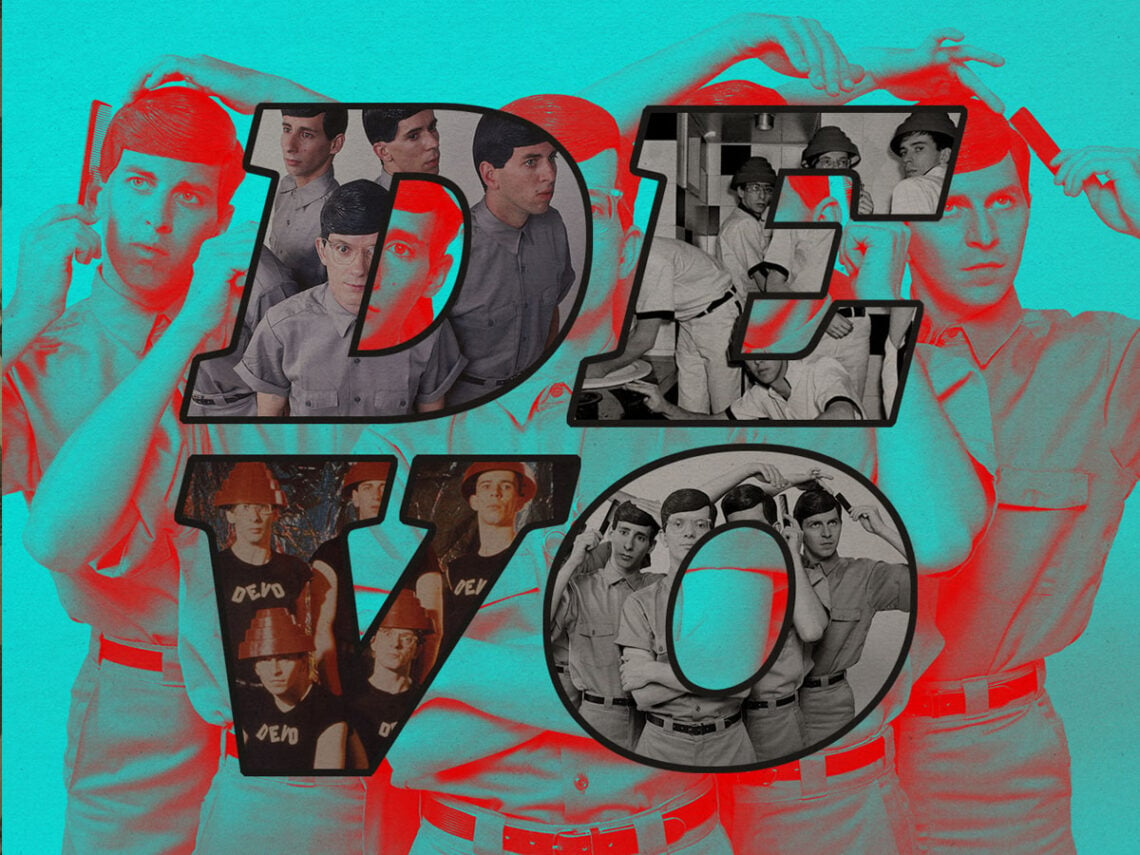
The origin story of Devo: “A long line of insane, cannibalistic apes”

“We weren’t cynical,” Devo co-founder Gerald Casale told Far Out in 2025, “We were just telling the truth, and nobody ever wants to hear that, and now it’s real. De-evolution happened, and here we are”.
To be clear, the validation of Devo’s worldview is not a recent, Donald Trump-era phenomenon. The men in the energy dome hats have been claiming ‘told you so’ since at least the 1990s, when Casale and frontman Mark Mothersbaugh pointed to everything from the Oklahoma City terrorist bombing to Mike Tyson biting off Evander Holyfield’s ear as the latest evidence of the accelerating de-evolution of Western society. Certainly, the White House hosting UFC fights on its front lawn suggests that trajectory has not altered. The question is, what planted this vision of approaching dread in the minds of a crew of white, middle-class kids growing up inside the idyllic suburban dream of Midwestern America in the post-war 1950s?
A good chunk of the Devo origin story is no different than dozens of other Baby Boomer bands: youngsters of the first television generation sitting cross-legged in front of their two-ton, black-and-white Zenith TV sets, watching in bewilderment as their carefully aligned antennas zapped in images of Elvis Presley or The Beatles playing on stages in New York City as throngs of teen girls screamed for them. But becoming a rock and roll band, like that, was never the guiding motivation.
The original Devo line-up of Mark Mothersbaugh, Gerald Casale, their respective brothers (each named Bob), and drummer Alan Myers (‘The Human Metronome’) all grew up in same place I did: Northeast Ohio, a mix of farmland and urban sprawl impossibly far away from both New York and Hollywood, but arguably more representative of the American ‘situation’ than any other portion of the country at any given time.
Devo formed in the shadows of the smoke stacks of the old rubber factories of Akron, Ohio, the longstanding international headquarters of America’s tyre manufacturing giants, Goodyear, Firestone, and BF Goodrich. It wasn’t a big city, but it was a thriving one from the 1920s into the 1950s, functioning in lockstep with the steel plants of Cleveland to the north and the auto factories of Detroit to the Northwest, providing loads of steady jobs, a reliable pension, and a sense of community. This area underneath the Great Lakes was known as the ‘Rust Belt’ by the time I was growing up in the 1980s, but the scene was shiny chrome for a good long while before that.
Akron wasn’t just nicknamed the ‘Rubber City’; it literally smelled like rubber, especially on a hot summer day, when the stink would carry for miles into the suburbs, happily ingested by lawn-mowing dads and gardening moms, knowing it was the putrid smell of prosperity.
On weekends, the future members of Devo could enjoy all the spoils of the 1950s American dream fully realised: parades down Main Street, the Goodyear Blimp flying overhead, and watching the trains carrying cereals out of the local Quaker Oats plant to the breakfast tables of the nation. Akron was home to the National Soap Box Derby, the World Series of Golf, and the Tournament of Champions in professional ten-pin bowling. The National Football Hall of Fame was just down the road in Canton. It was a sporty place, a flag-waving place, but like a lot of factory towns, it was precariously hanging in the balance, ever-dependent on its industrial overlords to keep the fires burning. Spoiler alert: they all eventually left.
That undercurrent lined up quite nicely with a lot of the other paranoias of 1950s America, from the increasingly violent struggles for Civil Rights to the Communist witch hunts of the McCarthy hearings and the fear of nuclear annihilation from the Soviet Union. The Mothersbaugh and Casale boys were part of the generation that practised atom bomb readiness drills in their school classrooms, huddling under their little wooden desks in a pointless exercise that succeeded mostly in terrifying thousands of Boomer kids rather than easing their minds.
By the time they’d reached their adolescence, all of these confusing contradictions between the American dream and its imminent nightmares came together with the assassination of President Kennedy. Now, the darkness behind the picket fence was impossible to ignore; check out any of the work of David Lynch for a similar dynamic.
If you were a kid in the mid-1960s, rock and roll was the most obvious outlet for rebellion against the conservative status quo, but Devo’s biggest inspirations, as Mothersbaugh has often explained, were more specific to the Northeast Ohio experience. In particular, there was the local, Cleveland-based late-night TV programme, Shock Theatre, hosted by a fast-talking, subversive beatnik character known as Ghoulardi. Played by Ernie Anderson, father of future film director Paul Thomas Anderson, Ghoulardi would present a weekly schlock B-movie, usually sci-fi, and talk over it with absurdist observations and his own distinctive, irreverent brand of humour. The show inspired a stunning number of future performers from the region, including director Jim Jarmusch, David Thomas of Pere Ubu, Chrissie Hynde of the Pretenders, and Lux Interior of the Cramps.
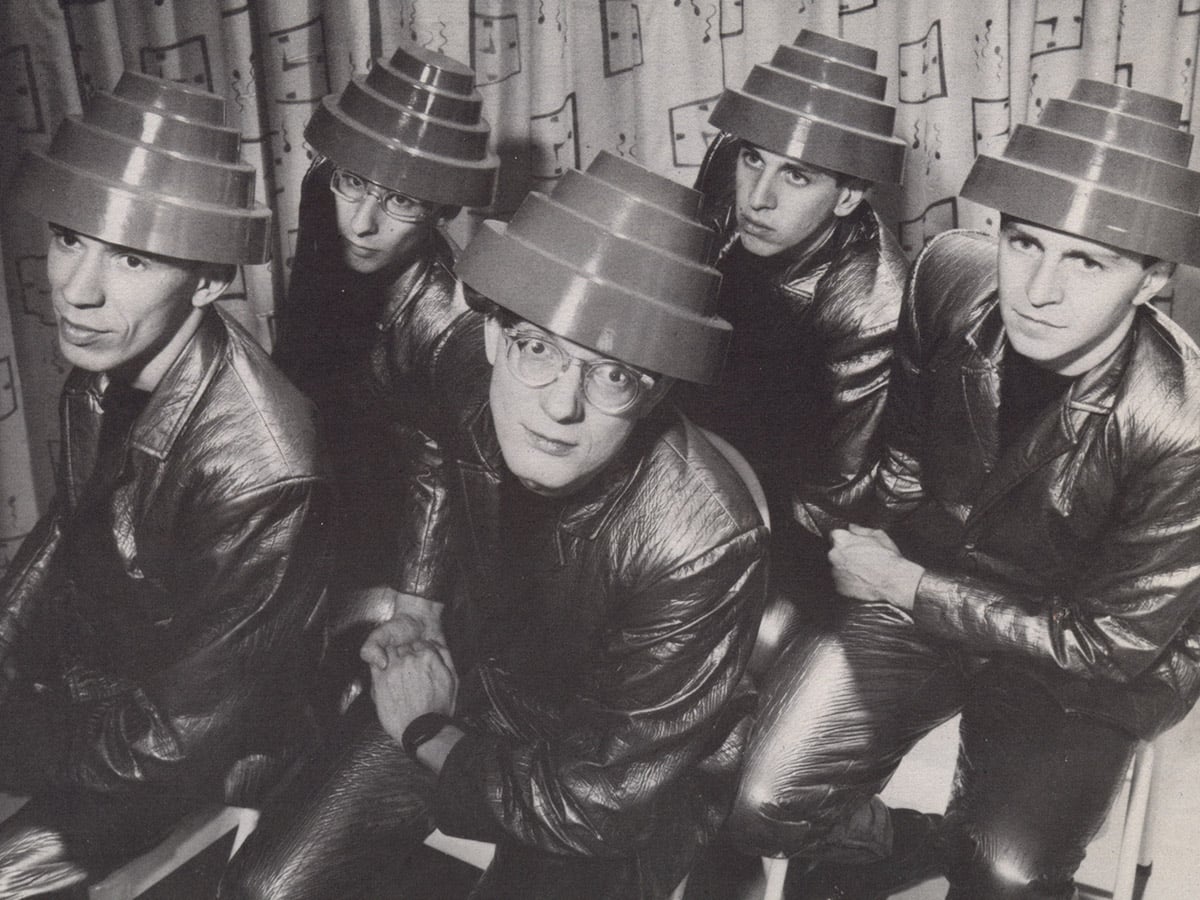
Devo carried the torch of Shock Theatre with the most seriousness, however, no matter how silly they might have looked doing so. Rather than being repulsed or amused by the aliens, monsters, and mutants in those low-budget movies on TV, Devo saw a reflection of their own reality at the tail-end of Akron’s slowly crumbling industrial heyday.
“I remember watching [the 1932 film] Island of Lost Souls,” Mothersbaugh told the Akron Beacon Journal in 1997, recalling one particularly important Ghoulardi broadcast, “There’s this scene near the end where there’s a revolt, where the subhumans, the failed experiments, as they called themselves, are rebelling. They lit the jungle on fire, and you see them running, at night, the fire is reflecting their shadows on the House of Pain as they run through the jungle, and you don’t really see them; you see their shadows. These hunched-over creatures, hobbling in pain and terror and chaos. And I remember at the moment feeling a camaraderie, and feeling like, ‘I’ve been there’.”
When Mothersbaugh later met Gerald Casale in the late 1960s as fellow students at Kent State University outside of Akron, the two quickly bonded over the shared influence of these kinds of films, as well as their similar views on the dystopic state of cities like Akron, as the American dream was beginning to fracture.
Casale and another classmate, Bob Lewis, had already developed the concept of de-evolution as an ongoing art project, meant as a form of comedic political satire. After four students were shot dead by the US National Guard during an anti-war protest on the Kent State campus in 1970, however, Casale and Mothersbaugh, who’d witnessed the tragedy, were inspired to take the ‘Devo’ idea more seriously, making it the impetus for a new music project.
“[Akron] worked as an art-directed backdrop for this kind of music we were making,” Casale said in 1997, “Because it had this hellish, depressing patina, this kind of a dirty latex layer that fills the air, and the people in Akron seemed, their spirits were depressed; they were desperate, their kids were kind of like the characters in Island of Lost Souls that rebelled in the pit.”
Mothersbaugh and Casale felt that the rebellious ‘freak out’ energy of the forgotten factory town kids aligned perfectly with some headier ideas from earlier European schools of art (Dadaism, German Expressionism), as well as the new twisted take on Americana coming from Andy Warhol’s factory.
“We had our very own backyard version of it; a rubber version,” Casale said.
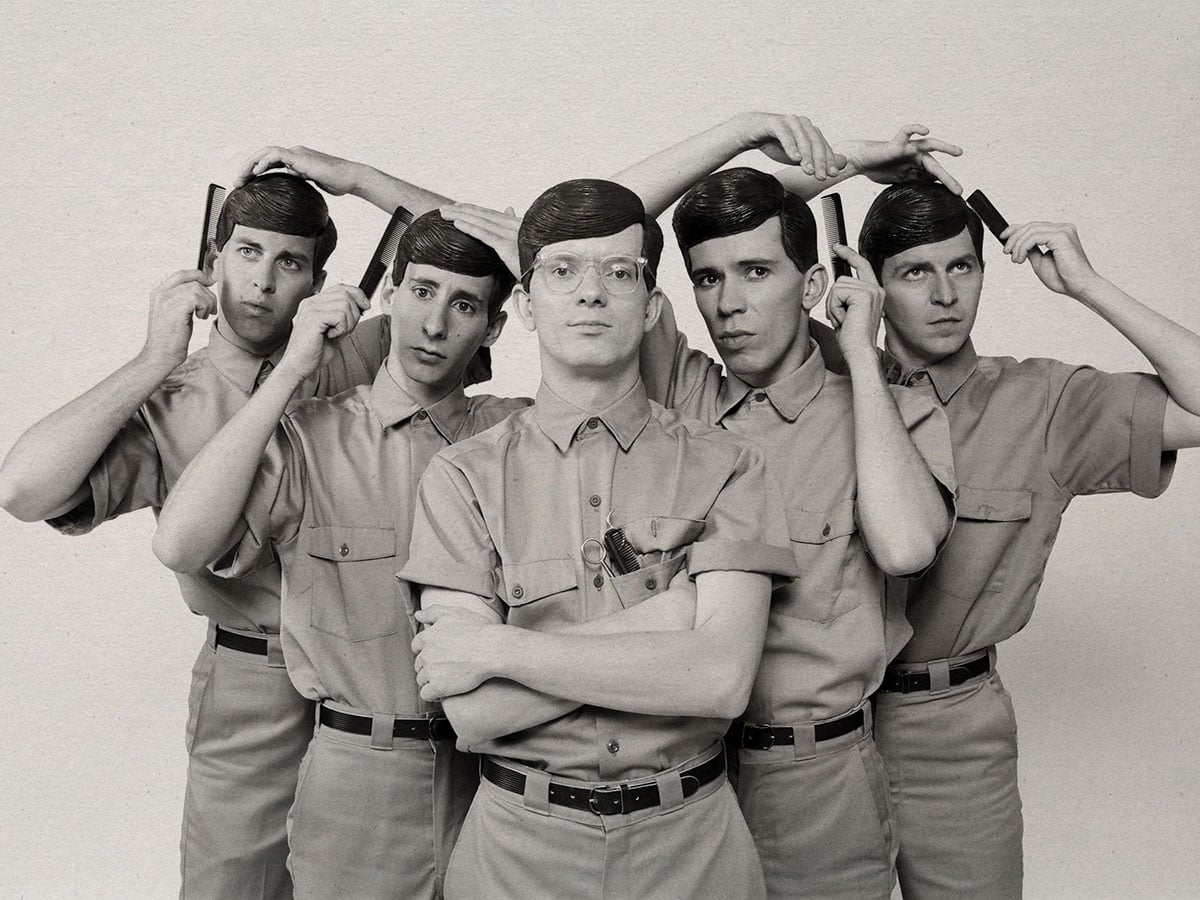
Naturally, once Devo started playing proper gigs with its recognisable five-man line-up in the mid 1970s, audiences weren’t always sure what to take away from a Ramones-esque punk band dressed like factory workers and behaving like androids. My parents saw them more than once during this era at a small club in Akron called The Crypt. They were friends with the drummer, Alan, and appreciated the urgency and precision of the music; the sense of humour, the social commentary, the relatable Akron-ness of it all. For the most part, though, the city of Akron didn’t want to deal with its own creation, and courted by the likes of David Bowie and Neil Young, Devo soon fled their Ohio nest for greener pastures.
Even out in the bigger world, though, their unique origins and worldview made the band hard for outsiders to completely grasp. Was it comedy? Tongue-in-cheek? Wearing matching jumpsuits and flower pots on their heads surely wasn’t intended as a way to be taken seriously, right?
For the better part of 50 years, though, Devo themselves have always maintained that they were and are deadly serious, especially about the theory at the root of their project.
“We believe,” Mothersbaugh said at the height of the band’s fame in 1981, “that man quite possibly devolved from a long line of insane, cannibalistic apes that found, by eating the brains of other apes, that they enhanced their own sexual power. But the byproduct was, it caused the brain to expand at a faster rate than the cranium, thus making them insane, and unnatural, and totally out of sync with the rest of the planet.”
Mothersbaugh argued even back then that 95 per cent of insane mutant apes, AKA humans, were beyond hope, but Devo were there for the other five per cent. They were Trojan-horsing themselves into mainstream pop culture via their energy domes and embrace of commercial jingles, but their underlying message was dire.
“There’s a lot of information out there,” Mothersbaugh said, “But what you have to do is look at it like an alien. You have to really analyse it as if you’re looking at something as foreign to you as an African tribe, for instance. You need to get the pygmy’s perception of Madison Avenue, which is probably more right on it than the majority of people in the United States.”

Never Miss A Beat
The Far Out Punk Newsletter
All the latest Punk content from the independent voice of culture.
Straight to your inbox.