


De-evolution, buckets of sweat, and 50 more years of Devo: “We’ll be the ones in the red hats and the yellow suits”

Ever since the space age, UFO sightings have been on the rise in the American Midwest, as sleepy rural towns look to the stars for some kind of Patricia Laffan figure to descend from the cosmos. In the midst of all those sightings, though, it is difficult to tell which spaceship landed Devo in Akron, Ohio, back in the 1970s.
Armed with theories of de-evolution, an intrinsic knowledge of American society, and a penchant for performance art, the seemingly tireless minds of Gerald Casale and Mark Mothersbaugh birthed Devo in 1972, and over the past 53 years, the outfit has remained one of the most individualistic, innovative, and bizarre groups to ever grace the airwaves.
From the subversive genius of Q: Are We Not Men? A: We Are Devo, to the misunderstood smash hit of ‘Whip It’, and the band’s litany of extra-curricular activities, which have seen members invade the worlds of advertising, film-making, and composition, Devo have done a lot of things, but they’ve always done them their own way. Even if those unshakable principles never afforded the band much in the way of commercial success, they did amass legions of similarly outcasted, disenfranchised devotees.
Speaking to the enduring influence of the group, even as they embark upon what is being billed as potentially one of their final tours, Netflix recently unveiled a feature-length documentary delving into the rich and at times unbelievable history of this strange outlier of a band. And it was the release of that documentary that meant the faces of Mark Mothersbaugh, Gerald Casale, and Bob Mothersbaugh were beamed onto my computer screen from the sunny surroundings of Los Angeles to discuss the past, present, and future of Devo.
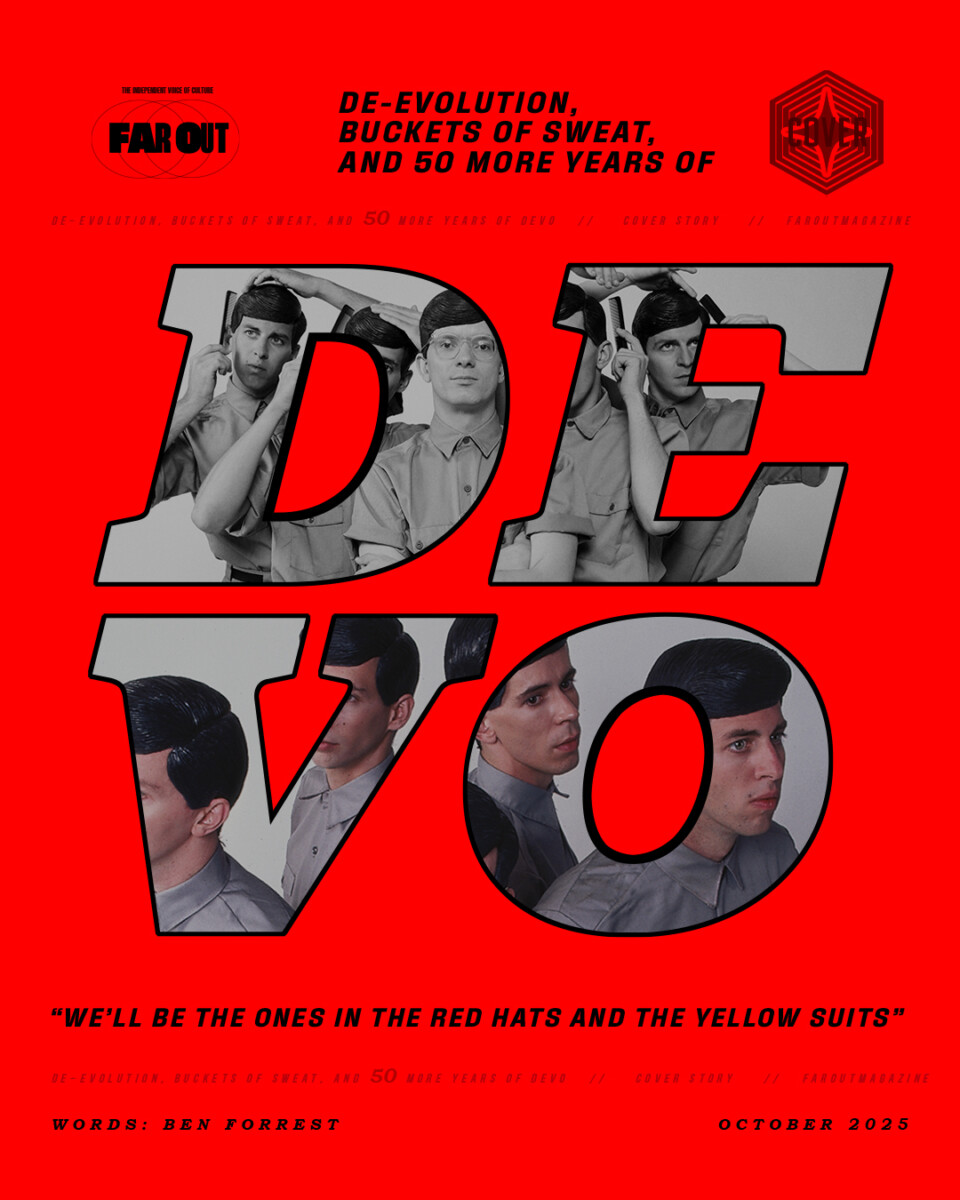
“I think it’s just coincidental. It just happened because it finally happened, and probably had to happen was probably now or never,” Casale told Far Out of the Netflix documentary, which has reportedly been in the works for quite some time. Devo differs from virtually every other band, either past or present, both in the nature of their output and in the motivations behind their work, which is something that the film handles very well: the concept of de-evolution.
Essentially, the crux of the theory is that humanity is moving backwards, devolving into a society devoid of morals or intelligence, and marked by overconsumption. Devo saw that process happening in the 1970s, as political corruption ran rife and American society fell into rapid decline, leading one television presenter to ask, “Aren’t you a little young to be cynical?” during one clip included in the documentary.
“We weren’t cynical,” Casale told me, setting the record straight, “We were just telling the truth, and nobody ever wants to hear that, and now it’s real. De-evolution happened, and here we are.”
Mothersbaugh laughed, “No, everything’s better now, though, that’s the important…that’s the great thing. All the problems are solved,” before adding the regrettably vindicating statement, “We were hoping we were just paranoid.”
Now, perhaps more than ever, the content of Devo’s material rings undeniably accurate, and perhaps that is why there is such an appetite for the power-dome-donned group to continue performing in the modern age.
“It takes a long time to say goodbye”.
Gerald Casale
Conversely, when they first emerged from Akron, Ohio, in the 1970s, the American mainstream didn’t know what to make of the band at all. “That’s what excited us. That made us laugh, that juxtaposition of the two worlds colliding, and it was very entertaining,” he shared, remembering the band’s unlikely appearances on shows like American Bandstand. “We were aliens, not alienated. We were just looking at the prevailing culture, almost like alien beings would observe another species.”
One of the prevailing methods Devo used to achieve that extraterrestrial appearance was their stage outfits. Even in their earliest performances, shared in the Netflix documentary, the band were already wearing industrial workwear and masks, and that soon developed into those iconic yellow hazmat suits, sleeveless turtlenecks, and a plethora of otherworldly getups.
“A lot of it just came from economics and DIY, because we can’t afford expensive costumes,” Casale revealed, noting, “What can we find that, you know, doesn’t cost a lot, but has a unique look and works onstage? That’s why we went with work wear and industrial wear, because we could get them back then for $2 a suit and then dispose of them, you know, they were disposable.”
It just so happens that I have some experience in that field, owing to a doomed Halloween costume from two years ago in which I donned disposable yellow coveralls and a power dome, and my prevailing memory from that night was one of rather intense heat. “They kept us thin,” Mark Mothersbaugh chuckled.
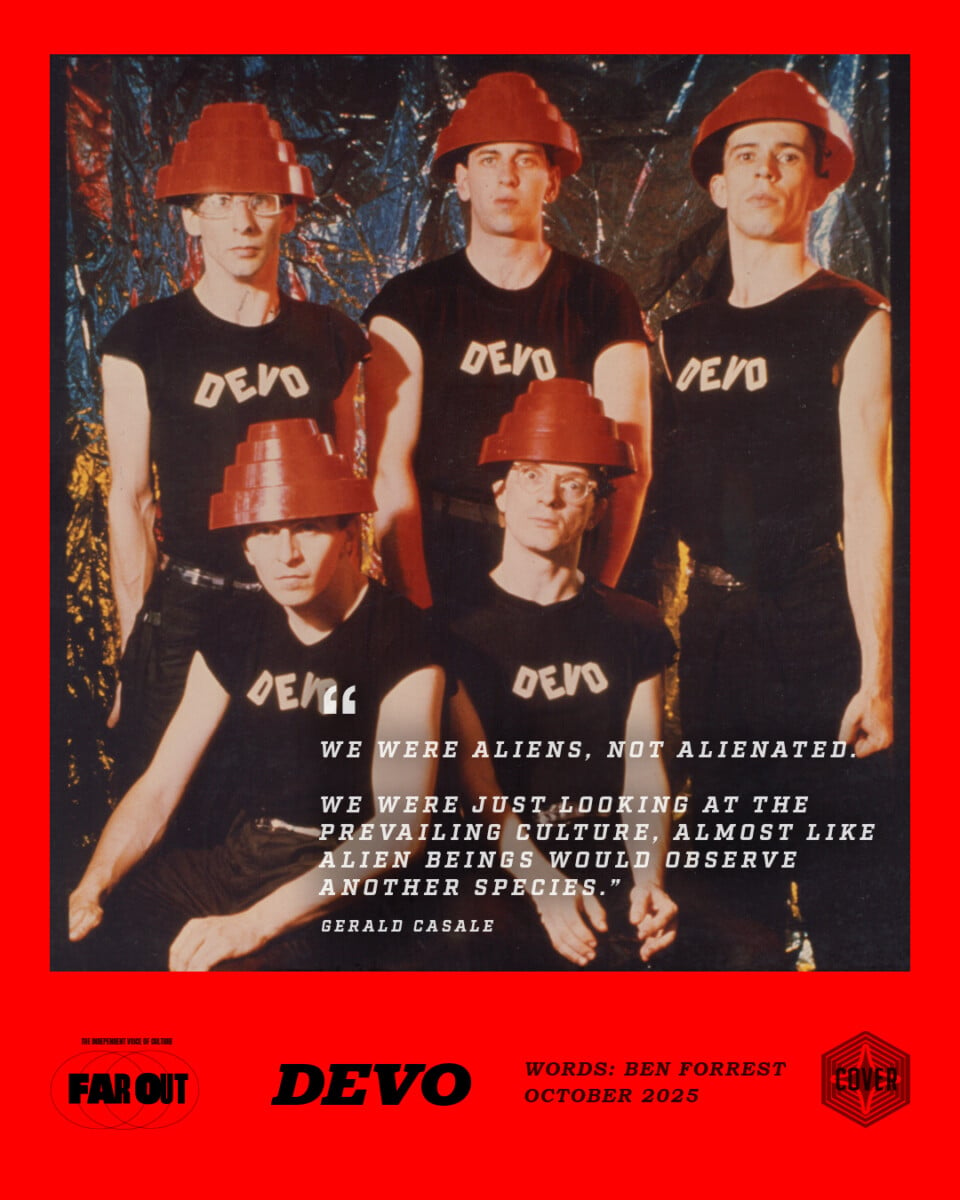
“We were masochists,” Casale chimed in, “We would probably lose three or four pounds some nights, because it would literally pour out of the sleeves, like a pitcher, because of the hot lights on stage.” So, if you are planning your own Devo costume for this October, maybe opt for their ‘Whip It’ era turtlenecks instead.
On the topic of that 1980 single, the song played a major role in the history of the band, becoming their biggest hit and introducing the musical mainstream to their unearthly output. As Mark attests to in the documentary film, though, “People heard ‘Whip It’ and went dancing,” without paying much attention to the actual meaning of the song, which was a pastiche on the worst aspects of American society.
“Well, whenever we explained, you know what it meant, we would bum people out,” Casale remembered with a smile, “They wanted it to be about S&M and masturbation. So we just kind of let that go.”
Still, at least ‘Whip It’ was exposed to widespread audiences, in stark contrast to a lot of the band’s other, arguably stronger, material. “I hear songs that should have been to me, huge radio hits, like ‘Uncontrollable Urge’ and ‘Gates of Steel’ and ‘Beautiful World’ and ‘Jerkin’ Back ‘n’ Forth’,” Casale highlighted, “I listen to the structure of those songs, of the composition, the changes, and I go, ‘what happened?’”
It could, of course, have been the simple fact that Devo were operating far too ahead of their time, something which was also reflected in the band’s ahead-of-the-curve adoption of filmmaking. Some of the band’s earliest projects came in the form of films, and they continued to create accompanying videos for their music in spite of complete confusion on the part of the record labels in the years before MTV hit the scene.
“We were dedicated to a multimedia approach. We were avid film buffs, and we wanted to make short films”.
Gerald Casale
“We weren’t making music videos. I mean, there was no name for that, and there was no outlet for that. The record company goes, ‘Why do you want to do this? What are you going to do with this stuff? This is stupid,’ and it turned out not to be stupid at all.” Another point for Devo on the vindication tally, it would seem.
They weren’t the only group doing things differently back in the 1970s, of course, and their upcoming tour of North America will see the group unite with The B-52’s, another band which is often lumped in with the punk rock boom of the mid-1970s despite sharing no sonic or visual similarities to the landscape of safety pins and bondage trousers. “Even though we’re very different, we’re both unique,” Casale said of his touring comrades, “There’s no other band that sounds like The B-52’s. There’s no other band that sounds like Devo.”
Despite their musical disparities, the two bands do share some things in common, as the songwriter shared: “What the B-52’s were singing about, and what we were singing about, we were appealing to marginalised demographics, and outsiders, and people that felt disenfranchised in general. You know, they were not accepted by the mainstream jock culture.”
He added, “The B-52’s now have a very strong LGBTQ following, and Devo has a different kind of outsider following that overlaps.” I pushed to see exactly how he’d quantify Devo’s following, partly hoping to uncover a new way of introducing myself to strangers, and the bassist laughed, “Mutants, spuds, maybe the libertarian bent; in other words, independent.”
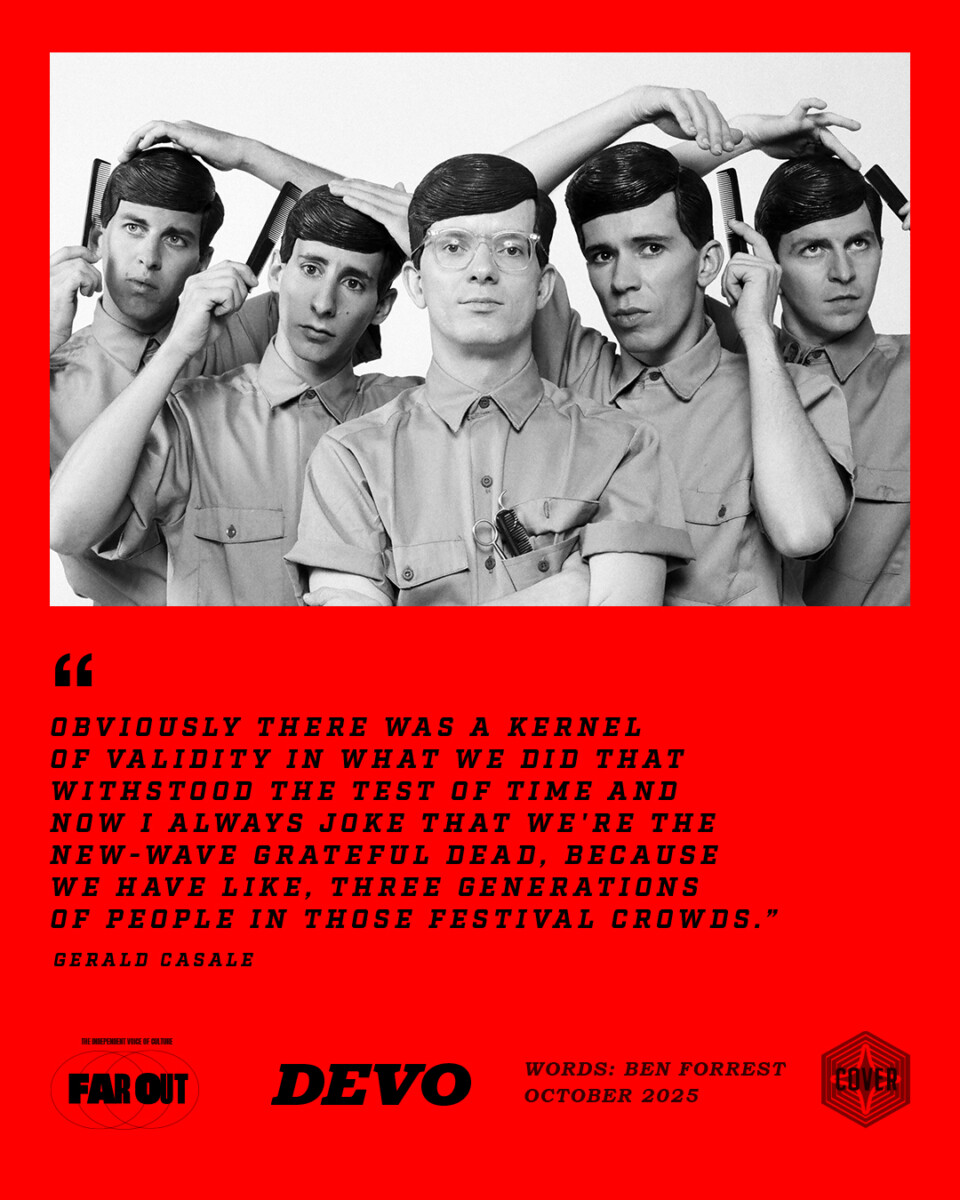
Regardless of names, that cult following has certainly grown in recent years, as more and more young people become exposed to the timeless mastery of the group, creating an interesting cross-section of society in the band’s crowds.
“Well, obviously, there was a kernel of validity in what we did that withstood the test of time,” Casale theorised, “And now I always joke that we’re the new-wave Grateful Dead, because we have like, three generations of people in those festival crowds.”
All of those generation-spanning mutants and spuds will presumably be out in full force at the Devo-B-52’s co-headline tour, which, as of yet, has no scheduled plans for a European leg (despite my pleading). When the band last visited UK soil, their shows were branded as a farewell tour, but that was over two years ago now. “It takes a long time to say goodbye,” Casale mused, “We still haven’t played about 50% of the markets that want us. So we keep moving through those.”
“Who knows? Maybe we got another 50 years. We’ll see how far we can go,” Mothersbaugh added. One can certainly hope. For now, though, Devo’s legions of spuds across the globe can take comfort in the band’s willingness to keep going, continuing to preach de-evolution theory and endlessly innovative musical excellence for years to come.
As our time together drew to a close, Mark Mothersbaugh signed off with, “We’ll be the ones in the red hats and the yellow suits.”
