


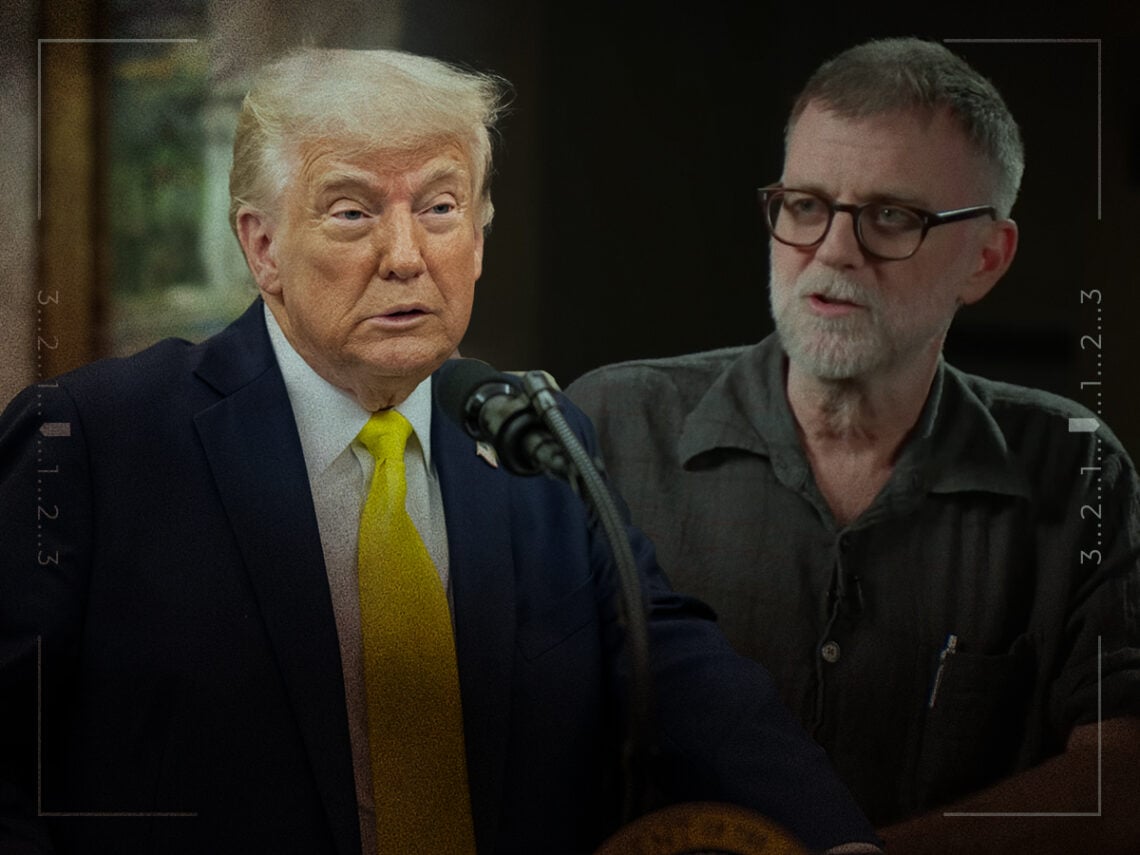
How Donald Trump disrupted a Paul Thomas Anderson movie: “It was a rocky start”

When Donald Trump was elected as the 45th President of the United States in 2016, everything changed. A country already at war with itself was plunged deeper into chaos, his bigotry forming a harsh cloud over everything that has only gotten more grey, more hopeless, over time.
Trump’s election – and his unfortunate re-election in 2024 – has affected everything, and with cinema holding a mirror up to society, you can see his influence in many modern movies, directly in films like political satires such as Don’t Look Up or, less obviously, in films like Paul Thomas Anderson’s 2017 drama Phantom Thread.
When you watch Anderson’s movie, a period piece set in 1950s-era Fitzrovia in London, where an upper-class dress designer named Reynolds Woodcock forms a relationship with a waitress, Alma, who becomes his muse, Trump doesn’t even come into the picture. Set not long after the Second World War, the setting feels far removed from President Trump, and from the United States, for that matter.
But the masculine power that Reynolds exerts, presuming that he will be able to control Alma because she is of a lower class and lower status than he, and because, of course, she is a woman, takes on a timeless relevance.
Anderson’s nuanced portrait of masculinity is one that highlights Reynolds’ snobbery, his high opinion of himself, and his assumption that people will bow to his every demand. Yet the director draws our attention to his weaknesses, revealing the instability at the heart of such patriarchal control.
His exploration of gender is as relevant to the Trump era as it is to the film’s 1950s setting, with Anderson explaining to the Guardian that the movie’s themes seemed to resonate with the changing modern political landscape, albeit accidentally. “You really can’t account for what the world’s gonna be. Back when we started this story, I didn’t think Trump would be president; I didn’t know where Harvey Weinstein’s life was headed. And here we are,” he said.
As filming began, so did Trump’s presidency. His inauguration collided with the first day of shooting Phantom Thread, and with Anderson incredibly disappointed with Trump’s victory, the new President cast an even darker shadow over the movie that extended beyond the film’s astute exploration of masculinity.

“It was a rocky start. The concentration the first couple of days was not there,” Anderson admitted. Phantom Thread wasn’t the easiest of shoots. It marked the filmmaker’s first film as a cinematographer, following his falling out with his long-term DOP Robert Elswit, while Daniel Day-Lewis admitted that living and filming in a small townhouse, which he described as being “like a termite nest”, made for a tough time.
Still, the movie wound up earning various prestigious Academy Award nominations, including ‘Best Picture’, although it only won one accolade overall, ‘Best Costume Design’. Phantom Thread remains one of Anderson’s finest works, one that stands as a stunning depiction of an unhealthy relationship marred by toxic masculinity, grief, and the oppressive gender roles that not only shaped the 1950s but still resonate today among the Trumpian hellscape.
