



“A democratic project”: José González is encouraging AI while championing the human

In November last year, José González posted a selfie on Instagram, followed by several snippets of a new music video, and at first glance, the entire thing was harmless, but further investigation revealed that the comment section was overflowing with disappointed fans pledging to unfollow the 47-year-old.
Turns out the music video for the new, light-hearted song ‘Pajarito’ was made entirely with artificial intelligence. In the clip, two Swedish archipelagos in late summer bumble around being “clumsy, cute, and adorable”, as per the prompt González uploaded into Sora and VEO. A comment deeming the ethics of the video “terrible” received over 200 likes.
In conversation with González about his new album, Against the Dying of the Light, I broach the subject with an open mind: “I used to work in data and AI myself,” I tell him, ready to get shut down in the same manner as many other musicians, who scramble to ignore the topic altogether.
Instead, González’s eyes light up. “How long do we have?” he smiles. The singer-songwriter talks me through his AI approach, which is equal parts concerned and curious, as well as his own lyrical experimentations with ChatGPT (which made it onto the new album), and his stance on the “inevitability” of AI music in general.

“We don’t want to create things we can’t control”
González admits that he was surprised by the backlash to his AI experiment, which he thought was “harmless”. We all know the dangers of social media providing a limited snapshot of a complex issue, and it appears González followers weren’t aware that the star is appropriately panicked about the technology, which is, he posits, exactly why the experiment came about.
On album opener ‘Perfect Storm’, the musician is pragmatic in airing out his grievances against the universal, increased uptake in AI usage: “It’s a numbers game, ignoring all the combined tail end risks, gambling with our common fate to quench the thirst of a few. No time for the masses to be informed, to have say,” he sings.
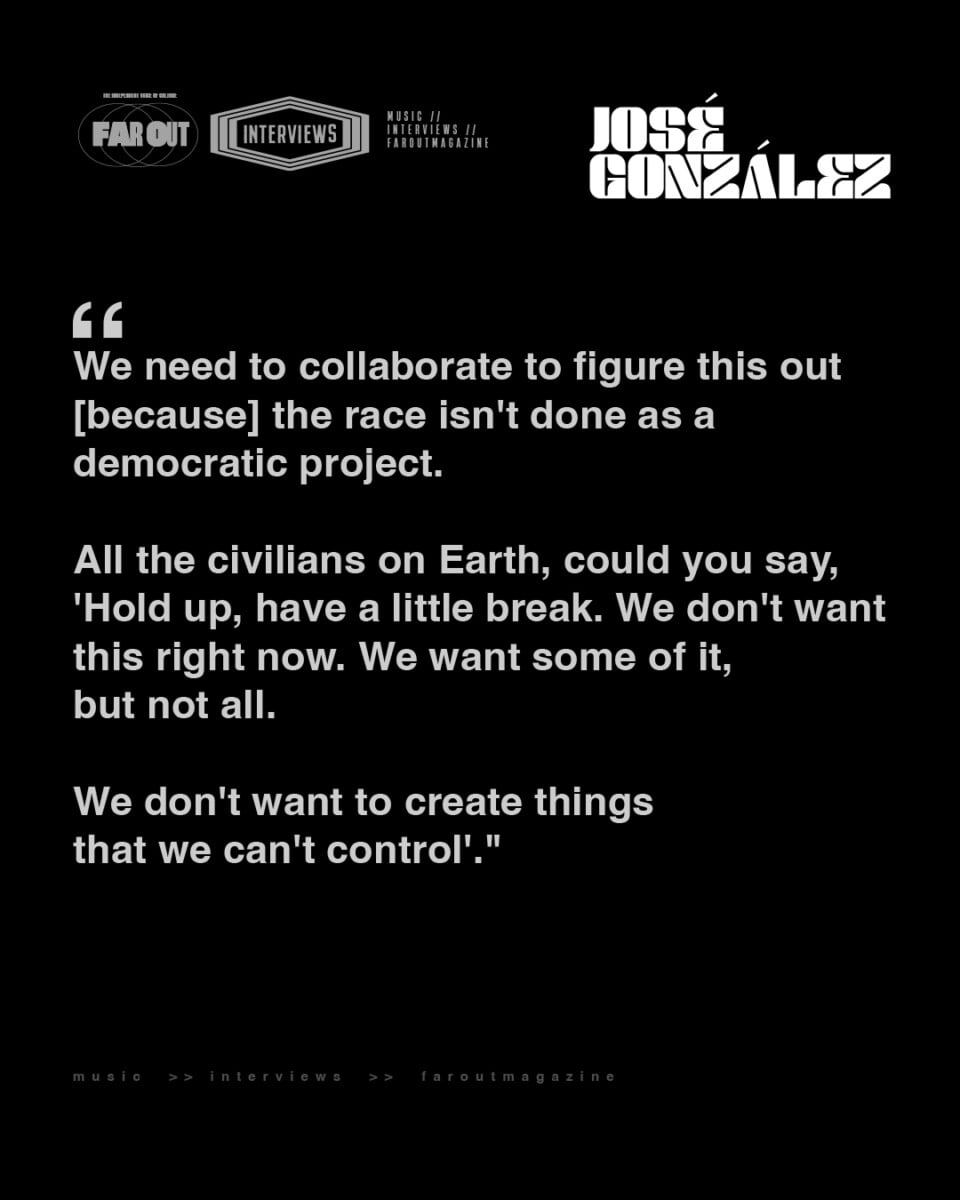
This is an echo of what the singer-songwriter repeats to me: “We need to collaborate to figure this out [because] the race isn’t done as a democratic project. All the civilians on Earth, could you say, ‘Hold up, have a little break. We don’t want this right now. We want some of it, but not all. We don’t want to create things that we can’t control’.”
González deems this a “very blunt” opener that highlights one of the album’s key themes picked up again on ‘Losing Game’, where the artist warns humanity that we’ve taken the wrong turn, and we’ve lost control. Unlike most other key players in the industry, he has an acceptance that the technology is here to stay. We are here now; instead of fighting for a way to turn back time, we might learn to deal with the current reality.
As such, the cutesy archipelagos were a “way of showing that I’m curious about this new technology”. He’d learn the hard way that this is a bigger threat to the industry than he’d first thought. González and I agree that the technology discussion lacks nuance: You can be for or against AI, but God forbid you straddle the two. This is too nuanced a take for our algorithmic society.
Robots, AI playlists, and human connection
González is different from many other musicians I’ve discussed this topic with, as he’s more clued in and concerned about AI as a sociopolitical, technological threat, and less concerned about AI as a threat to the industry.
“The concerns range from existential risks,” he shares, “To people losing their jobs, to social unrest, to bad actors creating novel viruses and causing pandemics”. When I ask him about AI music in light of Bandcamp’s recent decision to remove AI from their platform, it seems like an afterthought.
“It makes sense to just like cater to different tastes,” he muses of the pro-AI on streaming platforms stance, “Some people will want whatever music sounds good in the background, and it will just make a perfectly curated playlist for you. Some people will want that, and some people will just want real humans singing, real humans playing.” González doesn’t care for the difference between the two.
When I suggest that this will just push music listeners towards AI music, he suggests this is only “inevitable”. He explains that, cost-wise, “If someone is making an advertisement, they might choose a cheaper AI option instead of hiring musicians”.
At odds with my own belief, the singer-songwriter believes that the issue of AI’s ability to predict and concede to base human desires, and therefore become an addictive tool and gain power over human music, is an issue that will just “sort itself out”.
With a hopeful smile, he adds, “We’re already seeing that people value human interaction and authenticity; they want to go to concerts, to connect with real artists, to know the story behind the music”.
Therefore, he clarifies that lower down on his concern list is “AI making music that sounds better than mine… but then I’ll play live, and hopefully the robots won’t replace that human connection”.
Lyrical collaborations with ChatGPT
It’s a bold stance from an artist whose career spans over two decades and has afforded him a loyal fanbase. However, this position shows less consideration towards new musicians, who are already battling with the toils of an underfunded industry and are in no need of a new enemy to take on.
Though González actively bemoans the “race between the magnificent seven plus China” for control over AI, his own technological openness led to an unlikely lyrical collaborator on the album: ChatGPT.
He reveals that the last song of the album, ‘Joy (Can’t Help But Sing)’ was written with his “assistant”, as he prompted two different models of Chat GPT to innovate within specific lyrical parameters. It’s initially shocking, but not unheard of; this kind of AI collaboration has been championed by the likes of Boy George and Charlie Puth.
He prompted the AI tool with rules such as “the first verse should be about this, the second should be about this… So 4.5 was actually way better than 4.0,” he explains, “All of a sudden it could actually rhyme and had the right amount of syllables.”
“I still had to prompt for a very long time and did a lot of editing,” he is quick to add.
This goes some way in speaking to what González figures the future of AI in the industry will look like: “We’re entering a time where we will have lots of hybrids,” he muses, suggesting that a track may be entirely human-made save for a bassline or, as exemplified through his own experimentation, an AI model might be a quiet co-collaborator. This, as the next logical step, should be embraced.
Despite the ‘Heartbeats’ singer’s concern for the future, his hypothesis is one of eventual peace between AI models and human creativity. The battle isn’t between AI and creativity, he suggests, but between the high-power elites and the average man, watching on, helpless against the dying of the light.
