


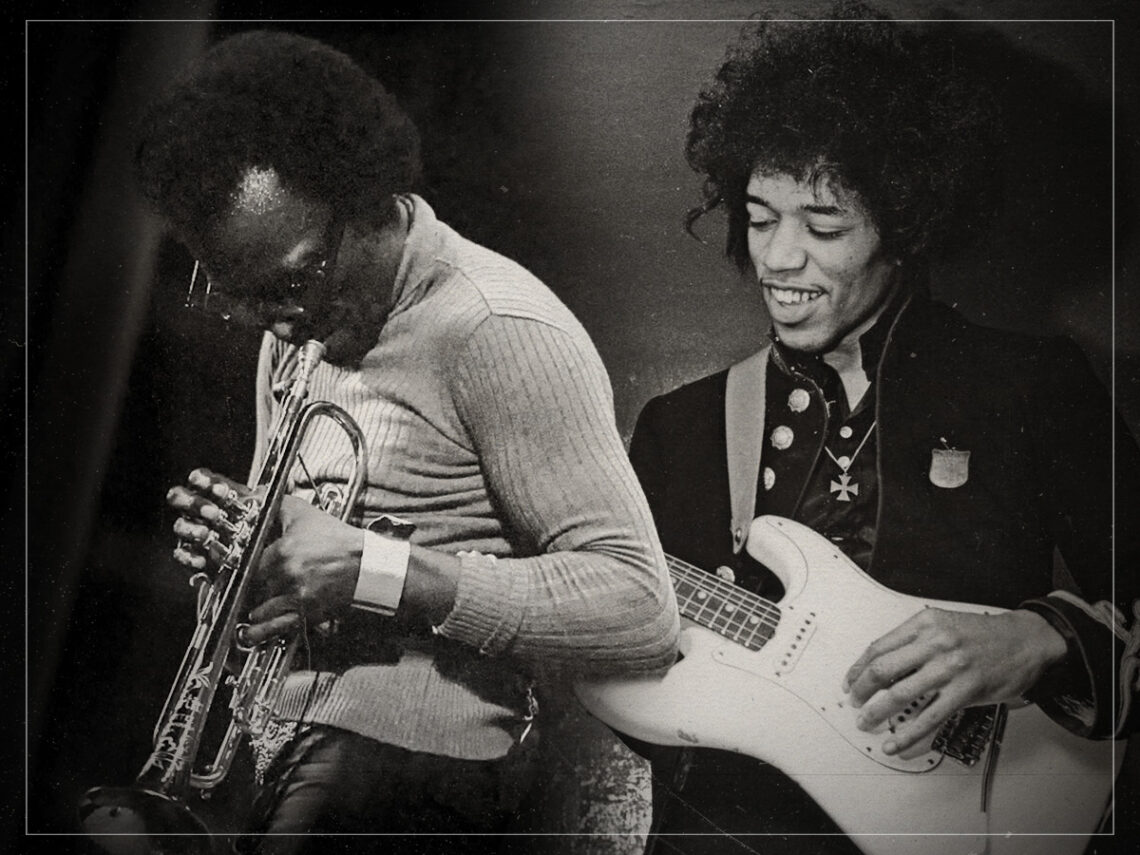
When Miles Davis paid tribute to his rock equal, Jimi Hendrix

While Miles Davis may have carefully cultivated an intimidating public image, there were plenty of musicians he also liked.
Of course, for someone as brilliant as him, the bar was relatively high, as the master of jazz was a ruthless leader, firing band members if they failed to meet up to artistic standards and expected everyone to live by the same philosophy as him, which was that jazz had no mistakes. Thus, he demanded a level of genius from his band, forcing them to cover up imperfections and turn them into new ideas.
He operated on a creative frequency that only few in the world understood, and so his respect for those around him was reserved for only those capable. Unsurprisingly, one such man was Jimi Hendrix, who came in and injected music with freshness right as Davis needed it most.
Because in 1967, Davis was somewhat artistically confused, making records with his second great quintet that just didn’t sell like his earlier work. The band felt stuck in the mud somewhat, playing old tunes to popular reaction but failing to scratch any innovative itch in doing so. During that period, he began bouncing around Chicago’s blues clubs in search of ideas when his girlfriend, Betty Mabry, introduced him to Jimi Hendrix.
Davis marvelled at Hendrix’s ability to infuse rock and roll with this new soul-influenced sound and so decided to nearly lift one of his ideas as a way of changing his own approach to recorded music. So on his record Filles de Kilimanjaro, Davis began plugging in some of the band’s instruments and set about interpreting Hendrix’s classic ‘Wind Cries Mary’.
On his track ‘Mademoiselle Mabry’, an ode to his girlfriend Mabry, Davis’ introduction rearranges the chord progression of Hendrix’s harmonic rock ballad opening and turns it into a jazz-fusion hybrid that then later spirals into typically Davis-style improvisations. It’s perhaps the closest thing to imitation you will ever find from him, but it shows him adopting it in a rather nuanced fashion that evidences his appreciation for the great guitarist.
It then sparked a relationship of mutual appreciation that later resulted in a hidden jam session between the pair. At the end of the decade, Hendrix was hanging out with singer Terry Reid when a knock at the door resulted in Hendrix informing Reid that he was simply waiting for a friend.

He recalled how the enigmatic Davis then walked in, and after a near wordless conversation, the pair grabbed their respective instruments and engaged in a jam for the ages. “It was truly beautiful,” he remembered, “It was tasteful playing, nothing showy, or over the top. In the jazz context, Jimi was still pushing the limits, and all those jazz guys respected him like they respected no one else in rock.”
It’s a moment that has to simply be left in the memory of rock and roll, with no one but Reid really knowing what it was like that day. Two unmatched legends of music history, conversing with each other in only the way they knew how.
