


The story of Johnny Cash’s first prison show and the career it would launch

Inspiration is a chain, an ever-running stream where everything is tossed in, and everyone is fishing. No one ever really knows how even the smallest moment might inspire the biggest things, like how one bold concert put on by Johnny Cash could have such a momentous knock-on effect.
In 1958, Cash had an idea. Throughout the ‘50s, the country singer seemed to be gaining the public image of an outlaw, being painted as the rebel of his genre and in his songs, he was playing into it. ‘Folsom Prison Blues’ was released in 1955 as one of his first big hits, but despite singing about incarceration and routinely referencing lawbreaking and jail time in his music, he never served any time himself.
At most, Cash got some misdemeanours, including one for literally picking flowers from a private property. It’s not exactly the hard crime or the hard time he sang of, and perhaps part of his idea to play a show in prison was born out of a slight guilt; he was using these people’s lives as lyrical inspiration, but he knew he couldn’t understand it at all.
But inside the walls of prisons, inmates could understand him perfectly. More and more, people serving time were requesting his songs, asking their jailers to get the vinyl to play in rec rooms, and when Cash heard about this, an idea began to form, which led him to want to play the songs for them live.
Overwhelmingly, the connection between Cash and prisons is most commonly thought of through Folsom Prison, the one he sings of in his song, and the venue where his 1968 prison show was recorded and released as one of his most well-known albums. But it became a whole decade earlier, in 1958, when he played his first prison gig at San Quentin in California.
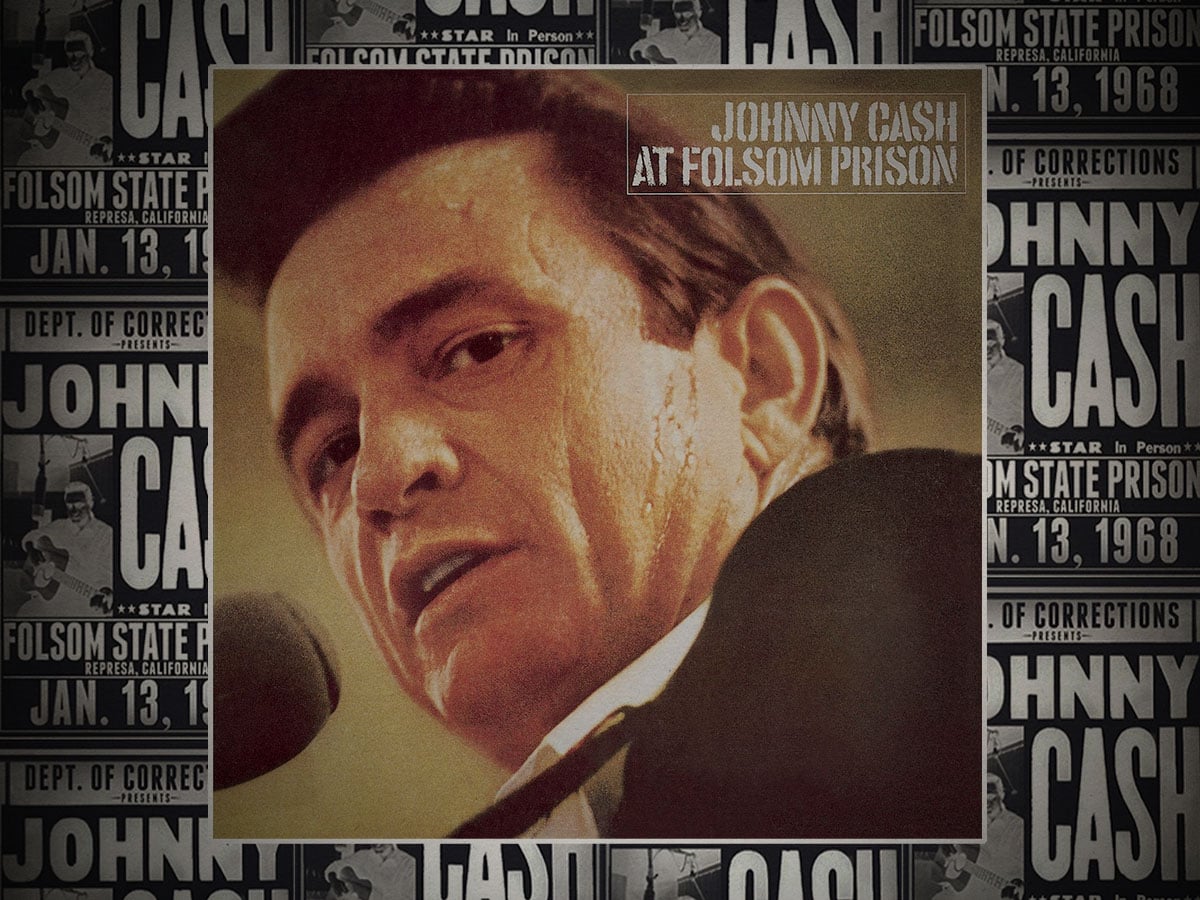
Later on, a repeat show at the same prison in 1969 would be released as a live album too. This run of prison shows, and the press it brought, would boost Cash at a time he was stalling in the mid-1960s, having a big impact on his own career.
But, as we said before, inspiration is a mythical thing, and the effect of something is never as simple as a neat knock-on effect, so the impact of this first San Quentin gig sprawled outwards, beyond Cash and into the career of someone else, and that was Merle Haggard, who just so happened to be in the audience.
It feels wild to say that serving jail time could ever be fate, but the fact that Haggard was transferred to San Quentin only three days before Cash’s show on the 23rd February surely has to be cosmic timing.
Everything changed then. As a barely-adult caught up on a bad path, Cash inspired Haggard in that instant. “He had the right attitude,” the future country star recalled, “He chewed gum, looked arrogant and flipped the bird to the guards. He did everything the prisoners wanted to do. He was a mean mother from the South who was there because he loved us. When he walked away, everyone in that place had become a Johnny Cash fan.”
As a lover of music who had been too busy getting into trouble to focus enough to make anything happen, seeing Cash in action inspired Haggard to get it together. “It set a fire under me that hadn’t been there before,” he said, and by the time Cash would return for a repeat performance, Haggard was no longer in the crowd, but was a star in his own right, and one of Cash’s friends.
