


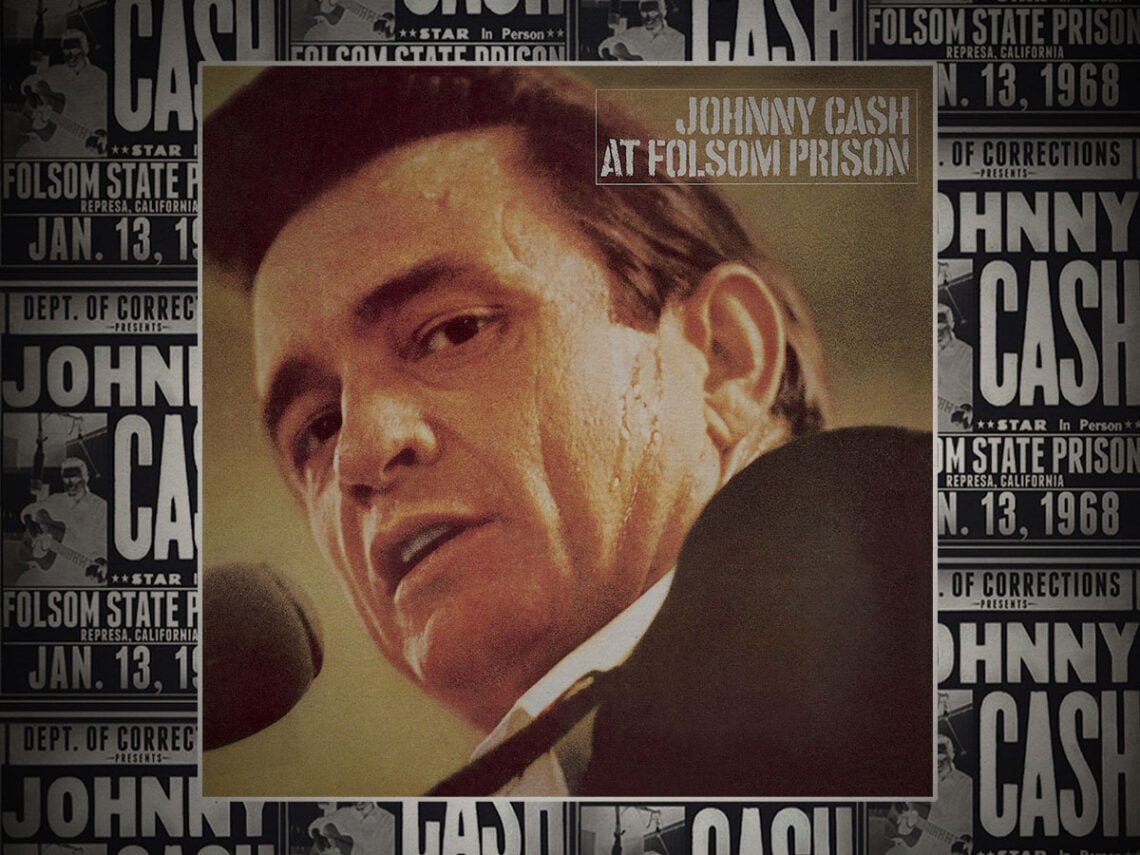
Why did Johnny Cash choose Folsom Prison?

Fun fact: without the intervention of the US Air Force, we might never have heard the name “Johnny Cash“.
That’s not to say that The Man in Black wouldn’t have been a country Megastar, you understand. Cash was a music obsessive from a young age. Writing his first song at the age of 12 and securing a spot singing for his local radio station in Arkansas not long afterwards. No, we literally might not have heard the name “Johnny Cash” without the Air Force because Cash’s birth name isn’t actually Johnny. Neither is it John.
Cash’s mother wanted him to be called John. His father was adamant that he was a Ray. The compromise was that he would be both, and JR Cash was born February 26th, 1932. That’s completely literal too; the name on his birth certificate was ‘JR’, rather than what those initials nominally stood for. Thus, when Cash was singing on those Arkansas radio stations, he was singing as little JR Cash and making something of a name for himself.
This all changed when he joined the Air Force in 1950. He was forbidden from using his birth name when signing up and was forced to change it. Making his mother proud by changing his name to John R Cash. Despite the Korean War raging at the time, after basic training, the newly christened John Cash was deployed not to East Asia, but to West Germany. Assigned to the 12th Radio Squadron Mobile in Landsberg, the biggest influence the Air Force would have on Cash wouldn’t come through combat.
It would instead come through a movie.

How did a movie change the life of Johnny Cash?
If Cash had joined the Air Force with dreams of heroism in combat, then he was in for a rude awakening when he was actually deployed. Cash was a radio operator, relaying messages from the front in Korea back to the United States.
There were some exciting aspects to the job. For example, Cash swore blind that he was the very first American to ever hear of the death of Joseph Stalin. However, for the most part, it was essentially an office job, but even more oppressive and insular.
The most exciting moments were when the Air Force would organise movie nights for the troops stationed in Landsberg. It was at one of these nights that Cash’s life would change forever when the troops were shown the 1951 Crane Wilbur noir classic Inside the Walls of Folsom Prison. A title that’ll ring a few bells to the Cash aficionados in our audience. Or, y’know, anyone who’s paid the slightest bit of attention to the history of pop music.
Cash was inspired by this movie and, a few days later, had written a song based on it. One where, during the writing of it, he’d mused upon what the worst thing one can do to another person was and settled on shooting them “just to watch them die.” This black-hearted thriller of a track became ‘Folsom Prison Blues‘, and five years after it was written, it would be Cash’s breakout single, starting one of the most legendary careers in rock ‘n’ roll.
All owed to the United States Air Force. They’ve got to be good for something, I guess…
