


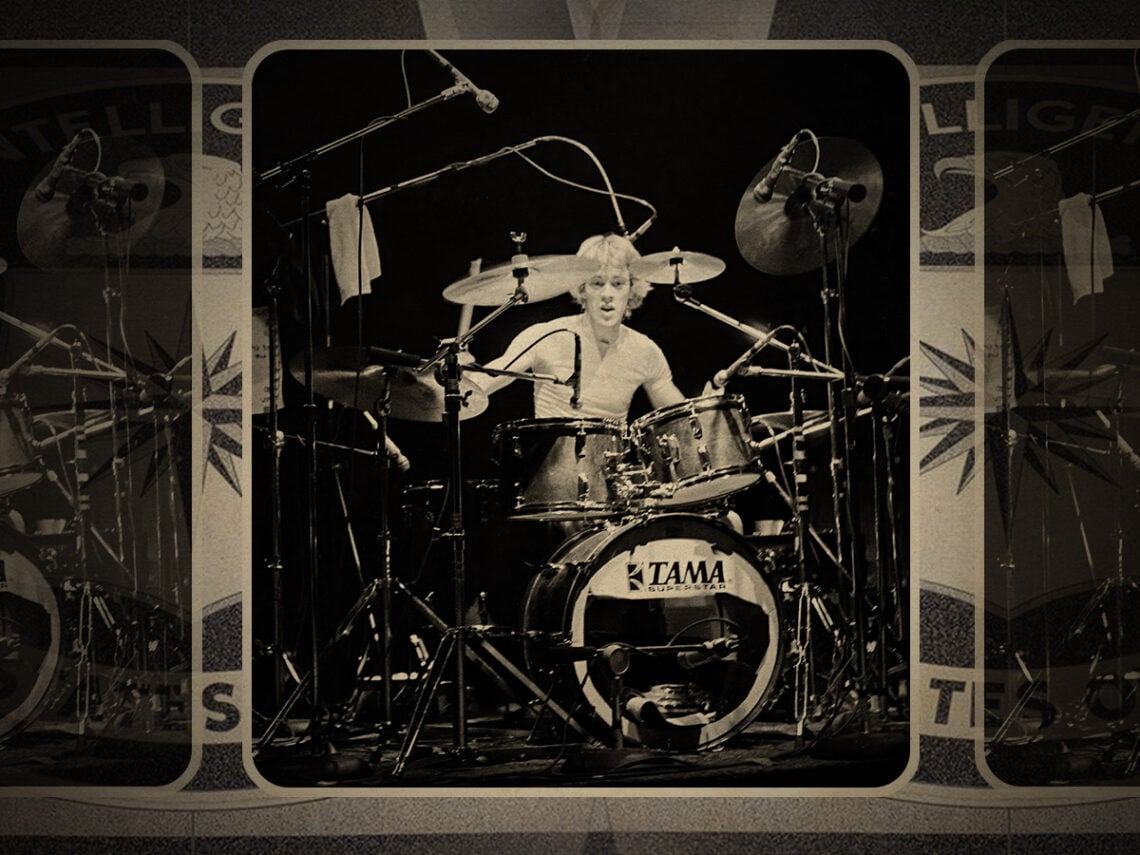
The Police, IRS records, and FBI booking: How Stewart Copeland and his brothers honoured their real-life CIA agent father

“Before I was born, my father planned to blow up the American embassy,” Ian Copeland (brother of Police drummer Stewart Copeland) wrote in his 1995 memoir Wild Thing, “But I screwed that up”.
That might sound like the sort of hyperbolic metaphor you’d expect from one of the most successful rock ‘n’ roll promoters of his generation, but Ian Copeland wasn’t speaking figuratively in this case. His father, Miles Copeland, was a high-ranking CIA agent working in Damascus, Syria, at the time of young Ian’s birth in 1949, and was deeply involved in plotting the notorious coup d’état attempt in that country, as he would be four years later in Iran, as well.
This isn’t usually the sort of upbringing that leads directly to a life in pop music, but Ian and his brothers Stewart and Miles Copeland III famously used their privilege to venture into very different territory from their conservative father.
In the mid-1970s, when Stewart was beginning his career as a professional rock drummer with the British band Curved Air, his father had entered a new phase of his own career in the private sector, acting as a high-profile commentator on matters of government intelligence, often defending his beloved CIA along the way.
“CIA officials believe that their agency is incorruptible,” the elder Copeland told a reporter in 1974 in the wake of the Watergate scandal, “Or at least as incorruptible as any organisation in history, in spite of the White House’s efforts”.
By 1977, a 25-year-old Stewart had joined a new band with singer/bassist Sting, for which he suggested the name, ‘The Police’. It was an attention-grabbing name for a punk adjacent band in London, part of a scene in which clashes with the actual police were part of the appeal, but it was also a subtle nod to the law enforcement background of Stewart’s father; a twisted, ironic nod, perhaps, but a nod nonetheless. The loose connection between the Police and the CIA might well have remained a little-known factoid if not for the subsequent business enterprises of Stewart’s brothers.
In 1979, eldest brother Miles Copeland III parlayed his success as a manager for The Police into the creation of a new record label in the US, called IRS Records. Nobody thought the Internal Revenue Service was quite as evil as the CIA, but it was certainly despised by Americans in even greater numbers, making it ripe for another bit of re-appropriation. Instead of collecting taxes, this IRS was putting out the latest hits by REM, the Go-Gos, and the Dead Kennedys. That’s right, the son of a man largely responsible for the neoliberal new world order of the 1950s went on to release anarchic punk rock records; psychologically, it makes sense.
As for the aforementioned third brother, Ian Copeland, his contribution to his family’s little inside joke also came in 1979, when he established a music booking agency called Frontier Booking International, or FBI. This company would count many of the artists on IRS as its clients throughout the 1980s, making it one of the leading agencies of the new wave scene.
As Ian Copeland would later write in his memoir, he and his brothers spent most of their childhoods having no idea what their father’s work involved. Once the facts started trickling in as they got older, Ian acknowledged that “there were many things I didn’t agree with, but there was one thing I did agree with. [My father] said that everyone should have an interest outside himself, an obsession, something he or she can be better at than everyone else, even if it’s only stamp collecting or tap dancing. It was around this idea that our family developed.”
