


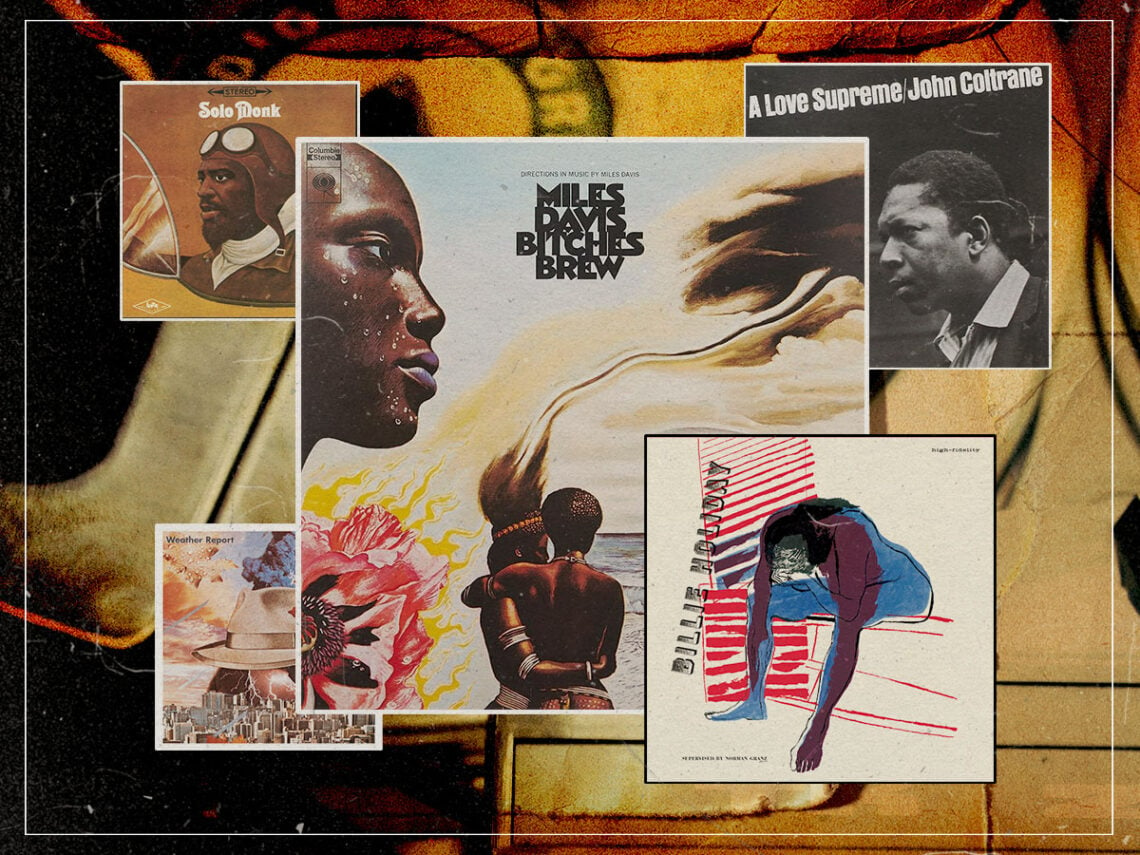
“Nauseating chaos”: The jazz albums that shaped rock ‘n’ roll

Jazz has always been relatively divisive and often gets a bad rap within the world of rock. Noel Gallagher’s derisive view that jazz is “fucking nonsense” seems to be pretty widespread, with Fast Show-esque representations of the genre giving an impression of jazz being pretentious, weird and unlistenable. However, even Noel Gallagher cannot dispute the idea that, without jazz, there would be no rock music. Jazz was among the first instances of music as a means of cultural revolution and rebellion, paving the way for later blues and rock ‘n’ roll scenes.
Throughout its history, jazz music has provided a voice to the unheard and oppressed. Rising from the vibrant surroundings of New Orleans, jazz soon became a global phenomenon, with the radical sounds of Jelly Roll Morton, Sidney Bechet and countless others providing a soundtrack for political struggles around the world. Even under the authoritarian rule of the Nazi party, rebellion groups like Swingjugend (The Swing Kids), used jazz music as a means of political protest. With this in mind, it seems fairly obvious that the rock ‘n’ roll revolution owed a lot of its subversive power to the jazz that had come before it.
Even after rock ‘n’ roll had established itself, jazz music still proved itself to be a valuable method of cultural expression and protest. The music of the civil rights movement was built almost entirely on the power of jazz and soul. Early protest songs like Billie Holiday’s ‘Strange Fruit’ found themselves re-energised during this period, inspiring the next generation of innovative Black musicians.
Rock and pop music is always looking forward to the next trend, so it is perhaps unsurprising that jazz music is often viewed as outdated and irrelevant. After all, the genre has a history going back well over a century, though it is constantly developing and reinventing itself. Although many rock and roll stars have been quick to dismiss the genre, the more astute individuals within rock have regularly paid tribute to the jazz stars who inspired them. The facts remain clear: without jazz, there is no rock.
The jazz albums that shaped rock ‘n’ roll:
Billie Holiday – Billie Holiday Sings
No list of great jazz musicians is complete without Billie Holiday. One of the greatest vocalists of all time, Holiday was also responsible for moving the genre away from 1920s big band arrangements to something more heartfelt and honest. A deeply emotional performer, Holiday always sang from the soul, something that would later inspire the singer-songwriter boom of the 1920s.
Joni Mitchell, for instance, was a disciple of Lady Day, once saying, “No one I know could express hurt and loss with such a good-hearted tone – not a trace of self-pity or melodrama in it. This was her great gift.” Her legacy on popular music would be long-lasting, with the 2 Tone revolution of The Selecter also influenced by her distinctive vocals – frontwoman Pauline Black would even play Holiday in a stage production during the 1980s.
John Coltrane – A Love Supreme
There is no shortage of legendary figures within the world of jazz, but few of them stand up to the colossal power of John Coltrane. Master of the tenor sax, Coltrane created some of the most innovative and unforgettable efforts in the genre’s long history. While his daring flirts into Spanish music on works like Olé Coltrane are undeniably great, it would take a lot to eclipse the brilliance of A Love Supreme.
The saxophonist would prove an unlikely influence on the world of punk and hardcore, with ex-Black Flag frontman Henry Rollins noting that “John Coltrane is my favourite musician, and jazz is the best thing America ever came up with, and I need to know every single thing about jazz.” Attesting that A Love Supreme is among his favourite records, he continued, “Coltrane’s tone, the music, it’s just beautiful. It aspires to so much. I really think John Coltrane thought he could cure the world of war and hatred and everything bad with his horn.
Wes Montgomery – The Incredible Jazz Guitar of Wes Montgomery
While most of the discourse surrounding jazz focuses on piano, brass or vocal performance, the role of the guitar should certainly not be forgotten. Jazz guitar has rightly become something of a genre in its own right, characterised by superhuman levels of technical proficiency and a particular penchant for improvisation.
The legacy of jazz guitar, Wes Montgomery in particular, can be heard in a variety of prominent rock guitarists – the likes of Frank Zappa standing out as a particular instance. However, this album proved to be particularly influential on a young Andy Summers, before he would rise to prominence as the guitarist for The Police. “Fantastic guitar playing and the waking-up to a new world on guitar,” he once shared, “I was 15 years old when I discovered Wes Montgomery!”
Thelonious Monk – Solo Monk
If you are looking for jazz piano, then there is no need to look any further than the distinctive tones of Thelonious Monk. An undisputed musical genius, Monk was often noted for his collaborative efforts, recording with the likes of Sonny Rollins and John Coltrane, but his solo work proved just as groundbreaking. His fifth record, Solo Monk, was so influential that it inspired the formation of no wave giants The Lounge Lizards.
Solo Monk is also among the favourite albums of experimental folk-rocker Tom Waits, who once shared, “Monk said, ‘There is no wrong note, it has to do with how you resolve it’,” Adding, “He almost sounded like a kid taking piano lessons. I could relate to that when I first started playing the piano because he was decomposing the music while he was playing it.”
Weather Report – Heavy Weather
During the 1970s, jazz music provided the inspiration for jazz fusion, with groups like Steely Dan and Weather Report incorporating the improvisational and organic nature of the genre with styles of rock and folk music. Jazz fusion proved to be fairly divisive, both among jazz fans and rock fans, but groups like Weather Report still hold a special place in the hearts of many.
One such person who adored the advent of jazz fusion was David Crosby, who found fame as a psychedelic rock progenitor during his time with The Byrds. He attested that Weather Report’s Heavy Weather album is “one of the best jazz albums that anybody ever made.” Strong words, especially coming from a musician who was more inclined to tear others down than build them up.
Miles Davis – Bitches Brew
Jazz music without Miles Davis is like having a 99 ice cream without a flake – sure, it would still be decent, but not nearly as exciting or delicious. The composer and trumpeter had an incredible influence over the development of the genre, inspiring the likes of Flea, Iggy Pop and countless others during his journey through different genres and influences.
His flirts with psychedelia on Bitches Brew proved to be particularly influential on the alt-rock stylings of Radiohead, who credit their magnum opus to the influence of Davis, “The songs on OK Computer, in our swollen heads, were trying to be Miles Davis, frankly.”
Thom Yorke added, “The first time I heard [Bitches Brew] I thought it was the most nauseating chaos, it sounded as though it came from Mars, I felt sick listening to it. But then, gradually. You aim for something that you’ve fallen in love with and you completely miss, but you do something else with it.”
