


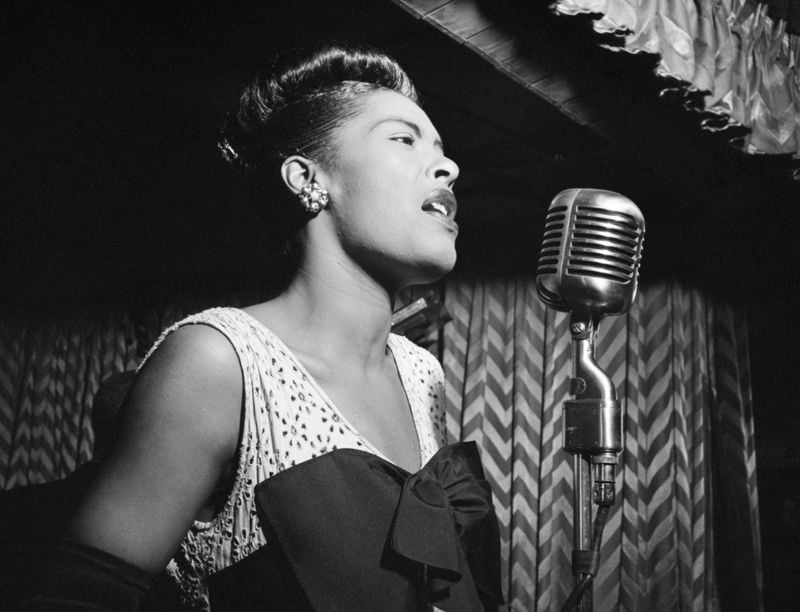
The life of ‘Strange Fruit’: The most powerful protest song ever written

As Billie Holiday lay on her death bed in hospital, the police came to her bedside and began trying to arrest her for possession of heroin. By this stage, she was arguably the most important artist in American history. They wouldn’t have bothered if she wasn’t. In some sad way, this scene serves as a pastiche of the triumphs and tragedies of her short life. A life defined, in many ways, by ‘Strange Fruit’, a song with two distinct backstories.
There is an argument to be made that all modern music is the product of protest songs. After all, it all stems from the blues, and the blues is, in essence, a codified protest song. As Lightnin’ Hopkins explains in his song about the tale of Mr Charlie’s Rolling Mill… “Once in the country there was this little boy and he stuttered,” Hopkins casually begins. It is a story of a pariah who left home after it became clear his mother couldn’t understand his stammering ways. Out on the road with a meagre flower-pack full of possessions and a spiritual sack-full of woes, he wandered his tired legs up to a dingy outbuilding called The Rolling Mill that belonged to Mr Charlie.
The boy stammered his way towards asking Mr Charlie if he had a place for him to stay. Mr Charlie told him he could stay in his Rolling Mill shack down the road so long as he sees to it that his stove never catches fire. The boy agrees and Mr Charlie tells him he never wants to hear from him again unless there is ever a fire. One day the boy is in the Rolling Mill and the place catches aflame. He races his way up to Mr Charlie’s house to tell him about the blaze. As the boy struggles to spell out the problem in his failing words, when Mr Charlie stops him and says, ‘Look here boy, if you can’t talk it, then sing it,’ at which point Lightnin’ Hopkins strums his guitar and bursts into song.
This is what many people did and suddenly a cultural revolution was underway. Alas, the messages were remaining largely covert and kept away from the masses. And in a more direct world of change, this created a problem. So, in 1939, with politics developing, it seemed that a spark was needed to bring about real change. Nine years earlier, a Jewish teacher named Abel Meerpool had been scarred by photographs by Lawrence Beitler of the lynchings of Thomas Shipp and Abram Smith in Marion, Indiana. These photos saw a crowd of white faces scowling up at the two men hanging lifeless from a tree, the bodies battered and bloodied.
Over the next seven years, Meerpool struggled to reconcile these monstrous pictures. So, he decided to depict them in the symbolic fashion of the blues in the most potent fashion. In a teachers union magazine, he published a poem called ‘Bitter Fruit’ under a pseudonym for protection. Over the next two years, he would hone this song and sharpen its message, taking away some of the subtlety to paint an ever-blunter picture. He would perform it socially with his wife. It soon blossomed as the voice of protest against black oppression grew louder. This was set to be the song that would kickstart the Civil Rights Movement. It just needed a singer. Billie Holiday seemed almost fated to be that voice.
She was born Eleanora Fagan in Philadelphia. Her father abandoned her to pursue a career as a jazz guitarist and her mother would frequently do the same, leaving her to be passed around relatives for care. Little is documented from this point of her life in her autobiography Lady Sings the Blues, and it seems to be a dower implication is of a childhood largely forgotten.
When she was just nine years old, she was facing a juvenile court for truancy. The result was a nine-month stint at a Catholic reform school. When she was just eleven years old, on Christmas Eve, her mother returned home to find Holiday fighting off a neighbour who was trying to rape her. He was arrested, but once again, Holiday, as a child, was held in protective custody for two months following the harrowing incident. Soon after her release, aged twelve, she was working in a brothel attending to the upkeep.
In an ironic twist of fate, it was while working at the brothel that she first heard the music of Louis Armstrong and Bessie Smith and experienced the exultant boon of music that both insulated her from the cruelties of reality, while simultaneously making sense of them. For the first time, a notion of escapism both spiritually and physically had seized her and when her mother left her for New York in 1928, the fourteen-year-old Holiday set off to join her less than a year later. She eyed a future in the jazz bars of the city.
It is not without its cruel ironies that when the legendary producer John Hammond saw her quite by chance when she replaced Monette Moore at the last minute on a jazz night bill, he remarked that she had a sense of lyric well beyond her young years. It seems in retrospect that you’d be hard-pushed to say Holiday was ever afforded the chance to be young in the first place.
She became a phenom of the music world with this style, but her true triumph was not in fame, the adulation of audiences or even the salvation she found in music, but with the song ‘Strange Fruit’ that she bravely found and set rattling towards the rafters for meaningful change. Now, a poem penned by a secret communist was set to drive a social revolution in the States, spearheaded by a star who rose from nothing and was constantly beset by grubby hands trying to take everything she now had away.

Nevertheless, she braved the slings and arrows that she knew she would face for the greater good. Her defiance was monumental. After all, 1939 was not a million miles away from the days when the blues had to be cryptic beyond recognition making Holliday’s statement all the bolder; everybody knew what she was saying with this powerful song. ‘Strange Fruit’ would be a harrowing and haunting anthem even if the message was symbolic, but the abhorrent truth behind the ‘fruit’ adds an unbearable context. By elucidating the inhuman situation in the south, Holliday helped to spawn the beginning of the Civil Rights Movement, and, to be frank, very few songs have been as meaningful as that since, fortunately, almost as a result, not quite as many have had to be.
Following this record, she played a residency at the Café Society and left the premises a star. Her fame that followed scored her hit records, movie roles, and due prestige. But sadly, this fame and fortune often meant solitude, her closest companion seemingly her excellently named dog Mister Downbeat. With money, fame and very little support, she succumbed to heroin addiction.
In 1947 she was arrested for possession of narcotics, and as she recalled: “[The trial] was called the United States of America versus Billie Holliday. And that’s just the way it felt.” She was guilty, but the trial was a pig circus, even her own lawyer wouldn’t represent her. “In plain English, that meant no one in the world was interested in looking out for me,” she said. She continued to fight against this, but her path was never clear after ‘Strange Fruit’.
Upon her death, the writer and civil rights hero James Baldwin wrote: “Billie was produced and destroyed by the same society. It had not the faintest intention of producing her and it did not intend to destroy; but it has managed to do both with the same bland lack of concern.”
