


The densest place on Earth: Inside Kowloon Walled City

In Hong Kong, once stood one of the most unsettling, dystopian urban environments to have ever existed, a place that looked like something from a futuristic movie, a densely populated enclave that was home to many, yet remained ungovernable and lawless, with police scared to enter its walls.
The truly unique Kowloon Walled City was born out of instability and existed as its own environment inside what was British-ruled Hong Kong, and since its demolition, it’s been remembered as a symbol of a bygone Hong Kong, which, despite its unsanitary conditions and crime, is still mourned by many who loved its off-kilter charm.
It started life as a fort during the Song dynasty, but it was post-Second World War when it started to become what we remember today. Even though it was a British territory, the Nationalist Chinese officials claimed it as theirs, and in 1945, after the Chinese Civil War, squatters began to move in, and within two years, there were over 2,000 living there. The British decided to have a ‘hands off’ policy to the walled city, which effectively meant that no British or Chinese law enforcement entered, and it only saw occasional raids from the Hong Kong Police. By the start of the next decade, it had become a haven for crime, with drugs, prostitution and gambling rife, and was being run by various crime syndicates.
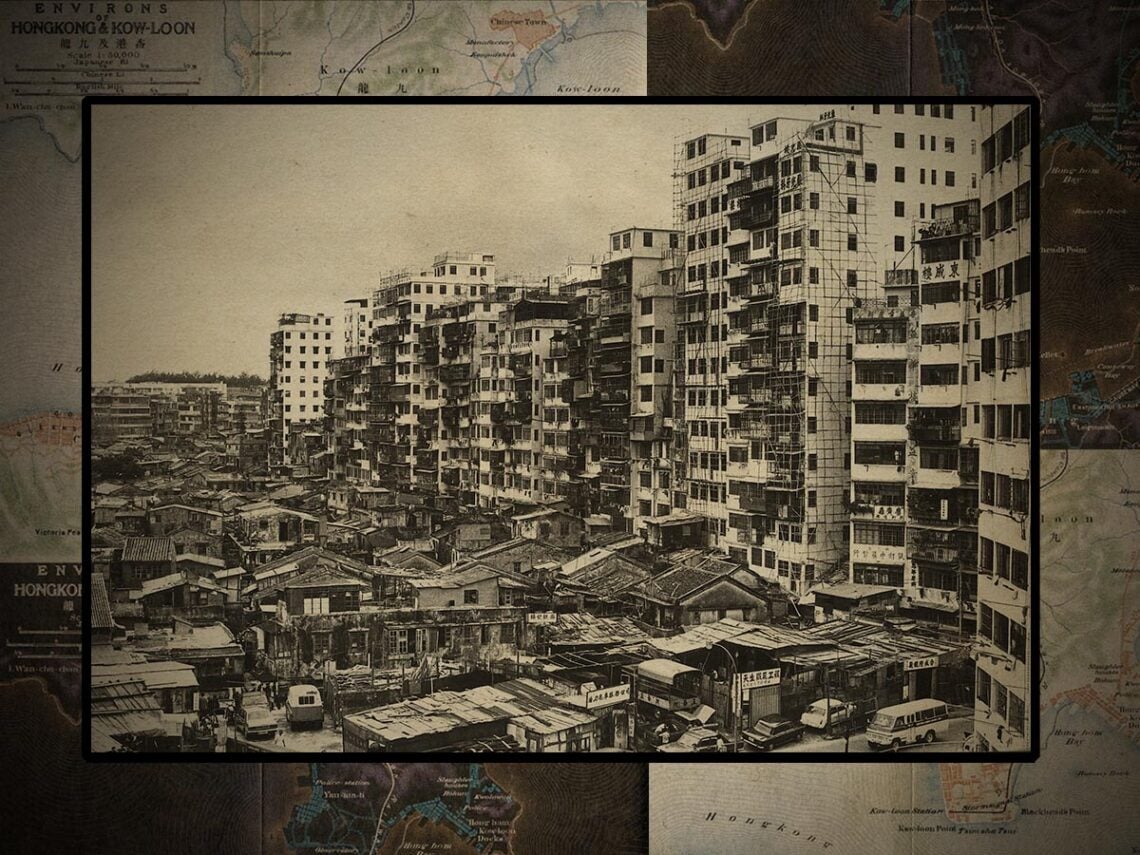
With no real infringement from lawmakers, things such as housing and building regulations were ignored, and developers kept adding new structures above old ones, without planning or thought, wherever there was space, meaning the walled city grew upward. By the late 1970s, Kowloon Walled City had reached its maximum size and had become the most densely populated place on the planet, with over 33,000 people living there, crammed into 300 buildings, across a mere 2.6 hectares. To put it into context, that meant that there were 1.2million inhabitants per square kilometre, which dwarfs that of today’s current highest Manila, with the Filipino capital having just 44,000 residents per square kilometre, and a long way ahead of London’s 5,800 per square km.
Dozens of alleyways, just one to two metres wide, cut across the city, like arteries in the body. Drainage and lighting were poor, and there was no plan or map to the pathways, meaning that it was a maze to anybody who didn’t live there, plus many properties had no utilities, with electricity stolen from elsewhere. Plans were made to demolish the city in 1987, and by April 1994, it was no more, replaced by the Kowloon Walled City park, a green, open space that was the very opposite of what it had superseded.
What makes Kowloon Walled City so incredible was how it looked, with buildings so tightly cramped together that it felt like a single solid mass, meshed together with concrete and metal. The corridors, stairwells and alleyways made it a labyrinth, a criss-crossed, unmapped, barely penetrable path across a landscape that felt alien and unlike anywhere else on the planet, while daylight barely snuck in, meaning that the damp walls, exposed pipes and tangled wires were lit up by bright fluorescent beams all the time.
It’s said that the air inside the walled city was different, thicker than that outside, and carrying the aroma of tens of thousands of people’s cooking, as well as their rubbish and the scents from the industries that operated there too. When kids wanted to play, they went to the roofs, which were capped at 14 stories high because of the neighbouring Kai Tak Aiport and it was here they could finally feel the sunlight on their skin and play like normal children.

Much like a living organism, the Walled City was noisy, its heartbeat being the hum of machinery and the voices of residents. The sounds of planes taking off nearby were a near-constant backdrop.
In the years since Kowloon Walled City was demolished, its legend has grown. Its poor and unsafe living conditions have been romanticised through time, but some truths do remain, in that this was a living, breathing community that saw lives come and go, and now it exists solely in memory, as a symbol of extreme urban density and, most importantly, humankind’s ability to adapt.
