


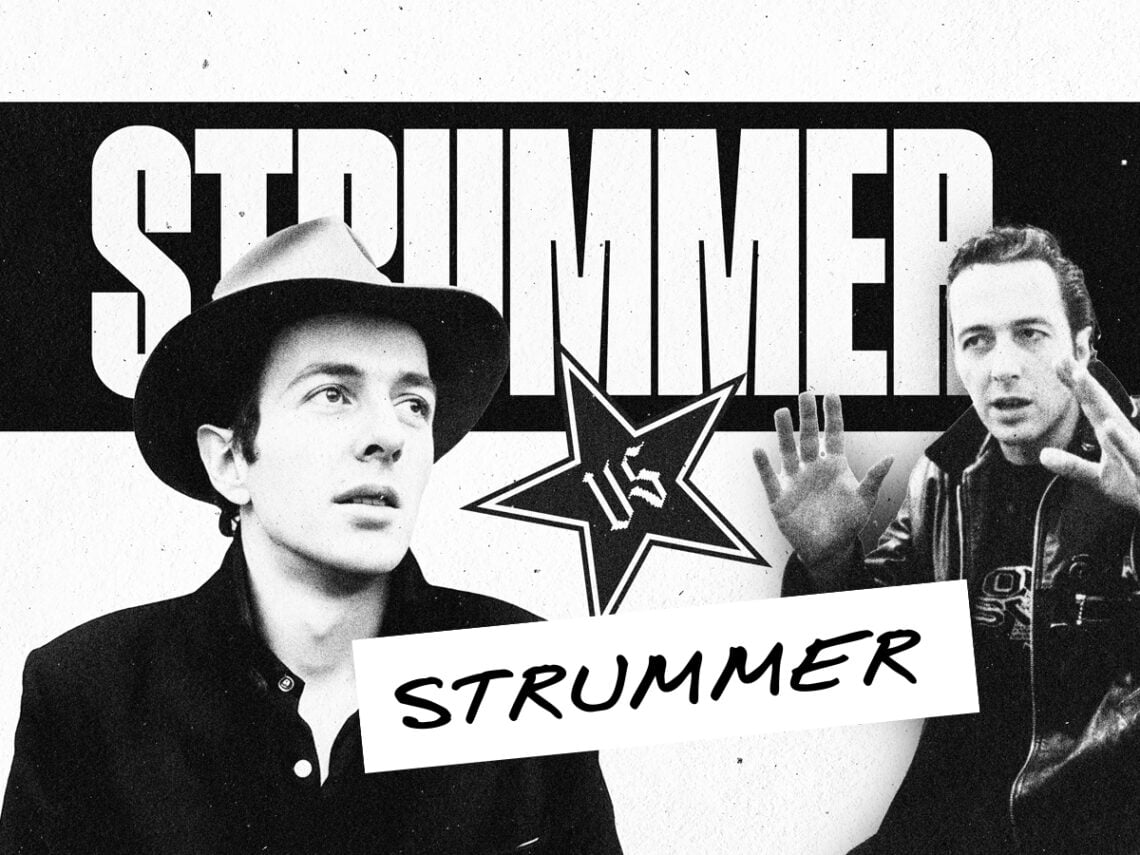
The Clash of personalities: 1978 Joe Strummer vs 1988 Joe Strummer

It’s not an earth-shattering observation to point out that people change a lot between their 20s and their 30s, not just as adult responsibilities and family circumstances realign priorities, but as the ideals and goals of our youth run into the inevitably disappointing stumbling blocks of reality. Sometimes, this even applies to rock stars, the people in society who supposedly never have to grow up.
In 1978, Joe Strummer was the frontman for the “only band that matters”, The Clash, the flag carriers for UK punk rock after the colossal crashing out of the Sex Pistols. He was 26 years old, and he took his role and his occupation very seriously, particularly when it came to using his platform as a means for speaking truth to power.
A mere decade later, in 1988, Joe Strummer was now the ex-frontman of The Clash, and was essentially out of the rock and roll game for a spell, spending most of his time working on film soundtracks and keeping a relatively low profile.
Pop stars are often asked the question, ‘What would you say to your younger self if you could talk to them?’, and they usually respond with some platitudes about ‘believing in yourself’. We wanted to take this thought experiment to a higher level, so Far Out commissioned the world’s first functioning time machine and utilised its one and only mission to collect both the 1978 version of Joe Strummer and the 1988 version of Joe Strummer, allowing the two icons to hang out together and sort through some stuff.
To keep things fair, both men were only allowed to communicate by restating things they’d already said, verbatim, in previously published interviews, primarily in Time Out magazine, Dec 15th, 1978, and the LA Times, Jan 31st, 1988.
Nonetheless, I hope you find the discussion engaging.
1978 Joe Strummer vs 1988 Joe Strummer:
Far Out: Starting with Mr Strummer from ’78, due to the rules of the Prime Directive and the potential risks to the space-time continuum, we can’t really give you any updates on how the various political issues plaguing Britain in your time have played out over the subsequent 50 years, but speaking from your own experience as a young man in a band at the end of ‘70s, care to make any guesses as to how things went?

Younger Strummer: “Things will get tough. I mean, a fascist government. But people won’t notice, like you won’t notice your hair is longer on Monday than on Sunday.”
Far Out: Not too shabby. And where do you see yourself fitting into this dark, highly likely future?
Younger Strummer: “What I’m aimed against is all that fascist, racialist patriotism type of fanaticism. There’s so much corruption; councils, governments, industry, everywhere. It’s got to be flushed out. Just because it’s been going on for a long time doesn’t mean that it shouldn’t be stopped. This is what I’m about, and I’m in The Clash, so of course, that’s what The Clash is about.”
Far Out: That’s inspiring stuff. Very punk. Very on brand. Turning to the older Mr Strummer now, I noticed you rolling your eyes a little bit there at your younger self. Are you embarrassed by the way you used to speak?
Older Strummer: “Don’t misconstrue me. I’m a human being. I’m not dumping on what I’ve done. I mean, I know we were doing social [activist] shit, alright. I just don’t like boasting about it”.
Far Out: So you think you were too brash and outspoken about politics back then? People got the wrong end of the stick from it?
Older Strummer: “I often felt that it all got a bit unbalanced. I kept trying to stress that [in later years], saying, ‘Hang on, we’re be-bop guys, we’re down in the alley on 57th Street… We loved Chuck Berry, Slim Harpo. We never heard of Friedrich Engels, you know what I mean?… I often felt worried that people thought we were Che Guevara.”
Far Out: I see that 1978 Joe is actually nodding in agreement here. You never really directly suggested a Guevara sort of worldview, did you?
Younger Strummer: “We ain’t no urban guerrilla outfit. Our gunpowder is strictly limited. All we want to achieve is an atmosphere where things can happen. We want to keep the spirit of the free world. We want to keep out that safe, soapy, slush that comes out of the radio.”
Far Out: So, Younger Joe, you feel like you always made it clear that you were political without being militant, essentially?
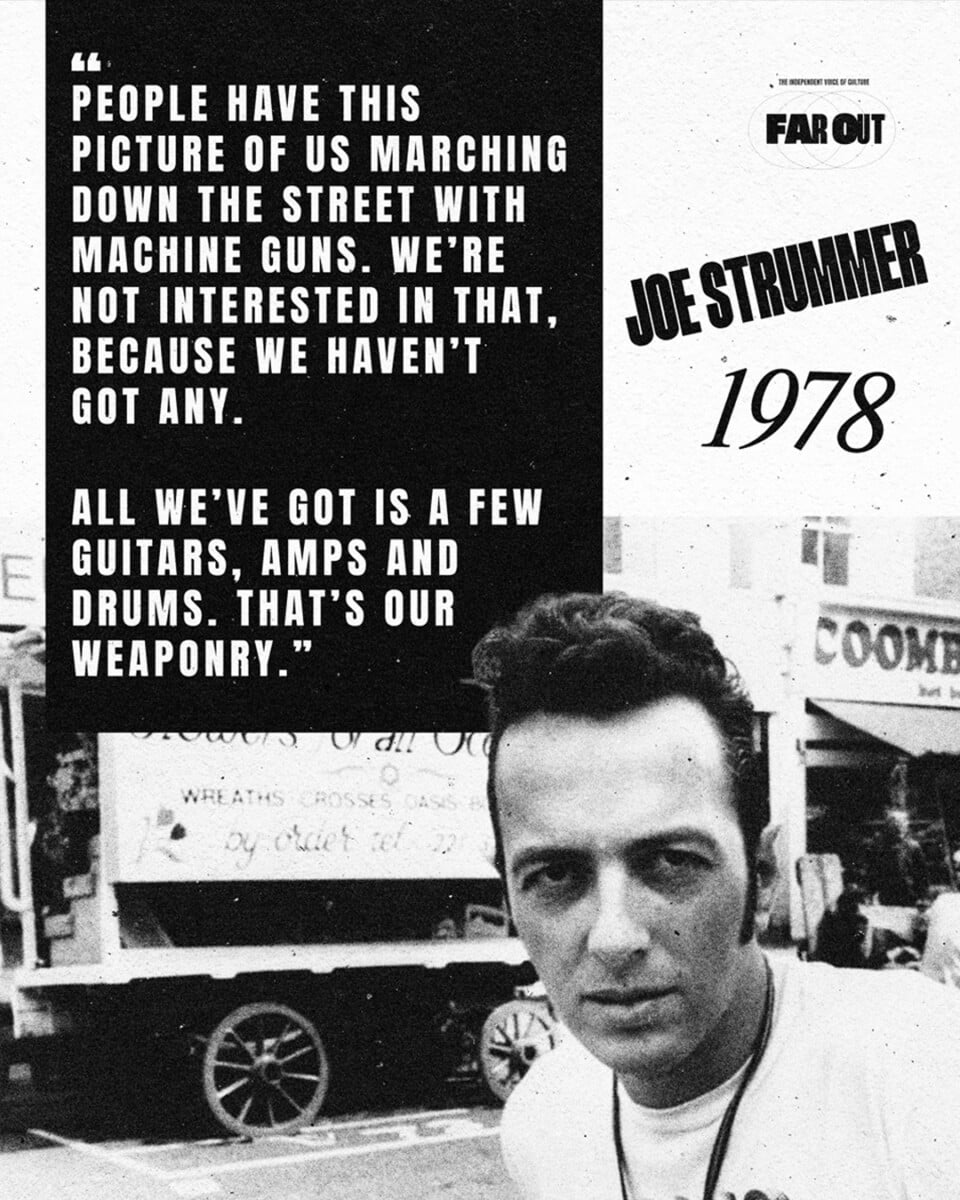
Younger Strummer: “People have this picture of us marching down the street with machine guns. We’re not interested in that, because we haven’t got any. All we’ve got is a few guitars, amps and drums. That’s our weaponry.”
Far Out: Older Joe, I get the sense again that you’re getting a bit of self-cringe from this interaction? Is that accurate?
Older Strummer [takes a breath]: “I’ll tell you something. When you see yourself become part of the cycle of generations, you lose your ego in the process, because you ain’t nothin’ special.”
Far Out: Ah, right, it’s probably important to note, and this is admittedly a spoiler alert for Younger Joe, but Older Joe became a dad in the ‘80s. He’s got two kids now.
Older Strummer: “When you devote all your interest into another person, you lose your self-obsession, and that’s when you understand what it is”.
Far Out: What what is?
Older Strummer: “You don’t know without that moment. You don’t want anything to harm this helpless being. That’s a fantastic change. I never understood anything until my first baby looked at me”.
Far Out: Interesting, that’s definitely more of a Drew Barrymore Show kind of revelation, but yeah, certainly understandable. Oh, it occurs to me now that you probably only know Drew Barrymore as the little girl from ET, but she ends up becoming a talk show host in the 2020s after a whole bunch of other weird stuff in between. Anyway, has becoming a dad made you generally more optimistic about the future then, Older Joe? What issues motivate you at this point?
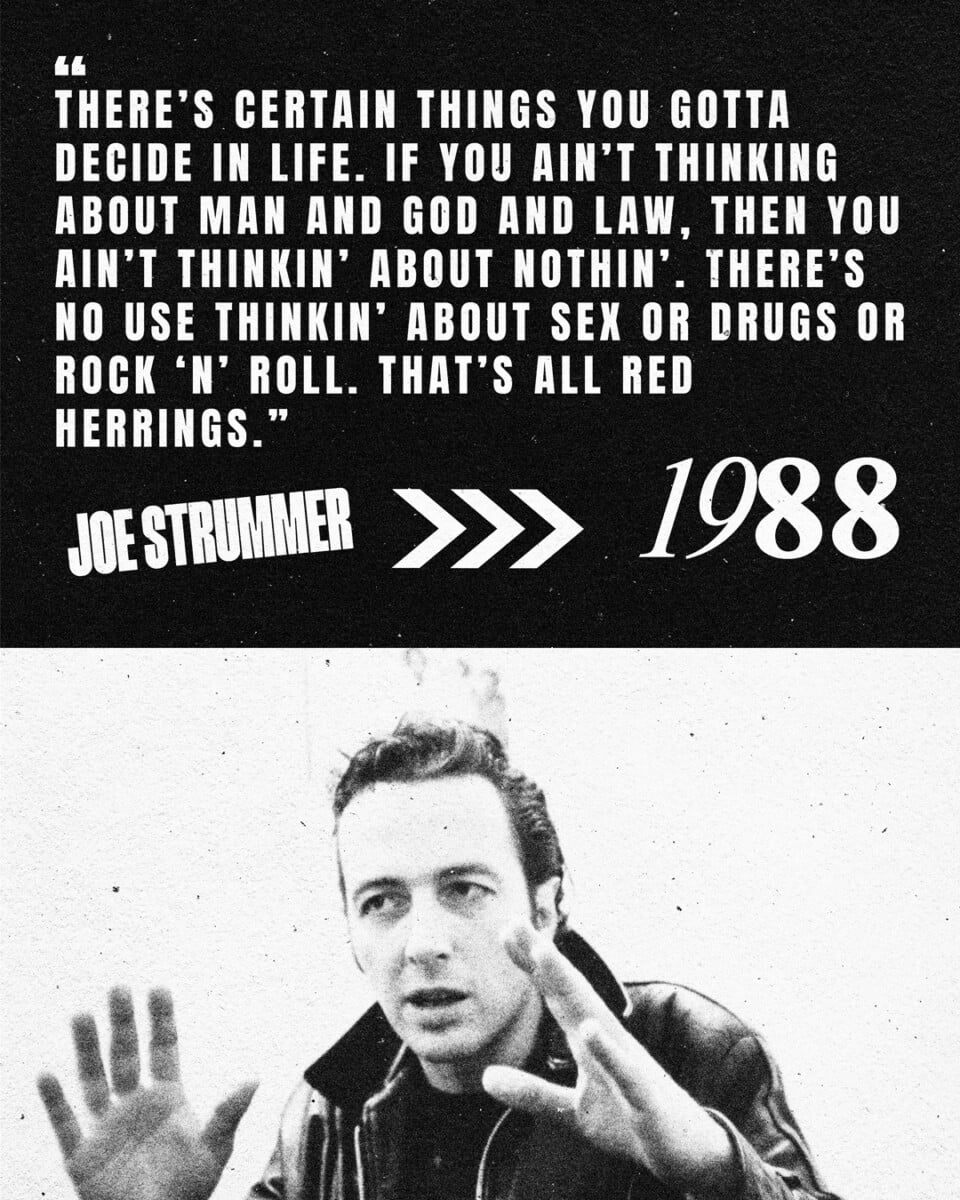
Older Strummer: “Oh man, you know. There’s certain things you gotta decide in life. If you ain’t thinking about man and God and law, then you ain’t thinkin’ about nothin’. There’s no use thinkin’ about sex or drugs or rock ‘n’ roll. That’s all red herrings.”
Far Out: Younger Strummer is raising his hand over here. Young Joe, you look annoyed now. Do you feel like your older self is being a bit broad and hokey for a guy still in his 30s? He’s kind of talking like Bob Dylan a bit, isn’t he? Would you say that taking a direct political stand was actually a commendable aspect of the punk movement, rather than an embarrassing one?
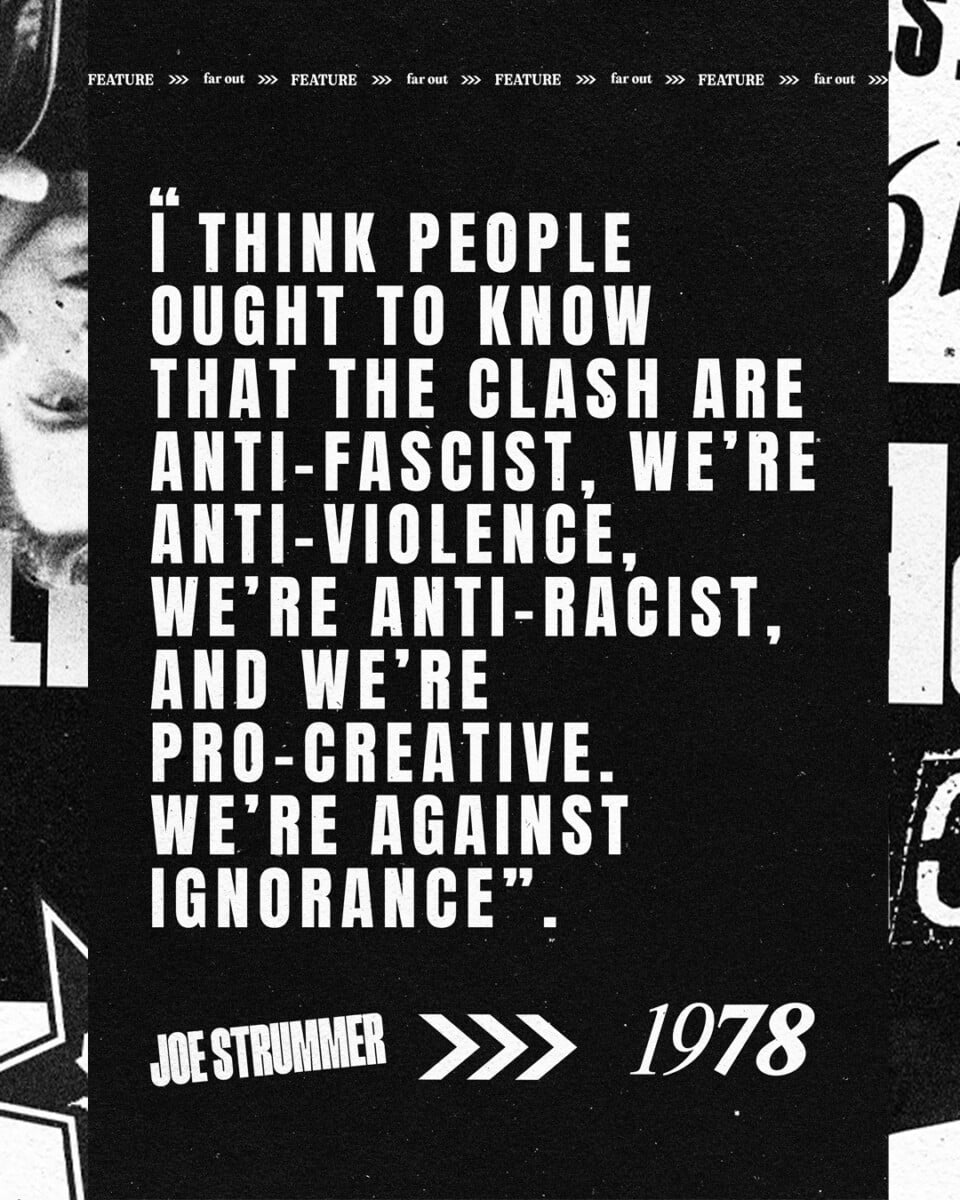
Younger Strummer [staring into the invisible camera]: “I think people ought to know that The Clash are anti-fascist, we’re anti-violence, we’re anti-racist, and we’re pro-creative. We’re against ignorance”.
Far Out: That’s much clearer and more succinct, yes. Older Joe, I have to ask, is it strange seeing the focus and energy and determination in your younger self over here? It seems like Young Joe really thought he could topple fascism, whereas you seem kinda resigned to philosophising or staring out the window pensively, comforted by the fact that Combat Rock sold enough copies to relieve any financial concerns for the rest of your life. It’s sort of reminding me of Norma Desmond in Sunset Boulevard, watching her own old movie performances, but hopelessly disconnected from them.
Older Strummer: “That must be an extra bitter thing, to have to face your age and yet always see your former glory… It’s a bit like that for me, too”.

Never Miss A Beat
The Far Out Punk Newsletter
All the latest Punk content from the independent voice of culture.
Straight to your inbox.