


Sonic Scares: The 10 greatest Halloween albums

I can almost hear it now, that Halloween chord. The dissonance of a knife being scraped along a sheet of glass, the creak of a floorboard, some far-off howl, and the awful caterwauling of foxes making whoopee. These are the dark sounds that stir on the spookiest night of the year. And they are sounds that bring some brilliant albums to mind.
Music mimics our vocal and physical expressions of emotion in order to convey the intended mood. This direct transposing of emotion into sound means that from an incredibly early age, we can intrinsically interpret musical triggers like major or minor keys into feeling. Responses to music, in other words, are hardwired from infancy. Studies have linked this interpretation of sound and emotion to evolutionary biology. Thus, in short, it is in our DNA to be scared by certain sounds—why wouldn’t it be? It could just save you from Fredy Krueger.
Certain artists have been brilliant proponents of utilising this. However, a simple, spooky or shocking piece of artwork doesn’t cut the mustard. True scares have a depth from which we can derive personal corroboration. As ghost story playwright Danny Robins told Far Out: “The horror films that have no impact on me at all are the ones that just feel like they’re laden with CGI and kind of cheap jump scares that feel kind of unconnected to character.”
Below, we’ve collated ten albums laden with hordes of character and quality. From Nick Cave and The Bad Seeds to Tom Waits, these classic crooked albums are perfect for Halloween. Enjoy with the lights on…
The 10 best Halloween albums:
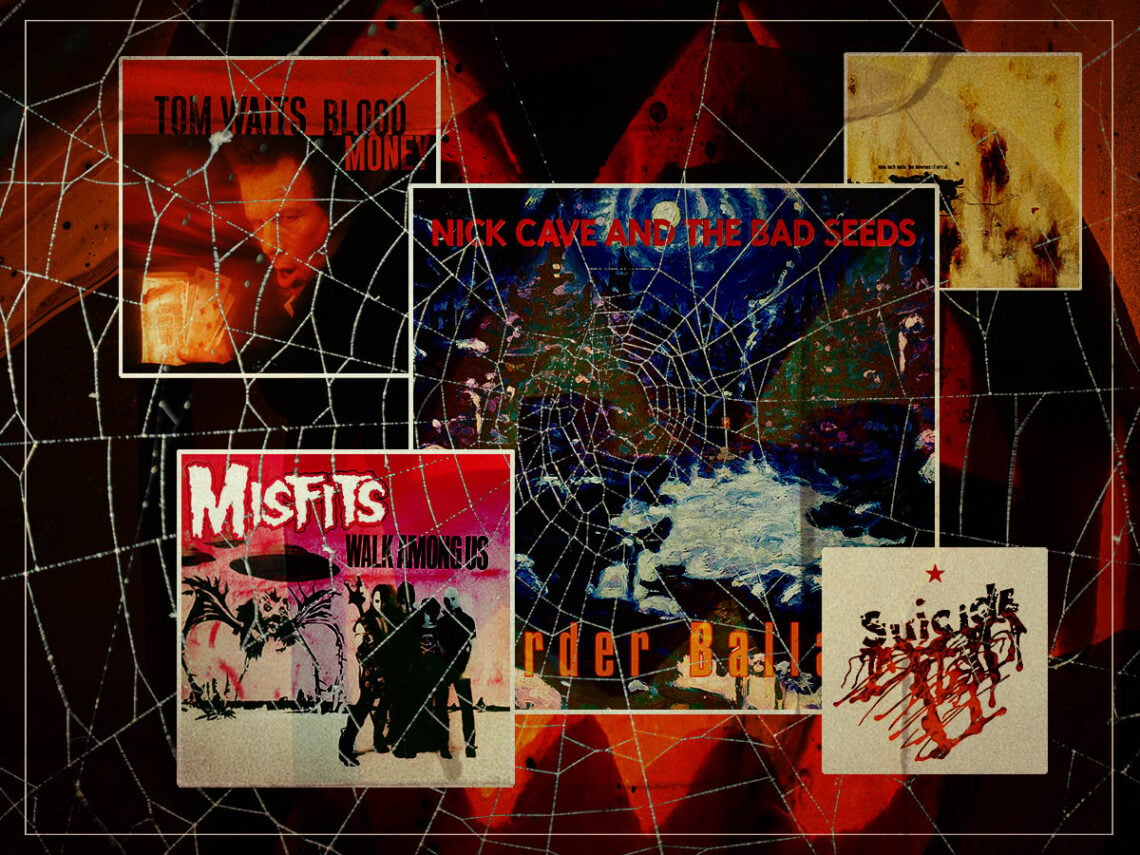
Murder Ballads – Nick Cave and The Bad Seeds
The original gothic goliaths of music, Nick Cave and The Bad Seeds announced themselves as poetic misfits from the start, like Edgar Allan Poe with a penchant for industrial music. The Murder Ballads put the darkness right to the forefront with a wry comic edge. The record is a masterpiece of eerie storytelling, and it hooks you into its fractured fables.
Nick Cave said himself, “Despite what people may think, I’m not interested in being dark all the time,” and despite what people may think, even at his most macabre, he very rarely is. Testimony to this abating of darkness in ‘the vampires’ songs’ is the fact that when it comes to jet-black comedic lines, there’s a plethora to choose from. This particular effort just happens to be amongst the most stand-out: “I jammed the barrel under her chin / and her face was raw and vicious / her head it landed in the sink with all the dirty dishes.”
Suicide – Suicide
Suicide were not a duo interested in making it onto the radio. They wanted to scare you into listening closely instead. Suppose any testimony was needed to define the band’s assertion that they were not entertainers. In that case, a ten-minute eerie hellscape that describes the tale of a young factory-working father driven to delusion by destitution should do the trick—that’s the tale of ‘Frankie Teardrop’, just one of the many spooky songs on their debut.
It is the track that Lou Reed said he wish he had written, Bruce Springsteen said it was instrumental to his Nebraska album and the author Nick Hornby said you would listen “only once”. Like mad scientists depicting political depravity, they draw on the DNA of William S Burroughs, tap into the cinematic scope of Taxi Driver and hand the sickly creation over to David Cronenberg to direct. Like pulling nose hairs for fun, it’s certainly not entertaining, but there’s an undeniably perverse reward.
God Bless Tiny Tim – Tiny Tim
There is nothing scarier than something that isn’t meant to be scary but really is. What could be sweeter than a child’s laughter… and what could be more terrifying than that same sound in the dead of night with no children about? The same applies with gleeful tableaus like tip-toeing through tulips or drinking strawberry tea… except when spoken about with Tiny Tim’s shrill falsetto on this album, they are truly horrifying propositions.
It is this inherently strange horror and the appeal of outsider music, however, that makes the album oddly alluring. It’s like a darkened alley that you inexplicably feel drawn to, if only to peak at the unknown. There is enough unknown swirling in the welter of this manic record to keep you occupied while you shudder to the core.
Walk Among Us – Misfits
Released the same year as George A Romero’s Creepshow, Poltergeist and John Carpenter’s The Thing, Misfits‘ ghoulishly gothic 1982 album Walk Among Us tapped into an international thirst for horror and a generalised fear that out-and-out nuclear war was inevitable. It’s no accident that the LP’s cover art features images from the 1956 film Earth vs The Flying Saucers and 1959’s The Angry Red Planet – both heavily infused with the nationalistic paranoia of the Cold War era.
Featuring tracks like ‘Vampira’, ‘I Turned Into a Martian’, ‘Skulls’, ‘Night of the Living Dead, “Astro Zombies,” and the provocatively-titled live single ‘Mommy, Can I Go Out & Kill Tonight?’, Walk Among is the definitive statement of one of the UK’s most antagonistic and culturally subversive rock outfits.
Blood Money – Tom Waits
From the opening bars of carnivalesque album-opener ‘Misery Is The River of The World’, Blood Money is a swaggering, snarling beast of a thing. The 2002 album – written for the musical Woyzeck – is a Frankenteinesque patchwork of pirate shanties, gothic waltzes and eerie ballads, every inch of which is utterly sublime.
Blood Money could easily be viewed as a soundtrack album. Indeed, its finest moments (such as ‘The Part You Throw Away’) are lyrical, orchestral affairs that seem to fade into the background of some fantastical and dimly-lit cabin. Blood Money was Waits’ third outing with theatre director Richard Wilson following The Black Rider and Alice, the former of which saw the musician work closely with the poet William S Burroughs.
If you’re looking to conjure a faintly magical atmosphere this Halloween, Blood Money is the album for you. Laden with darkness and wrapped in a veil of mist, it is the perfect soundtrack for late-night explorations of lonely cemeteries and crumbling churchyard.
The Drift – Scott Walker
Darkness pervaded The Drift almost like no other album in history. The creation of this spooky masterpiece almost drove poor old Scott Walker to madness. He began work on the project in 1997, but it wouldn’t be released until 2006. Far from the sign of idling, this overlong gestation is evidence of how wholly he crafted this darkness and how close he came to being subsumed by it.
The legendary musician, cited by David Bowie as his “idol”, didn’t just write the record; it was his understanding that he was partaking in a sonic séance of sorts, purposefully flirting with madness. Rather than rely on the instruments he knew how to play for the eerie sounds of the psyche he was trying to capture, he took a more challenging route, punching carcasses and scraping metal.
All the while, he weaved in legitimate jolts of terror—there are screams in tracks that truly perturb as much as any horror movie. Beyond the shocking sounds, he whisks up tales of Elvis Presley’s dead brother, sermons of schizophrenia, and a general sentiment of a musician reaching well beyond the charts.
Soundtracks for the Blind – Swans
When Swans set out to make their 1996 album Soundtracks For The Blind, they intended to create a soundtrack for a film that didn’t yet exist. The end result is something otherworldy, haunting and completely mesmerising. Forged by tying together audio collage works and minimalist soundscapes recorded in various environments, Soundtracks for The Blind was heavily influenced by Brian Eno’s use of non-musical sources.
The process of making the album was one of salvaging and repurposing material from several other projects. Swans collected a number of FBI surveillance tapes and blended snippets of the recordings with vocal loops made back in 1985 on a sixteen-second digital delay unit.
The group also sampled live shows and material written previously for a soundtrack film in the early 1980s. Altogether, Soundtracks for The Blind is a thing of startling juxtapositions and timeless beauty.
The Downward Spiral – Nine Inch Nails
Nine Inch Nails’ second studio album is undoubtedly one of the darkest albums of the 1990s. Detailing the mental decline of a man from his psychotic break to his eventual suicide, The Downward Spiral put Trent Reznor and Atticus Ross on the map, winning them critical and commercial success just as Reznor began his own downward spiral into depression and drug addiction.
The video for the album’s lead single, ‘Closer’, caused an uproar on release. Starring a bondage-clad Reznor dancing around a grotty sex dungeon where a raw human is pumping time with the kick drum and a live monkey is being crucified, there was a lot to be upset about. Interestingly, a lot of The Downward Spiral was recorded at the same house where Sharon Tate was killed by the Manson Family. Speaking to Rolling Stone, Reznor recalled being confronted by Tate’s sister, Patti, who accused him of exploiting her sister’s death by staying in the property.
Embarrassed, he told her that the decision to set up the band’s studio there was due to his ongoing interest in “American folklore” and that he’d wanted to be close to the place for creative reasons. He would later admit that he’d not considered how his presence at the Tate property might have affected Patti.
Phantasmagoria – The Damned
The Damned’s first album without founding member Captain Sensible, Phantasmagoria marked a shift away from the group’s gritty punk sound towards the goth and darkwave aesthetics of bands like Bauhaus and Sisters of Mercy. The self-produced album was an attempt to throw off the shackles of three-chord punk rock. With drummer Rat Scabies providing the essentials, the rest of the band were free to furnish their sound with baroque instrumentation and funerary chord progressions.
There’s a playfulness throughout Phantasmagoria that makes it difficult to dismiss. In songs like ‘Sanctum Sanctorum’ and ‘Street of Dreams’, the group’s burgeoning fascination with Hammer horror soundtracks and the Victorian gothic is abundantly clear, these influences having been deliberately heightened to the point of excess.
Phantasmagoria is essentially what The Rocky Horror Picture Show would have sounded like if it had been written by a melancholy 14-year-old goth with a penchant for Victor Price films. It’s bloody brilliant. Heightened by rumours of the band’s own spooky antics, this classic truly captures the spirit of Halloween right down to its hammy edges.
Commissioned Music – Blixa Bargeld
With Blixa Bargeld’s version of ‘Somewhere over the Rainbow’, he proves that if you judge a book by the cover, then at least read the blurb. After all, even Edward Scissorhands had a heart of gold despite the deadly appendages at the end of his arms. Blixa Bargeld might be renowned for his industrial underworld hellscapes and have the look of a recently reanimated Alaskan vampire, but the one-man atmosphere machine clearly has a sweet side, too.
Back in 1995, for his Commissioned Music album, he took on a string of old classics and added his twist to them. At the time, Bargeld was just pulling away from the heavy chains of Einstürzende Neubauten and trying to establish himself as a solo artist. Some of the anthems were stirringly sumptuous but always touched by his inescapable sense of spookiness.
