


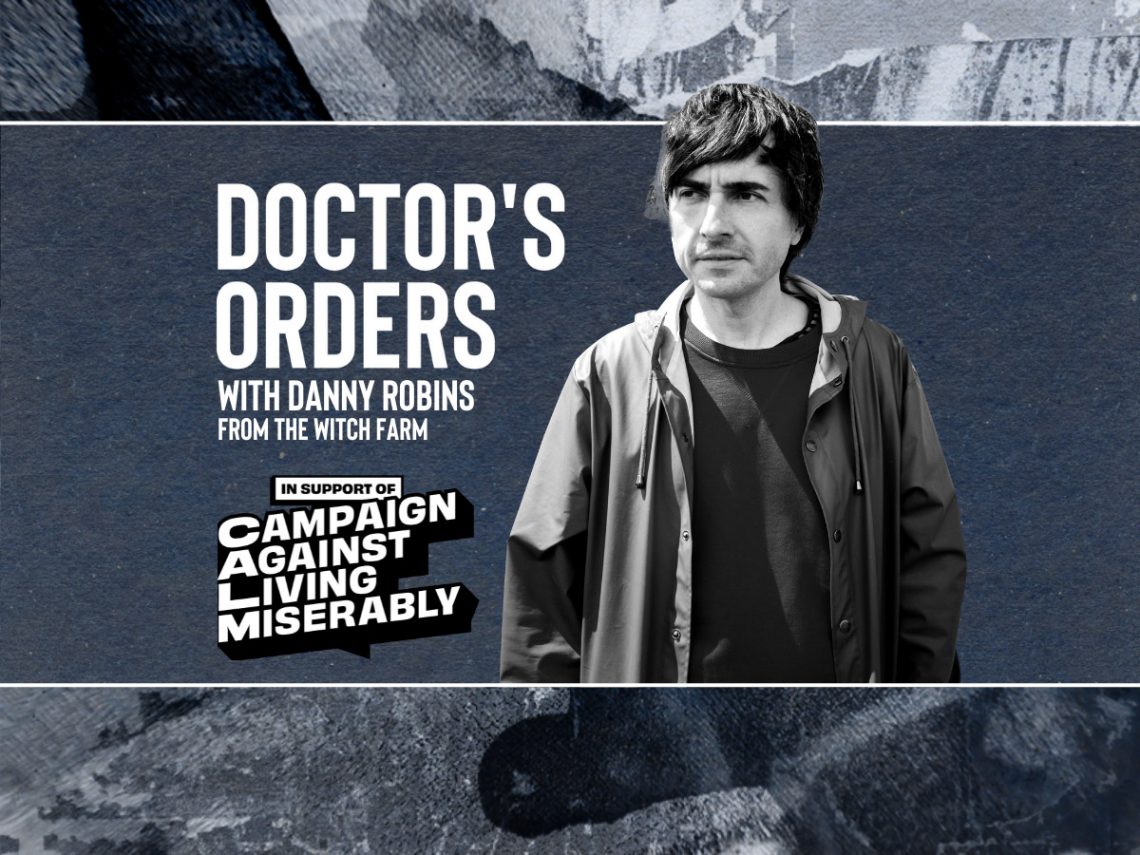
Doctor’s Orders: The Witch Farm creator Danny Robins prescribes his nine favourite records

Danny Robins is the mild-mannered Arthur Conan Doyle of the modern age. Like a mouse with a monocle suddenly emerging amid the pantry, very few prying callers can prove so loveable and funny, and yet wreak a maelstrom of manic terror untold. He’s been a comedian, journalist, Jon Ronson collaborator and more, but his latest guise as the Spook Master General is a cape he wears well. From his award-winning onstage horror 2:22 to his brand-new paranormal investigation The Witch Farm currently on BBC Radio 4 and BBC Sounds, his charming lull can lure fanatics, hardened sceptics, and seemingly even spectres themselves into his oddly affable but stupefying snare.
His tales are of dark intrigue tempered with his former comic eye for simple engaging entertainment and they have a lot to say about us and, indeed, the other. This unique style has gathered a real unified following. “To me, that is the thing I felt most proud of in the whole experience,” Robins joyfully tells me from within the bowels of the shed (it’s far more light and airy than you might think for a horror den). “It feels surprising to have a group of people with such diverse opinions, and yet, there’s this kind of respectful debate.”
This is something all of his fans have found to be a refreshing balm to the grind of the cynical status quo. “You could say that ghost belief is as divided as Brexit. It doesn’t get much more divided. And yet, something about the paranormal makes it seem like a safe space, I think. If we were arguing about politics, it’s so emotionally charged, and it’s quite hard to see the other person’s point of view, but there is something about the way that people tell their stories, and you’re listening to someone who is genuinely coming to terms with something and wrestling with going from this moment of not believing to believing because they feel they’ve seen something. You can hear that is life-changing and the fear they speak of is profound. Even if you’re not a believer you can respect that, so I love that people have enjoyed the shows in their own way.”
It was this sense of sincerity that attracted him to investigate the happenings in The Witch Farm—a task he has been hooked by and obsessed with for two years. “We came across this case, and we spoke to the woman at the heart of it, Liz, and I just felt the same thing that I felt with Shirley in The Battersea Poltergeist. It’s not words – it’s nothing they say – it’s just how they say it. There’s this quality to the voice where you feel this little frisson of fear. When you feel that the person is still scared it is incredibly compelling.” When you add the fact this case is “plastered with phenomena,” then you really have a mystery. “There’s poltergeist activity, there’s apparitions, alleged possessions, physical injury, there’s just so much stuff. Things are linked to witchcraft and ancient Celtic history, rumours of murder. I just felt really excited,”
Once more, it is done with the engagement of an empathetic fandom in mind—a collection of whatever the opposite of ‘likeminded folk’ are, coming together in a friendly fashion to break free from the grind of reality and revel in the depths of a daring mystery. This beloved fanfare is causing his star to rise. Film producers are already sniffing around 2:22 which is set to make its Los Angeles stage debut on October 29th, an Uncanny special is on the way, and a forthcoming book and further mysteries along the way are all headed to his fans.
Thus, with the notion of engaging empathy in mind, let’s segue into the songs that have proved to be a boon to Robins when he’s not got his eyeglass to mystic whodunits throughout his life. In partnership with CALM, we’ve asked a selection of our favourite artists and public figures to share nine records that they would prescribe for anyone and the stories behind their importance. Doctor’s Orders sees some of our favourite musicians, actors, authors, comedians and more offer up the most important records, which they deem essential for living well. CALM, whose full working title is ‘Campaign Against Living Miserably’, offer a free, confidential and anonymous helpline for those most in need of mental health support.
Danny Robins prescribes his nine favourite records:
‘Prince Charming’ – Adam & the Ants
“The first one comes into my life when I’m very, very, very young, like almost so young, that these are kind of slightly dreamlike memories,” Robins explains before delving back into his past to pluck out an early 1980s icon. “It’s ‘Prince Charming’ by Adam Ant and I just remember dressing up as him at one point in a very unconvincing way, in a burgundy cardigan, and some face paint. I think I was trying to get out of being taken to town by my parents, and it took so long to get dressed up as Adam Ant that I think I was successful. But, I just guess, I really, really connected with the idea of Adam and does this kind of dandy figure.”
Even as a boy, it was more than just the music that formed an alluring connection for Robins. “I think maybe it fed into the fact that I always sort of felt a little bit different as a kid growing up, and I grew up in a part of the world where difference wasn’t really tolerated. You know, I spent the first sort of eight years of my life on a counsellor state in Washington and then moved to Newcastle, I sort of certainly felt like it was a place, back then, where difference wasn’t particularly tolerated.”
Thus, Adam Ant was an illumination of individualism. As Robins continues: “I think I kind of really related to that kind of flamboyance and that sort of daring to be different. And then, you know, later in life, I happen to be living in a small block of flats with a woman who had dated Adam Ant, and he had actually been sectioned in her house when he went through his own mental health crisis. That sort of struck a real chord for me. Seeing somebody who had been this incredibly confident, a flamboyant character, and then had been involved in a very deeply unhappy time in his life. It made me very aware, I guess, that this can happen to anyone and the extreme power of those moments of mental ill health really. It felt like a really sad and shocking moment to witness that transformation.”
‘Smells Like Teen Spirit’ – Nirvana
“I just played it again now to myself,” Robins informs me with a smile on his face. “I haven’t listened to it for a long time, but instantly, it takes me back to being a teenager and a house party. See, isn’t that kind of that terror of trying to talk to girls? And, and then the exhilaration of actually maybe kissing a girl you know, and just the adrenaline the kind of hormonal energy, the frenzy of dancing around.”
Robins begins to relive his youth rather viscerally at this stage. “It was music that sounded unlike any other music, and I think it still holds up as that. It still stops you and sounds the same. I mean, you would recognise Nirvana anywhere they don’t sound like anybody else. And I think that, for me, this is about the turbulence of the teenage years. The confusion and excitement of being an adolescent. And it’s sort of embodied as this kind of musical howled from Kurt Cobain.”
‘Temple of Love’ – Sisters of Mercy
“This sort of taps into me being a closet golf,” Robins confesses, looking sheepishly like a goth at heart if not at wardrobe. “I never openly came out with a goth, but I was in a goth band. I actually got sacked from a goth band for not dressing up as a goth. I think I never quite had the confidence to go to full-on goth.”
But money changes everything, as Robins adds: “Then I finally did it when I was doing a piece for the Culture Show for BBC Two about Whitby goth weekend. And I went up there and I got gothed up—and God I loved the way I looked. I thought I looked great. And I sort of wished I’d had the confidence to do it when I was a teenager.”
Aside from this aesthetic regret, there is a lot about Sisters of Mercy that has helped Danny over the years. “There’s something about the darkness and melancholy, the brooding theatricality, the melodrama of Sisters of Mercy that I’ve always really identified with. I’ve seen them live a few times in more recent years. So, there’s a little bit of a shadow of the self now, I guess. I just love it. I love a bit of theatricality. It taps into the darkness inside me.”
‘Change’ – The Lightning Seeds
As someone who came of age in the 1990s, Britpop was always going to enter his psyche. “This is, for me, a song all about unrequited love,” he beings. “When I was a sixth former I went away to this residential week, which was you – there’s no way to say this without sounding slightly like I’m showing off – but it was for high achieving students (the same North-eastern retreat that Bob Mortimer was on). If you’re doing well in your work, you got sent to this special course as a kind of reward.”
For Robins, it sparked a brutal one-way romance. “I met this girl,” he recalls, “and I just fell head over heels in love with her. But she was a kind of troubled soul. She had the scars of self-harming on her arm, and she was a very unhappy person. But I just was so head over heels in love with her. But… it was unrequited. And I remember making her this mixtape and sending it to her and it had this track. It was the first time I felt really kind of uncontrollably in love and experienced the anguish and pain of somebody not returning that really, so this song makes me think of that.”
However, that’s not as comically heartbreaking a conclusion as it might sound. As Robins proudly proclaims in retrospect: “You need those experiences in your life. I think you need to feel that. That unrequited love, I think it’s how we cut our teeth for when it is requited. We learn how to love and what love feels like and then we’re ready for when someone’s ready to love us back.”
‘The Lady in Red’ – Chris de Burgh
“This is my guilty pleasure,” Robins gingerly begins. “This is the one that I feel slightly embarrassed about. But it’s ‘Lady in Red’ by Chris de Burgh. I played this to my now-wife when we first met. We met about a month before I did the Edinburgh Festival, I was doing a comedy show at the Edinburgh Festival. I was doing it in a pub in Camden and I looked down to the audience and there was this beautiful woman who I fell instantly in love with. And I could just feel this connection and she says that she felt it too. Our eyes met and then we got talking after the show and that was it. It was love at first sight.”
It’s a far cry from ‘Change’ and its dower tale, but the contrast beautifully illustrates how music scores our lives. As Robins lucky in love moment continues: “She came up to visit me at the Edinburgh Festival a few weeks later and I was doing this show and I was like, ‘I gotta impress this girl! How do I impress her?’ The way I impressed her was to buy a seafood platter from Marks and Spencer’s, to light some candles, and to play her ‘Lady in Red’ by Chris de Burgh.” (NB this may not always work).
For Robins, it happily did, as he adds: “Somehow, she didn’t run away and she wasn’t scared off,” he laughs. “But I still think of this as like our song. It’s one of those things—everything about this song should make you run a mile; it’s a sort of slightly creepy very cheesy song. But it just works. It’s a brilliant song. It’s a song that I challenge you not to listen to and want to kind of have a slow dance with the person you love.”
‘The Cold Swedish Winter’ – Jens Lekman
“This is, again, about love in a way,” the romantic Robins begins. “My wife is Swedish, and I knew nothing about Sweden before I met her. And I sort of you know, fell in love with Sweden when I met her as well. It’s a country that I find endlessly fascinating. I think the Swedes are in many ways very like us and very similar to us, but at the same time very different and have this kind of exotic allure to us.”
Adding: “I think we often look to Sweden as a society that feels like it’s working better than ours. The Swedes feel like they’ve got quality of life cracked, This is about Sweden and about a love affair between a Swedish man and a woman I think. It’s the song that makes me think of Sweden.”
Thus, he decided to incorporate it into another of his rich and varied projects. “It became the theme tune to my series, The Cold Swedish Winter that I made, which was essentially a kind of love letter to my wife—to my wife, and a love letter to Sweden about being the English guy trying to break into Swedish society.”
‘Square Hammer’ – Ghost
We’re in Sweden again for his next album with the band Ghost. “This is the song I stick on these days when I need a bit of energy when I’m working,” Danny explains. “It’s about worshipping Satan, essentially. I mean, I love it. It’s got shades of Black Sabbath, shades of Kiss, shades of all sorts. It’s kind of very fun, theatrical metal, with a kind of strain of devil-worshipping running through it.”
It would seem that the dark side is simply riveted to Danny’s otherwise sweet and light soul. “You know, I’ve always had a fascination with the occult. I remember as a teenager dressing up in a cape and having occult rituals with my friends and my goth band. So, ‘Square Hammer’, I just love it. It gives me lots of energy and I find myself singing out loud. (Danny then delivers a short verse in a mildly gruff and rocking tone). There you go. That’s my workout tune, except I’m not actually working out, I’m just sitting and writing.”
‘Old Town Road’ – Lil Nas X
“The next one would be Old Town road by Lil Nas X. Which again, might feel slightly cheesy, but I really do think that it’s one of the best songs written ever,” Robins proclaims. “I just think the story of Lil NAS X is quite incredible. This guy, this young guy coming out in the hip-hop community. I mean, what a brave thing to do. You know, you talk about the intimidation of coming out as a footballer, well, the intimidation and coming out as a rapper is huge. I have endless respect and admiration for him.”
Aside from that defiant triumph, the song also has a rather more personal place in his life. “It’s also probably the first song that me and my kids connected over,” he says. “My kids enjoyed listening to it and loved singing along. They made me keep playing it again and again… and again. We drive around in the car on holiday. We’d keep finding different remixes of it with different rappers guesting on it. So, I guess it’s special in that way that it was a song that adults and kids could connect over in our house for the first time. The kids could see the pleasure of a song and the pleasure of music.” That’s exactly what this feature is all about.
‘The Imperial March’ – John Williams (Star Wars)
“’The Imperial March’,” Danny says with sudden certainty. “The last one has to be ‘The Imperial March’. Again, this is to do with my kids. Because a bit like me and my brother they have slightly separate interests but over lockdown, they both got really into Star Wars and that’s something I could get involved with too.”
Danny would emerge from his spectre scrutinising shed, “And we’d blast this as a family and just have real fun. It’s a really fun piece of music and Star Wars obviously connects the generations.” Robins also does that with his own work. As he says of The Witch Farm: “If you’re a believer, then it’s a whodunit, as in, who is the ghost. And if you’re a sceptic, it’s a how-done-it, and you can look at environmental factors, psychological factors. However, you can still enjoy it and I think that’s a pretty good metaphor for life: you could come together and find your own way of enjoying the thing and not feel that agreeing with a person is the be-all and end-all, you can disagree with somebody and still respect them.”
