


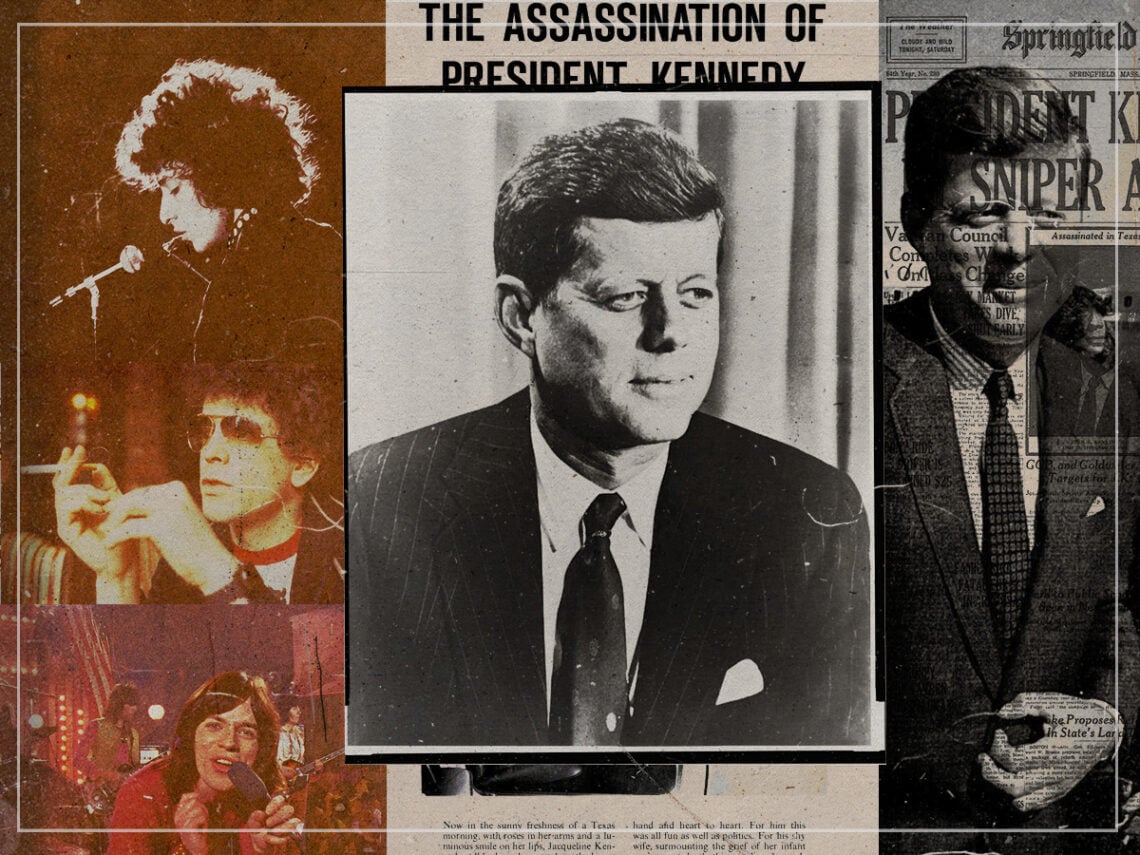
The 10 best songs about the assassination of JFK

The 20th century had many momentous junctures. Yet, outside of the two World Wars, arguably the most consequential was the assassination of President John F. Kennedy in Dallas, Texas, on November 22nd, 1963. He may have been a controversial character, but regardless of what side of the political debate you sit on, it is undeniable that those brief minutes in the Lone Star State altered the century’s trajectory.
A Democrat from a prominent political family, Kennedy’s life is storied. The youngest ever president when elected, Kennedy was in office when the Cold War was at its peak, and the threat of nuclear annihilation was closer than it had ever been, a period which brought many obstacles. Still, this is only the tip of the iceberg regarding his life. From his politics to his exploits out of office, which included claims of affairs with Marilyn Monroe and Marlene Dietrich, Kennedy was a cultural force.
Yet, his life’s most famous, perplexing and heartbreaking moment was its end. Gunned down at age 46 when riding in the presidential motorcade through Dallas, the circumstances surrounding it are as mysterious as they come. Was it Lee Harvey Oswald who killed the president of his own supposedly communist volition? Or was he just a patsy for a broader political conspiracy? We will likely never know for certain, as Oswald himself was murdered only two days after JFK, and thousands of documents relating to the investigation remain classified.
Regardless, for the supporters of Kennedy, it was the day the dream of tangible peace in the world and American democracy died. Understandably, the arcane and brutal nature of his death prompted intense distrust in the establishment from the younger generation. This would become a prominent feature of the counterculture later in the decade.
Accordingly, the life and death of JFK has permeated music in the years since that day in Dallas, with a list of legends addressing the assassination in their songs. We’ve compiled the ten best. Find the list below.
10 songs about the assassination of JFK:
10. ‘Conspiracy Theory’ – Steve Earle
Despite being ostensibly a country rock musician, the legendary Steve Earle is one of music’s most outspoken socialists and, in 2017, decried the then-incumbent President Trump as “a real live fascist”. Fusing his swaggering musical excellence with a political slant has made the bandana-donning Texan a distinctive and influential artist.
He covered the JFK assassination in the track ‘Conspiracy Theory’ from 2002’s Jerusalem. A duet with Siobhan Kennedy, it’s a funky number, fusing the stoned essence of the counterculture with Earle’s gritty guitar. Addressing the deaths of both JFK and Martin Luther King in the track, Earle sings: “What if you could’ve been there on that day in Dallas? / What if you could wrestle back the hands of time / Maybe somethin’ could’ve been done in Memphis / We wouldn’t be livin’ in a dream that’s died.”
9. ‘Brain of J’ – Pearl Jam
Pearl Jam frontman Eddie Vedder has a penchant for covering macabre and challenging subjects; it is one of the reasons that the Seattle band were able to appeal to Generation X so greatly at their peak in the early 1990s. He’s also discussed the assassination of JFK in one of the band’s most overlooked and arguably emo tracks, ‘The Brain of J’.
Taken from 1998’s Yield, the track is a direct number featuring dynamic guitars and a main chord progression straight out of the punk handbook. Wasting no time getting into the complex subject, the first line is: “Who’s got the brain of JFK?” before Vedder asks, “What’s it mean to us now?” The latter is referring to the fact that in 1966, Kennedy’s brain was discovered to be missing from the National Archives, where it had been since his autopsy on the night of his murder.
8. ‘Born in the 50’s’ – The Police
People might not think of The Police as a particularly political band, given Sting’s general pretentiousness and the group’s shared dedication to supposed musical refinement. Yet, each band member was old enough to have enjoyed the counterculture and the 1960s when they were at their peaks, which philosophically made its mark on them moving forward. Furthermore, The Police emerged from the post-punk movement, which repackaged the hippie ethos for its own era.
Accordingly, on the group’s ridiculously named 1978 debut album Outlandos d’Amour – which features classics such as ‘Roxanne’ and ‘Can’t Stand Losing You’ – frontman Sting covers the JFK assassination on the track ‘Born in the 50’s’. Vocalising how the younger generation felt watching JFK die, he sings: “My mother cried / When President Kennedy died/ She said it was the communists / But I knew better”.
7. ‘Oswald Defence Lawyer’ – The Fall
The late leader of The Fall, Mark E. Smith, covered many topics in his time. From being wired on amphetamines to adapting William Blake’s legendary Jerusalem into a post-punk staple and even making the Christmas classic ‘Hark the Herald Angels Sing’ utterly insane, the misanthropic Lancastrian was afraid of no issue.
He also broached the JFK assassination in a fan favourite. This emerged on the earworm ‘Oswald Defence Lawyer’ from one of the group’s most respected efforts, 1988’s The Frenz Experiment, which includes the indomitable ‘Hit the North’ and ‘There’s a Ghost in My House’. One of the most surreal lyrical palettes Smith ever conceived, it references what happened that day in Dallas and the notorious magic bullet theory.
Smith sings: “Decent lawyer fishes in buckskin hat / Raccoons drown beneath his embarking mass / When he sees CIA shit flying over head fast / Goody goody looks up / In cloudless sky enhancing theory / Of zig-zag bulletline Oswald Defense Lawyer”.
6. ‘Sympathy for the Devil’ – The Rolling Stones
The Rolling Stones released many songs that captured the fevered spirit of the 1960s, with the rumbling samba rock of ‘Sympathy for the Devil’ from 1968’s Beggar’s Banquet proving one of their most effective efforts. Drawing strong influence from Mikhail Bulgakov’s book The Master and Margarita, the track mentions several historical moments, including the death of Jesus Christ, the European Wars of Religion and both World Wars.
Frontman Mick Jagger also references the deaths of JFK and his brother, Robert, who was assassinated in June 1968, in one of the song’s most memorable lines. He howls: “I shouted out / ‘Who killed the Kennedys?’ / When after all / It was you and me.” Initially, the line was “Who killed Kennedy?” but was changed to “Who killed the Kennedys” after Robert was slain.
5. ‘The Warmth of the Sun’ – The Beach Boys
The Beach Boys leader Brian Wilson knows how to prompt a moment of weighty introspection. One of the finest examples is ‘The Warmth of the Sun’ from the band’s fifth album, 1964’s Shut Down Volume 2. Written by Wilson alongside his bandmate and perennial enemy, Mike Love, this heady, blue piece was fuelled by the emotional stupefaction both felt after Kennedy’s death.
In 2016’s I Am Brian Wilson, he writes: “When the shooting happened, everyone knew instantly. It was all over the TV and on every kind of news. I called Mike and he asked me if I wanted to write a song about it. I said sure. It seemed like something we had to think about, and songs were the way I thought about things. We drove over to my office and in a half hour we had ‘The Warmth of the Sun.’ We didn’t think of it as a big song. It was a personal response. But it got bigger over time because of the history linked to it.”
4. ‘The Day John Kennedy Died’ – Lou Reed
Another prominent artist who was of age to understand what it represented when JFK died was Lou Reed. 21 years old at the time and studying at Syracuse University, like many of his generation, the future Velvet Underground leader was astonished at what occurred in Dallas. In the solo effort ‘The Day John Kennedy Died’ from 1982’s The Blue Mask, the 40-year-old Reed recalls where he was on that day with candour.
He was in a bar watching university football when the television announcement informed him of the news. He sings: “I remember where I was that day, I was upstate in a bar / The team from the university was playing football on tv /Then the screen want dead and the announcer said, / There’s been a tragedy”.
3. ‘We Didn’t Start the Fire’ – Billy Joel
Billy Joel is another artist who was a young adult when JFK was murdered. So, when he came to write the iconic race through history that is 1989’s ‘We Didn’t Start the Fire’, the topic was on his mind. 40 years old when he penned the masterpiece, he did so after a conversation with a friend of the 21-year-old Sean Lennon, who was complaining about how hard people of his generation had it. This prompted Joel to reflect on how bad people thought they had it at that age, with the Cold War trudging on.
The song is a comprehensive journey into the history of the 20th century from Joel’s perspective, mentioning everything from the Nazi war criminal Adolf Eichmann to Beatlemania. In the most famous line outside of the chorus, Joel gruffly shouts at the end of the seventh verse: “JFK – blown away, what else do I have to say?”
2. ‘He Was a Friend of Mine’ – The Byrds
As one of the leading lights of the music of the counterculture, The Byrds produced many songs that spoke to their generation’s mindset. Most famously, they reimagined Bob Dylan’s ‘Mr. Tambourine Man’ and Pete Seeger’s ‘Turn! Turn! Turn!’.
One of the most profound numbers The Byrds released was ‘He Was a Friend of Mine’, a tribute to the Democratic legend John F. Kennedy. A reworking of the traditional folk song, with new words by leader Roger McGuinn, laments the President’s death in 1963. He sings: “He was in Dallas town / He was in Dallas town / From a sixth-floor window, a gunner shot him down / He died in Dallas town/ … Leader of a nation for such a precious time / He was a friend of mine.”
In a 1998 interview, McGuinn explained how the song emerged: “I wrote the song the night John F. Kennedy was assassinated. I suppose you could say it’s one of the earliest Byrds songs. The arrangement used was as I’d always sung it. I just thought it was a good idea to include it on the Turn! Turn! Turn! album.”
The track would also play a significant role in the history of The Byrds. After they played the song during their appearance at 1967’s Monterey Pop Festival, David Crosby made a series of controversial remarks about the death of JFK, claiming that Lee Harvey Oswald did not kill him on his own. This only hastened the end of Crosby’s time in the band.
1. ‘Murder Most Foul’ – Bob Dylan
Bob Dylan knows how to write a song better than most. With over 60 years of experience, he’s written some of the most incisive poetry the world has ever known, to the extent that in the 1960s, he was dubbed ‘The Voice of a Generation’. Although he might have experienced a varied and oscillating career since those days, the quality he has produced has, for the most part, been remarkable.
Reflecting this point is that 2020’s Rough and Rowdy Ways, his 39th studio album, features some of his finest moments to date. Undoubtedly, the highlight is ‘Murder Most Foul’, a trip down memory lane that puts Billy Joel’s ‘We Didn’t Start the Fire’ to shame. Thought-provoking and emotional, and clocking in at nearly 17 minutes, this piece of artistic refinement will likely be remembered as one of the Duluth troubadour’s finest.
Opening the song, Dylan sings: “Was a dark day in Dallas, November’ 63 / A day that will live on in infamy/ President Kennedy was a-ridin’ high / Good day to be livin’ and a good day to die / Being led to the slaughter like a sacrificial lamb.”

Never Miss A Tale
The Far Out Bob Dylan Newsletter
All the latest stories about Bob Dylan from the independent voice of culture.
Straight to your inbox.