


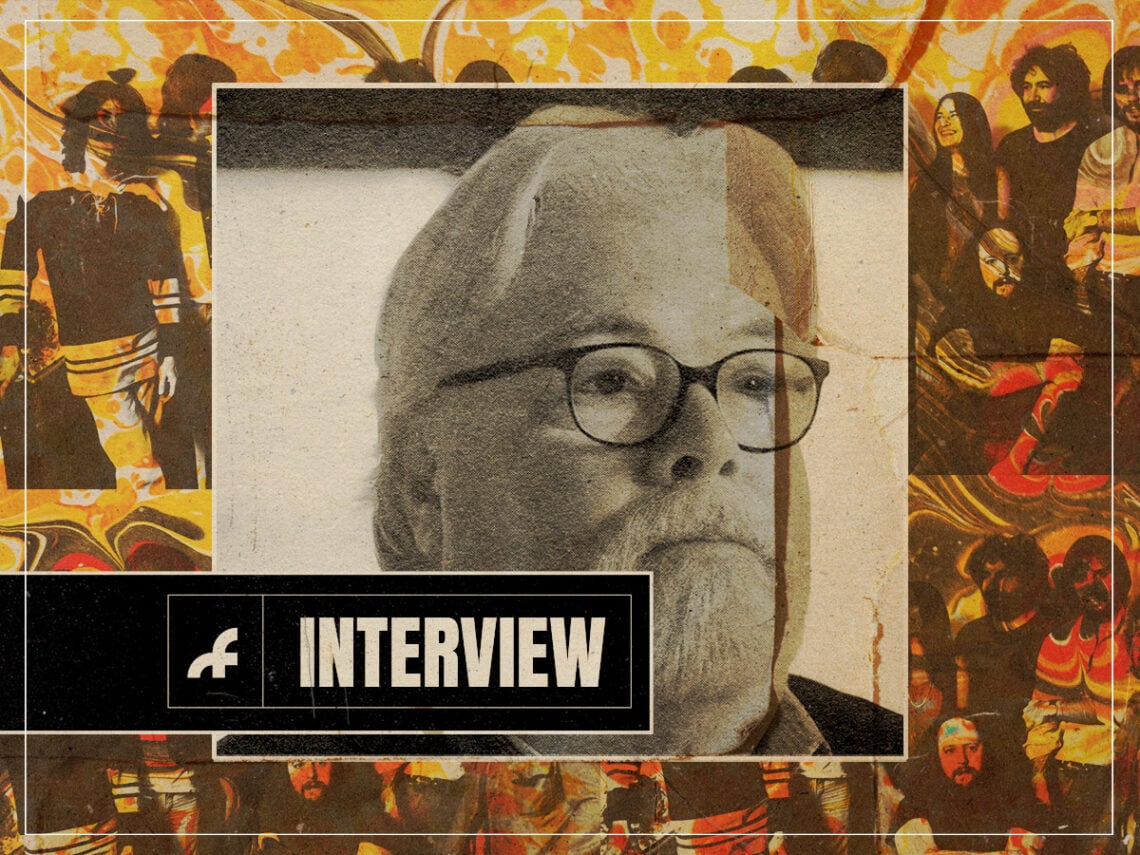
“Do no harm”: Robert Mooney on his journey from the Grateful Dead at Winterland to ‘Homicide: New York’

Robert Mooney has lived a life of simply incredible proportions. The retired New York homicide detective is celebrated for his intellect, empathy, and people skills. These attributes played a critical role in solving high-profile cases such as the 1997 Central Park slaying and the East Harlem Serial Killer. And he claims the crux to solving all these crimes was a love for the Grateful Dead. He recently stood out from a luminous cast of colleagues on Netflix‘s hit docuseries Homicide: New York, where he made this criminal curio known.
The show is a fresh take on the classic murder documentary, resonating with audiences thanks to its lucid exploration of the effects crimes have on those tasked with solving them. Mooney’s concluding observation that working over 1,500 murder cases and witnessing 700 autopsies left individual injuries that never healed was particularly hard-hitting.
Yet, it was not only Mooney’s immense emotional capacity regarding the cases that left a mark on viewers. It was the fact that in the ‘Central Park Slaying’ instalment of the show, he was revealed to be a lifelong Grateful Dead fan. An ardent Deadhead, his dedication to Jerry Garcia’s troupe of sonic voyagers influenced his people skills and professional conduct.
Distilling this inextricable connection to the legendary ‘Touch of Grey’ band is the moment in the episode where he refuses to take his Dead pin badge off his lapel before testifying in court. “Pfft, not happening,” he told an uptight young DA. He either testified with the pin or didn’t testify with the pin; either way, the story ended with him wearing it.
Naturally, I was fascinated by the tale of how two spiritually antithetical forces in the definitive countercultural band and being a homicide detective could be seamlessly reconciled. Yet, according to the New Jersey native, they are two things that have more in common than we might expect. In an eye-opening conversation, Mooney humanised both aspects, outside of the wild tales of LSD-taking that often characterise the former and the negative opinions wildly held about law enforcement of all kinds.
I spoke to Mooney over Zoom as he and his wife were returning from the mountains in North Carolina to their home on the coast. He had done his share of the eight-hour drive; it was now her turn. “It’s amazing that this is actually, like, this big,” he says of the hit Netflix show, noting that he had done several similar things in the past, but “nothing that has garnered the kind of attention that this thing is getting.” He’s getting calls from Fox News and producers from other prominent companies, as well as an array of social media messages from crazy cat ladies in need of a detective. “I’m like, ‘Oh, man. I’m retired,'” he warmly laughs.

Mooney believes the success is due to the showrunners’ approach. He thinks their concentration on their subjects’ behaviours and emotions has been critical.
The show treats investigators as people with lives beyond crimes, so it wasn’t long before we were diving into his lifelong fandom of the Dead. “I’m about to be 67 years old…” he says, before noting that since iconic Grateful Dead bandleader Jerry Garcia died in 1995, he’s only been to a handful of shows by the band’s spin-off acts. “I love the music, I love it, but it’s not the same thing,” he explains. Furthermore, as outlined in the show, he’s over being in big crowds and lives at the beach to escape the hustle and bustle.
I wondered how he reconciled being a Deadhead with his line of work, as it’s a tremendous paradox to the outsider. However, he had a full-bodied explanation. “It’s certainly incongruous, to say the least, but my opinion is it relates to myself and my behaviour,” he notes. “I started going to Dead shows when I was 15 and have probably been to 250 or 300. I couldn’t tell you a solid number, but it’s at least that many. The community that exists at the shows, and even when you’re not there, is everybody’s just nice to everybody else. There’s a lot of kindness. There’s a lot of concern for other people.”
This environment is not the same for many other prominent rock acts from the era, with Mooney naming The Rolling Stones as an example, as his wife is a big fan. When they went to watch Mick Jagger and the band a couple of years ago, what he discovered was utterly different. Their audiences are more aggressive, for one. With the Dead, “half of the experience is the crowd,” you’d get there before, and the parking lot would be a big party, with fans genuinely interested in each other.
“That sort of socialisation allowed me to have a much more open mind about the kind of stuff I would deal with in the police,” Mooney continues. “It’s just something that shaped my behaviour for years before joining the police; you are the sum of your experience. Going to the police with that background allowed me to see things and understand things some of my colleagues didn’t.”
Saliently, he continues: “You’re much more accepting of people that are a little bit different, their culture is a little bit different, or they’re from different ethnic or racial backgrounds. There’s nothing in the Grateful Dead experience that people ever do to exacerbate problems in those worlds. Everybody wants everybody else to be happy and have fun; as long as you’re not hurting anybody else, you can do whatever you want. So, therein lies the line that gets drawn in the sand while I’m working.”
The records that got the future police hero into the Grateful Dead were 1970’s Workingman’s Dead and the follow-up later that year, American Beauty. After hearing their refined psych-folk fusion, he knew he had to see them live, and his dedication to them continued to expand.
Was Mooney deeply ensconced in the counterculture as you’d expect? Not particularly. His father was a cop, and his mother was a nurse. While they didn’t abide by generally rebellious behaviour, they were “pretty open-minded,” which he credits with giving him a foundation of “not judging people.” As they weren’t adherents of countercultural behaviour, though, the young Mooney tried his best not to expose them to it. Cutting a different figure from the stereotypical policeman, he still partook in his share of teenage hijinks: “Did I do things when I was a kid that the police department would go crazy over? Probably, certainly, I did, but it’s nobody else’s business at that stage.”
While most civic agencies like the police would disagree, Mooney believes “the proof is in the pudding,” so to speak. His ability to do his job can largely be attributed to his interactions with other human beings during this era. You learned every time you conversed with someone, and whether they were good or bad lessons, it was “always a positive thing for you.”
Heading down memory lane, Mooney was reminded of a “funny story”. It was Christmas of 1978, and he’d returned home from college for the holidays. One evening, he went to a local watering hole he frequented while living at home and bumped into an old friend who informed him her brother was now living in San Francisco, the former centre of the counterculture. The brother had 25 tickets to the Grateful Dead’s iconic The Closing of Winterland on New Year’s Eve, the last-ever concert at San Francisco’s Winterland Arena, one of the band’s favourite venues.
Eager not to miss it, by the end of the night, a gang of six friends, including Mooney, “piled in a van and drove to California.” It took three days to get there, and the gang of cash-strapped students pledged all their funds. He recalls: “I’m halfway there, and I call home from somewhere in Colorado, and my mother’s like, ‘Where the hell are you?’ and I’m like, ‘It’s kinda a long story, but I’m good, I’m safe, I’ll be alright, I’ll see you in a few days.'”
It’s safe to say his mother was not happy, but with three other children to worry about and the fact that Mooney generally did not get himself in trouble, she resigned herself to it. However, when he got home, he “certainly got an earful from both of them.”
The following morning, New Year’s Day, when the fans were still coming down from the storied show that had gone on all night, the legendary impresario Bill Graham, who played a pivotal role in the countercultural scene and the story of the Dead, had turned the lobby into a cafeteria and was feeding everyone who remained. This reflected the band’s gregarious status as “very early pioneers” in looking after their workforce. Everybody who worked for the band was cared for with health insurance, retirement money, and the like. It was hippiedom in praxis.

As a baby of the 1990s, far too young to experience the band at their peak, I queried whether the Dead were better live than on record. It was hard to answer, as it varies, but Mooney tells me that 1971’s live album Grateful Dead, better known as Skull and Roses to fans, is, in his opinion, “the greatest live recording that exists”. His highlight is the transition between ‘Not Fade Way’ and ‘Goin’ Down the Road Feeling Bad’. “Garcia was on fire, on fire,” he asserts.
Again, cutting a different figure from a renowned policeman who cracked many horrific cases, Mooney outlines: “All of a sudden, they’re switching from one song to the other. There’s no stopping. You can hear this slide up the neck, nice and slow, and it brings everybody down to the same tempo. It’s the greatest.”
How exactly did Mooney become a policeman, then? He recalls being in his early-mid 20s, teaching American history in high school and working as a bartender in the evenings, where he was somehow making more money than during the day. Although he was grafting until the early hours and needed to be back in school by 8am, he was living “the dream”. As we all know, bouncing back is easier during that stage of life.
He had already taken a couple of tests for the police in New Jersey, but the “hardcore military aspect” was grossly off-putting. However, one day, his father, still a serving officer, returned from working in Manhattan. He had been at a precinct where they were handing out applications at the front desk and suggested he try it.
Lo and behold, a year later, Mooney was a New York City policeman. When his mother found out his father had promoted the idea, “she nearly killed him.” It goes without saying that the Big Apple back in those days was not a pleasant place, as we are reminded by fictional renderings such as Taxi Driver and the work of Alan Vega and Martin Rev in Suicide. “It was crazy,” he notes, contending that after a period of marked improvement, the city has now regressed.
The year Mooney joined the force was 1983 when the crime rate was out of control and somehow kept getting worse. He adds: “In the early 1990s when I was a new detective, there were 2,500 homicides per year.”
Offering a further comment on how he really reconciled being a Deadhead and an NYC policeman, Mooney asserts: “The number one rule in the world of the Grateful Dead, just like doctors, is ‘Do no harm.’ Do no harm to anybody. When I went into the police department, I always felt like that, but I knew that there were certain people who needed to be harmed because they were harming everybody else around them. And that was our job, to protect.”
Drawing the two sides together beyond reasonable doubt, the bearded Netflix star concludes: “So, it’s not that out of line, philosophically, with being a Deadhead, you just end up with a much more involved role, rather than just talking about being nice to the people around you. It was was much more real life.”
