


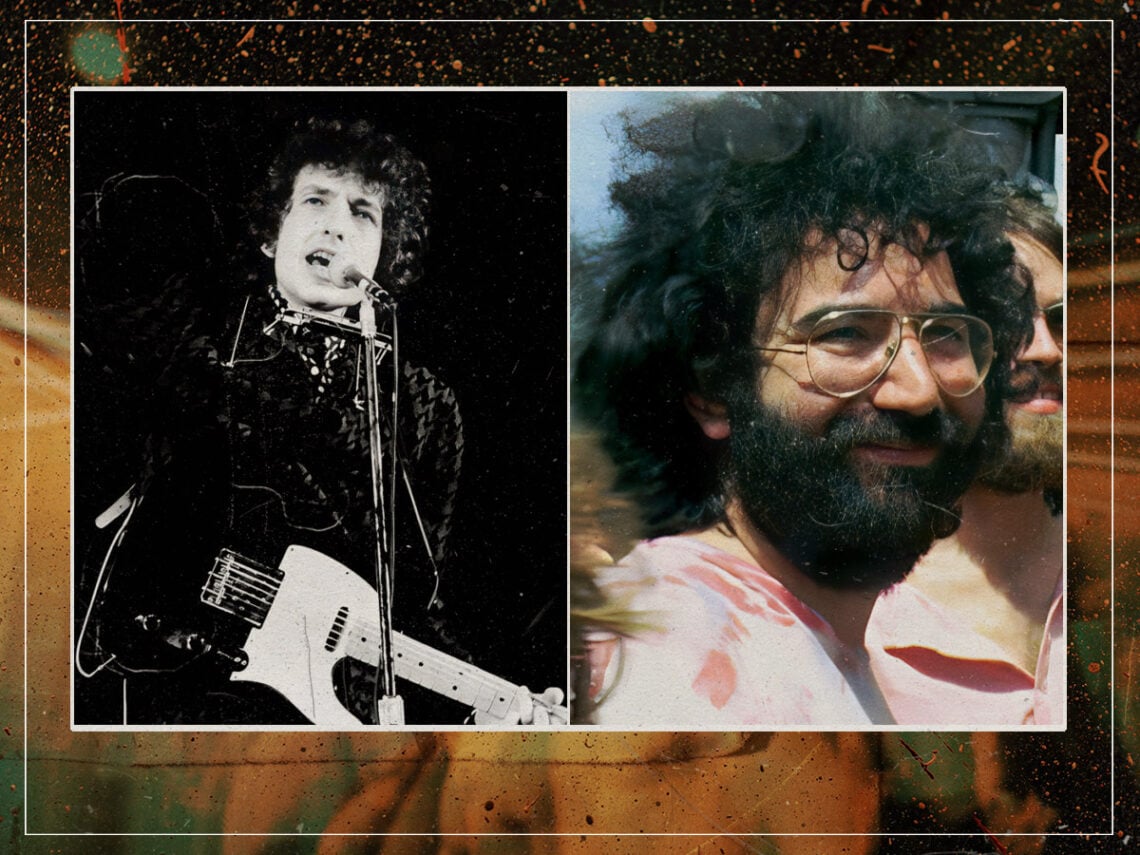
Bob Dylan explains how Jerry Garcia embodied counterculture

In the early 1990s, Bob Dylan followed his nose into the New York folk scene. Although he was as politically aggravated as the next man, the folk tradition taught Dylan to speak his mind and question authority. A unique voice completed the puzzle, and within two years of his recording career, Dylan was the voice of a generation, tempting change in a Cold War climate with popular anthems like ‘Blowin’ In The Wind’ and ‘Masters of War’.
While he couldn’t be held solely accountable, Dylan was undoubtedly one of the first dominoes to fall on the path to the hippie era. In the mid-1960s, pop-rock outfits like The Beatles, The Byrds and The 13th Floor Elevators were among the first to dabble in the oddities of psychedelia. Still, such bands would invariably cite Dylan’s Beat-inspired lyricism as a crucial turning point.
Another early psychedelic wave proponent was the Grateful Dead. Led by founding frontman Jerry Garcia, the group brought instrumental versatility to Dylan’s folk-rock innovations. Alongside his co-founding members, Bob Weir, Ron ‘Pigpen’ McKernan, and Bill Kreutzmann, Garcia also drew from blues, jazz, country, bluegrass, roll, gospel and reggae influences.
This technicolour palette was a huge hit with the hippies, and soon, the Grateful Dead became leaders of the Vietnam War-era peace movement. In this particular cult, the use of psychedelic drugs, especially LSD, was actively encouraged, giving the Grateful Dead shows a kaleidoscopic legacy.
Among their devoted fans was the author and pioneering journalist Hunter S. Thompson, also a huge Dylan fan. “If the Grateful Dead came to town, I’d beat my way in with a fucking tyre iron, if necessary,” the Fear and Loathing in Las Vegas wrote in a 1970 letter to Dave Lombardi. “I think Workingmen’s Dead is the heaviest thing since [Dylan’s] Highway 61.”
Of course, by 1970, Black Sabbath and Led Zeppelin were creating some of the heaviest rock music around, but Thompson seemed to imply a weight attained in emotional impact. Bob Dylan and the Grateful Dead had a transformative effect on their listeners and hence became central figures of the mid-20th century countercultural movement.
Dylan’s influence on Garcia was immediately apparent, but less obvious is the reciprocated inspiration. When Garcia passed away from a heart attack in 1995, Dylan was among the famous names to contribute to a Rolling Stone obituary. “There’s no way to measure his greatness or magnitude as a person or a player,” Dylan wrote, introducing his tribute. “I don’t think any eulogizing will do him justice.”
While Nobel laureate Dylan is remembered above all for his lyrical contributions, Garcia’s principal strengths lay in instrumental composition and innovation. “He was that great, much more than a superb musician, with an uncanny ear and dexterity,” Dylan added. “He’s the very spirit personified of whatever is Muddy River country at its core and screams up into the spheres. He really had no equal.”
Continuing, Dylan revealed the extent to which Garcia had inspired his post-peak career. “To me, he wasn’t only a musician and friend; he was more like a big brother who taught and showed me more than he’ll ever know,” Dylan wrote.
Although Garcia had his irons in many well-established fires, he combined them all to create a nuanced product. “He filled them all without being a member of any school,” Dylan praised. “His playing was moody, awesome, sophisticated, hypnotic and subtle. There’s no way to convey the loss. It just digs down really deep.”
During early Grateful Dead shows, Garcia would cover Dylan as one of his central idols, but they would share the stage as equals several years later. On June 25th, 1995, Dylan invited Garcia on stage to perform the encore songs ‘It Takes A Lot To Laugh, It Takes A Train To Cry’ and ‘Rainy Day Women #12 & 35’ during his tour stop in Washington, D.C. This was the last time the pair performed together before Garcia’s death on August 9th.
Listen to an audio recording from the June 1995 concert below.

Never Miss A Tale
The Far Out Bob Dylan Newsletter
All the latest stories about Bob Dylan from the independent voice of culture.
Straight to your inbox.