


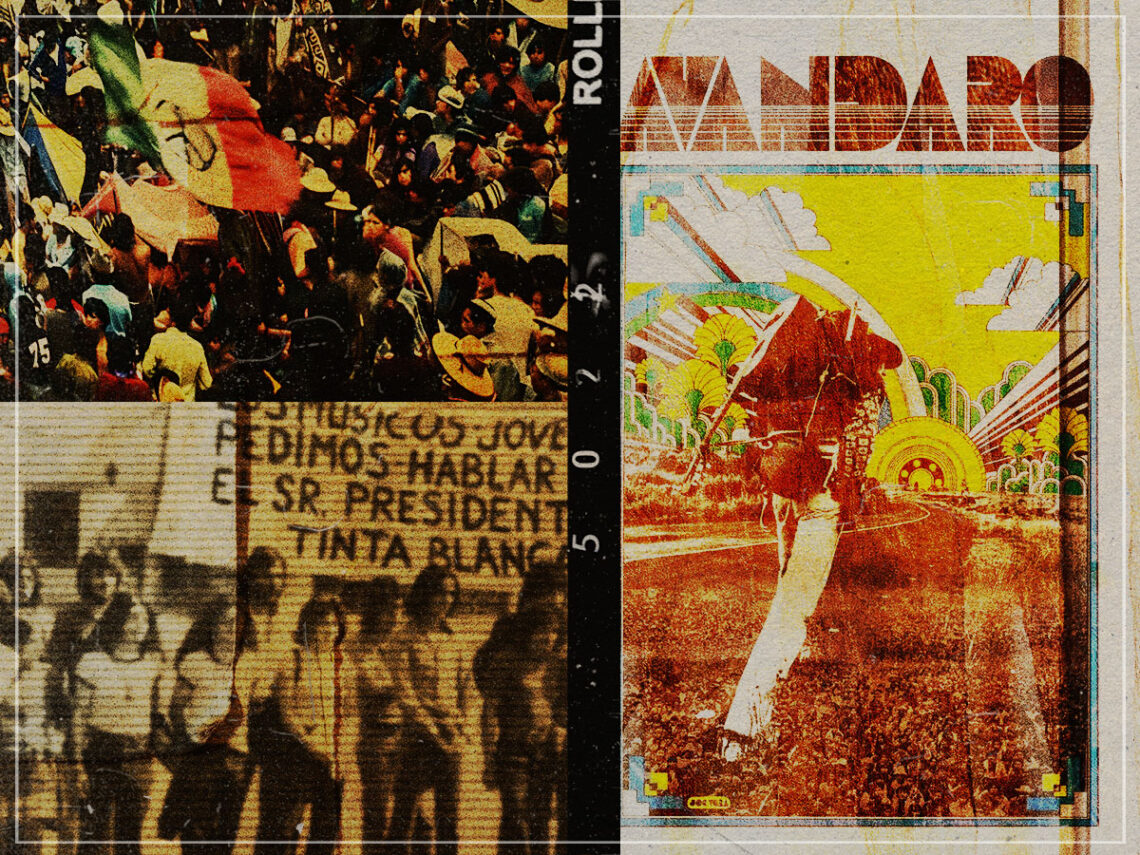
Avándaro 1971: Mexico’s countercultural answer to Woodstock

When discussing the counterculture movement, most of the conversation concerns the Global North, particularly in America and the United Kingdom. However, the countercultural philosophy spread far outside this region and had significant cultural effects in many different environments, ranging from Brazil to Japan. One location that felt the tremendous impact – although it is not widely reported in the Western media – is Mexico. This was to the extent that the Central American country even had its answer to Woodstock, and a fallout of the likes America and its allies could not have imagined.
Known as the Festival Rock y Ruedas de Avándaro, Festival de Avándaro, or simply Avándaro, the bonanza was an organised attempt by Mexico’s counterculture movement to enact change in the face of a government they had long been in conflict with. A historic rock festival held between September 11th and 12th on the shores of Lake Avándaro in the hamlet of Tenantongo in the central State of Mexico, the event was organised by the brothers Eduardo and Alfonso Lopez Negrete’s company, Promotora Go, alongside McCann Erickson executive Justino Compeán and Telesistema Mexicano producer, Luis de Llano Macedo.
Held at the height of La Onda (The Wave), the multidisciplinary artistic movement created in Mexico by artists and intellectuals as part of the broader global counterculture, it celebrated youth, music, peace, free love, ecology and life itself, with many parallels to Woodstock, which had taken place two years prior. There was psychedelic music, artwork and even a dash of chaos, with the attendance estimated from 100,000 to 500,000.
The festival was originally due to include 12 bands booked by the impresarios Armando Molina Solis and Waldo Tena, but eventually, 18 acts performed to an enormous crowd. The event was captured in film, with the audio caught by Polydor Records and a live radio broadcast sponsored by none other than The Coca-Cola Company. It was further immortalised by photographers such as Nadine Markova, Graciela Iturbide, and Pedro Meyer.
For context, in 1971, Mexico was ruled by the centre-right Institutional Revolutionary Party (PRI), which did so uninterrupted for 71 years, from 1929 to 2000. They were attempting to gain a reputation as a modern country to the outside world. This concerted effort saw them host the 1970 FIFA World Cup and the 1968 summer Olympics. However, their efforts would today be classed akin to sportswashing. Running concurrently to their extensive PR campaign was that the Institutional Revolutionary Party violently put down political opponents, with two of the gravest moments being 1968’s Tlatelolco massacre and June 1971’s El Halconazo massacre. All the while, the Mexican Dirty War, between the PRI and left-wing student and guerrilla groups, raged in the background.
Beginning with the importation of American and British rock ‘n’ roll into Mexico, the idea of the counterculture movement started to spread. This gave way to the Mexican branch of the hippies, known as the “Jipitecas”, a term coined by the supportive priest and scholar Enrique Marroquin. They spearheaded La Onda, which did not endorse a violent overthrow of the PRI but wanted stark change nonetheless.
Aside from the violence of the Dirty War, a few events had a particular effect on the Jipitecas ultimately hosting Avándaro. The hit musical Hair was banned by the PRI in 1969 after a performance in Acapulco, the rock band Los Shakes were censured, impresario Alfredo Elias Calles was investigated – despite being the grandson of late President Plutarco Elias Calles – and the deportation of those behind Hair, Michael Butler, Gerome Ragni and James Rado. Understandably, this cultural crackdown by the government attracted heavy coverage from prominent American media such as Time and The New York Times.

Furthermore, in 1969, the controversial band Pop Music Team were censored due to the hit ‘Tlatelolco’, which was released only months after the 1968 massacre on their album, Society is a Shit. Despite being popular amongst the younger generation, ‘Tlatelolco’ only received two weeks of airplay before being censored. Famously, the band would support The Doors in Mexico City before breaking up in 1972 after the government crackdown on La Onda following Avándaro; ‘El Avandarazo’.
Elsewhere, in February 1971, in Monterrey, the collective band Sierra Madre, led by the eminent Teja Cunningham and featuring the pioneering light show Music and Light Show, were quashed after their failed attempt to hold the three-day concert Concierto Blanco (White Concert) inside the state government palace in the city’s main square. This led to more violence.
As if they needed any more convincing for a show of solidarity, The Jipitecas were inspired to host Avándaro by the success of American festivals like Woodstock and Monterey Pop Festival, which gave them more fuel to hold a significant event for the counterculture.
Enter brothers Eduardo and Alfonso López Negrete. In the right place at the right time, the Negretes were looking for a means of resurrecting their famed auto race, Circuito Avándaro, after it was cancelled due to the death of Formula One driver Moisés Solana in 1969. They partnered up with McCann Vice President Justino Compeán and decided to organise an expansive auto race with added live rock music acts. They then worked with the Telesistema Mexicano promoter, Luis de Llano Macedo, to record the motoring and hire the two most popular Mexican rock acts, Javier Bátiz and La Revolución de Emiliano Zapata.
At the time, de Llano was producing a piece named La Onda de Woodstock for news anchor Jacobo Zabludovsky’s programme, Hoy Domingo (Today Sunday), so he was in the perfect place. To organise an event rivalling Woodstock, he assembled a team of roughly 330 to manage the musical side of the festival, which included Armando Molina, Carlos Alazraki, Roberto Naranjo and Eduardo Davis.
Molina would prove to have an instrumental role in Avándaro. As he was a musician known for being in the band La Maquina del Sonido and an impresario, Molina was appointed the position of Music Coordinator. The coordination of the musical aspects was placed in the hands of Arte, the company owned by Molina and fellow musician Waldo Tena – of the band Los Rebeldes del Rock. Eventually, Molina managed to book 12 artists, and the esteemed graphic designer Joe Vera was enlisted to design the official poster. Strangely, tickets were sold for MX$25 at AUTOMEX-Chrysler agencies across Mexico.
Gaining support from the media, Zabludovsky was a big proponent of the festival, with his daily news programme promoting it and coming to its defence in the aftermath.
Five hours were bought on Television to live-broadcast the race, interspersed with music recorded the day before. Some reports claimed that a maximum of 25,000 attendees, 122 drivers with their staff and 12 Mexican bands, with the slight possibility of American acts arriving, were expected. As planned, the bands would play from 7pm on the Saturday to 7am the following morning, giving way to the race’s start. It was later revealed that one of the American bands was to be Santana, but that never materialised.
Eduardo Negrete and Juan Montes de Oca Loza, the Mayor of the nearest town, Valle de Bravo, agreed that no alcohol would be sold, with beer only available with a meal. A radio interview with Armando Molina later revealed that Mayor Montes de Oca advised the Valle de Bravo populace to be polite to the incoming hippies despite being overwhelmed by their legions. Remarkably, not one inhabitant complained, regardless of the chaos that ensued.
Due to the mass of attendees that converged on the Tenantongo site, it was decided early Saturday morning that the auto race was cancelled. Bringing this snap decision into context, thousands of Jipitecas were already on location from the Friday, leading de Llano to famously quip: “They survived for three days sharing rain and mud; that was in attempt to have an identity.”
In the official soundtrack narration, Molina and his assistant, Jaime Almeida, maintained that the entire event was held in peace but that the attendees destroyed the barricade and invaded the exclusive areas of the stage and light towers. However, in the soundtrack, the desperate calls for calm from one of Molina’s other assistants, Robert Naranjo and the bands Dug Dug’s, El Epilogo and Peace and Love are clearly audible.

At one point in the day, an audience member fainted, and singer Maricela Durazo instructed the rest of the crowd to protect her. Later, the Chief of the Medical Team and the on-site improvised hospital listed the day’s casualties: “There was one case of acute appendicitis, 20 intoxicated with pills, 50 with marijuana, 5 with alcoholic congestion, 5 cases of gastroenteritis and some with wounded heads, ankle fractures and burns.”
The usual festival chaos wasn’t over yet, however. In the early hours, the photographer, Nadine Markova’s truck caught fire, with images of the firefighters attending the scene some of the most well-known of Avándaro. Even de Llano has recalled the event in detail on numerous occasions.
In a strange convergence of the powers that be with the Jipitecas, the governor of the State of Mexico, Carlos Hank, sent 300 buses to ferry some of the attendees home. Cheers from the crowd met this quite surprising news, as they could not believe he had supported them. When announcing the word to the audience but wrongly crediting President Luis Echeverría with the buses, de Llano said: “Let’s cheer up Luis Echeverria, who is gonna send 300 buses of 50 seats each so we can go back…is a good guy that fella”. 300 was not enough, though, and in a sign of the times, the thousands of Jipitecas overwhelmed the buses as even 15,000 seats were just a drop in the ocean.
Whilst the aforementioned aspects of chaos were poor, they were nothing compared to Altamont and Woodstock 1999. Yet, Avándaro stands out in the memory for the further controversy it caused. As heard in the soundtrack, Peace and Love played their controversial tracks ‘Marihuana’ and ‘We Got the Power’, which the Catholic and conservative elements of Mexican society were staunchly opposed to.
Not only did Peace and Love rail against the establishment with their music, but frontman Ricardo Ochoa also used a string of expletives to gee up the crowd, in a stark parallel to what American countercultural heavyweight Country Joe McDonald did at Woodstock two years prior.
Moments like these, broadcast by radio stations nationwide, caused a storm. Some parts of society aligned with the government, and generally conservative ones, were appalled and considered Avándaro a direct threat to the status quo. For instance, ‘Marihuana’ shocked people for advocating smoking the sweet leaf, and ‘We Got the Power’ was wrongly seen as a call to arms. This perceived link between the Jipitecas and the radical political opponents of the PRI led to the ‘El Avandarazo’.
In the aftermath of the festival, despite the many well-publicised interviews with concertgoers who also maintained it was a peaceful event, the Secretary of the Interior, Moya Palencia, accused the organisers of acting with intent. Carlos Hank also got involved, saying that the organisers “were given permission to perform a sporting event, but instead they presented a rock festival”.
As is the case with most things culturally significant, opinions on Avándaro were highly split. Most of those on the left, who were part of La Onda, including prominent writers Parménides García and José Agustín, positively reviewed the event, with intellectuals such as Paco Ignacio Taibo I, Elena Poniatowska, and Octavio Paz objectively assessing it. Elsewhere, the likes of Roberto Blanco Moheno and Eduardo ‘Rius’ del Rio criticised it.
Reflecting this schism, the Cardinal of Guadalajara, José Garibi y Rivera, condemned Avándaro, but priest and thinker Enrique Marroquin was full of praise. The latter even penned a contentious article in the countercultural Piedra Rodante magazine that defended the festival, titled God Wants the Rain So We Can Unite.
The religious front was deeply affected by Avándaro. At Mexico City’s La Profesa church, during a mass tribute to the Mexican Independence hero, Agustin de Iturbide, a group of around 250 members of a conservative civil movement departed in protest at the mass being served by Monsignor Rafael Vazquez, who had strongly supported Avándaro.
Other famous critiques came from PRI-affiliated union leader Fidel Velazquez, who described it as “a Bacchanalia”, with Attorney General Ojeda Paullada calling it a “witches’ Sabbath”. More alarmingly, the President of the Senate, Enrique Olivares Santana, passionately proclaimed at a press conference, “Let there be no more Avándaros in the Republic!”
Under pressure, President Luis Echeverría condemned the festival in a statement: “While we regret and condemn the phenomenon of Avándaro, it also encourages us in our belief that only a small part of our youth are in favour of such acts and entertainment.”
‘El Avandarazo’ ensued. A crackdown on La Onda was undertaken, with hits from the early 1970s, such as Rosario’s ‘Avándaro’ and Pajaro Alberto’s ‘Seguir al Sol’, which paid homage to the event, banned from the radio. DJs from Radio Juventud, which had live broadcast the event, Félix Ruano Mendez, Jaime Marin and Agustín Meza de la Peña, were also temporarily suspended from their positions. Contrary to popular opinion, they were not fired. However, in 1972, Piedra Rodante was shut down, with McCann Erickson executive Justino Compeán, one of the festival organisers, even fleeing Mexico for a period.
Alongside other rock acts, Tinta Blanca unsuccessfully attempted to open a dialogue with Echeverría and held a protest outside the President’s official residence of Los Pinos. After a while of not getting through, the rally was dissolved without incident.
Avándaro 1971 remains controversial in Mexico. After the ‘El Avandarazo’, rock music was effectively banned and pushed to the fringes of society, with the illegal gatherings called Hoyos Funkies at abandoned warehouses being its home. Alas, the winds of change cannot be spurned, and around this time, the global counterculture had started to collapse for a myriad of reasons, from economics to the Mansion Family Murders, and La Onda was not safe from it.
However, the popularity of Mexican rock would give way to other genres, including disco, metal, punk and prog, as well as the highly significant country-exclusive Movimiento Rupestre. This folk music swell was spearheaded by the late Rockdrigo Gonzalez, who had a defining impact on the direction of the country’s rock music moving forward.
Eventually, the importance of Avándaro would be recognised by the Mexican powers that be. In November 2019, Senator Marti Batres of the left-wing MORENA party offered his condolences to the Molina family after Armando’s death. He also announced the official recognition the Senate would give the festival. Following this, later in the month, the Mexican Senate bestowed Avándaro a formal recognition, as well as to the different musicians who featured. They also paid tribute to Molina. This effectively ended 48 years of Avándaro’s censorship.
Watch footage of Avándaro below.
