


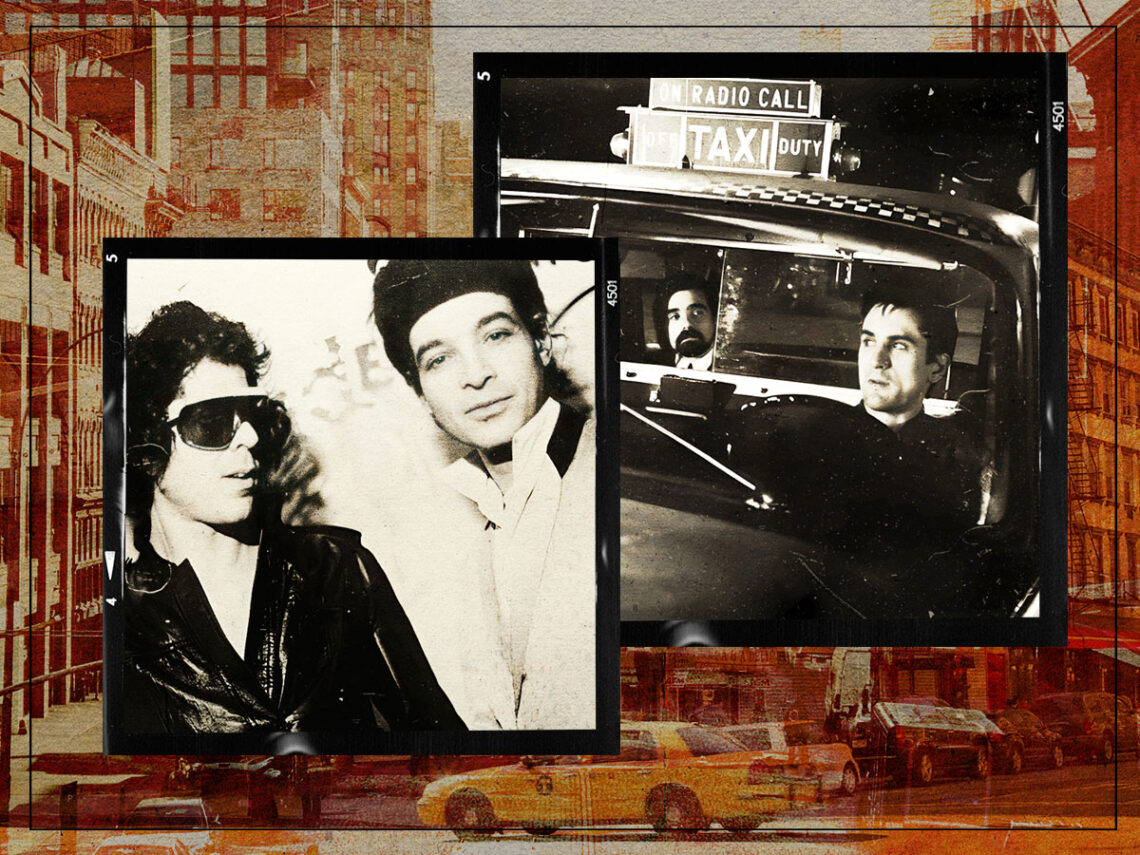
Cultural Connections: Suicide, Martin Scorsese’s ‘Taxi Driver’, and the violent nightmare of 1970s New York

Art is inherently personal. When crafting an artwork, the artist imparts lived experiences upon their creation that make it their own. However, the true power of art in all its forms extends far beyond this notion. Shared experiences allow people to understand what is before them and extract meaning related to their own reality. This also facilitates connections between different art forms, as together, they paint a larger portrait of the zeitgeist. One fascinating instance of this notion is the understanding that electro-punk pioneers Suicide and the Martin Scorsese masterpiece Taxi Driver are related.
When analysed on an atomised level, Suicide’s first two albums and Taxi Driver triumph in conveying the violence, squalor and isolation of 1970s New York City.
Suicide members Alan Vega and Martin Rev were both natives of the Big Apple, just like Martin Scorsese. They were born within ten years of each other, Vega in 1938, Scorsese in 1942, and Rev in 1947 (although Vega often lied about being younger). Together, they experienced a conurbation on the brink of lawlessness, with a dire socio-economic situation underpinning the rubble.
As both exhibits make clear, this was not a place anyone would want to be, despite the ostensible career opportunities it promised to the peripheries. We only need to look at other art created during this time to get a sense of this. Alan J. Pakula’s 1971 film Klute is one example, alongside the cultural references of Suicide’s peers in the proto-punk and punk scene. Even Sol Yurick’s 1965 novel The Warriors, whose themes apply to the following decade, all point to the same thing. Violence was omnipresent in New York City; it was a living nightmare.
New York in the 1970s was a place where crime, decadence and poverty lived side by side. Famously, there were sex shops on the corner of the iconic Times Square, the most culturally referenced area of the city. In a metropolis where there was no night and day, with both sides indistinguishable, many denizens could not escape the filth. Of course, living in such a hell hole produced great art, with Scorsese bringing the city’s grit to life twice with the 1973 movie Mean Streets and, three years later, with Taxi Driver.
Starring Robert De Niro and Harvey Keitel, Taxi Driver taps into something truly profound. Much like the music of Suicide, the movie is a broadly genre-defying offering. It’s a touch of neo-noir, in places a psychological drama, and in others a traditional thriller, with a distinctly dream-like edge that makes its themes incredibly fascinating.
Set in a morally bankrupt and decaying New York City in the years following the disastrous Vietnam War, the movie tracks De Niro’s veteran taxi driver, Travis Bickle. He works nights in the city, and his mental state deteriorates, assisted by the untamed streets. Featuring Keitel as the pimp Sport and a 12-year-old Jodie Foster as the child prostitute, Iris, although fictionalised, the movie was based on real events. This makes many aspects more harrowing because crimes like Sport’s were commonplace.
Importantly, and providing another link between the definite experiences that influenced Taxi Driver and the work of Suicide is the film’s screenwriter, Paul Schrader. His personal affairs living in New York City imbue the movie with much of its tangible nature. Schrader’s presence provided a substantial human edge to the film and one that latches on to the experience of life in the city that Vega and Rev captured on Suicide’s first two albums. “Taxi Driver was written when I couldn’t really distinguish between the pain in the work and the pain in my life,” Schrader recalled.
During an interview on The Tomorrow Show in 1981, Schrader explained that when he lived in New York City, he battled chronic insomnia. This condition led him to frequent pornographic bookstores and theatres as they were a part of the select establishments that were open all night. Adding more intensity to his situation, Schrader spent several weeks living in his car following his divorce and ensuing breakup with a live-in girlfriend. Then, after being hospitalised with a stomach ulcer, he wrote the screenplay for what would become Taxi Driver in “under a fortnight”.
“The first draft was maybe 60 pages, and I started the next draft immediately, and it took less than two weeks,” he remembered. “I realised I hadn’t spoken to anyone in weeks […] that was when the metaphor of the taxi occurred to me. That is what I was: this person in an iron box, a coffin, floating around the city, but seemingly alone”. The screenwriter also explained that he opted to make Bickle a Vietnam veteran because the national trauma caused by the conflict mirrored the paranoid psychosis of Bickle. In many ways, Bickle embodied a New York City that was on its knees. He was, in part, Schrader, but everyone else too.
There’s an argument that Schrader’s insomnia nursed the creation of the dream-like sensation of Taxi Driver and the feeling of being constantly suspended in a world that looks like our own but is not. There’s an evident absence of humanity which is established by Bickle’s increasing fraughtness. The sense that he, and by association we, are being pulled away from reality is almost inescapable. Our idea of the self and New York society rapidly changes.
Additionally, Scorsese openly looked to the camerawork of Alfred Hitchcock’s 1956 effort The Wrong Man and Jack Hazan’s 1973 David Hockney biography A Bigger Splash for inspiration. He specifically wanted to convey a hallucinatory feeling to audiences, which was augmented by Hitchcock’s composer Bernard Herrmann and his haunting score. Like in 1970s New York City, in Taxi Driver, there are no real separators between night and day, fact and fiction, and whether Travis is a product of his environment or delusions.

Regarding the first two Suicide albums, the music is hypnotic and dream-like. Quite paradoxically, it’s also bolstered by a hefty quantity of industrial, New York-centric violence, presenting an interesting juxtaposition.
Bringing Schrader’s experiences of floating around the nightmarish city to life, Bickle does the same in his taxi. The audience gets to inspect both the primal nature of the man behind the wheel and those of his fellow citizens parading outside the cab’s windows. Loathing the people he’s surrounded by, at one point, the veteran declares: “Someday a real rain’ll come and wash all the scum off the streets.”
Of course, he means rain in the form of the violent vigilantism he undertakes later, but his sentiment can be stretched and transposed to Suicide’s approach. As Vega proclaimed, the band’s name was inspired by the title of a Ghost Rider comic issue, Satan Suicide, about the suicide of American culture in the Vietnam Age. Whilst not wishing a violent purge on New York City like Bickle, there’s a similarity in the reading of the metropolis’ condition.
This aptly moves us onto Suicide’s ethos and their intention to weaponise artistic violence to change the world. At their inception, the duo intended to be more of a performance project than a conventional band. Decked in black leather like a pair of thugs you might have encountered on the streets of their native city at the time, Vega and Rev strived to break down the barriers between performer and audience. They created an environment of total participation, regardless of whether their viewers wanted to or not. This was just like New York City; if you lived there, you were exposed to every side of it, including crime and violence.
Drawing on socialist politics and the philosophy of Iggy and The Stooges, Suicide saw violence as a way to force their largely middle-class audience to pay attention to the omnipresent social decay in New York City. “The audience would walk through the door of the venue, and they’d be in hell,” Vega told The Jewish Chronicle in 2008. “We were saying, ‘Wake up, man. You’ve gotta change this shit!'”
“For a long time, we didn’t have songs as such,” Vega said of the band’s creative violence to The Guardian in 2008. “So Marty would repeatedly kick his keyboard, and I’d hit the microphone stand with a broken bottle or make these horrible noises come out of a trumpet. Then I graduated to screaming, and eventually that led to writing actual lyrics.”
“People were looking to be entertained,” the frontman explained in the same interview. “But I hated the idea of going to a concert in search of fun. Our attitude was, ‘Fuck you, buddy, you’re getting the street right back in your face. And some.’ At one of our first shows, there was a guy in the audience who’d brought this trombone. I jumped into the audience, fell over and knocked the slide out of his trombone. These South Americans took real offence to that. So they immediately attacked us with chairs, tables, anything they could get their hands on.”
Describing the visceral extent of his individual propensity for brutality and echoing Bickle’s, Vega added: “That became the norm. I started carrying a bicycle chain on stage, figuring if you can’t beat ’em, join ’em. If the violence got really bad, what I’d do was smash a bottle and start cutting my face up. That seemed to have a calming effect on the crowd. I guess they reasoned that I was so fucking nuts that nothing they could do would bother me. I figured out a way of doing it so that I drew a lot of blood, but I wouldn’t be scarred for life. I had it down to a fine art. Another ploy I had was to lock the exit doors so nobody could escape. That was the ultimate ‘fuck you’, as far as I was concerned.”
On both the literal and figurate levels, the art of Suicide is intensely connected to Martin Scorsese’s Taxi Driver. Take the first single Suicide released, ‘Johnny’; it bears many similarities to the narrative of Taxi Driver. Echoing Bickle’s quest for love, and his increasingly violent dreams, Vega sings at one point: “Johnny, mmhmm / He’s cruising the night looking for love / He’s looking so mean, he’s feeling so tough”.
There’s also ‘Harlem’, a track taken from the duo’s second album, Suicide: Alan Vega and Martin Rev. Another literal depiction of what the band perceived, in one verse, Vega discusses how “Mr. Pimp Man” is the king of the streets, with prostitution rife in the city. Harvey Keitel’s pimp, the central antagonist of Taxi Driver, captures this quite well. Rev sings: “Yeah, Mr. Pimp Man, he is the king / Mr. Pimp Man, he is the king / Mr. Pimp Man, he is the king / Mr. Pimp Man is the king of the streets”.
And of course take the 1979 classic ‘Dream Baby Dream’, which would act as an appropriate soundtrack to Taxi Driver in substitution of Herrmann’s score. A repetitive, hallucinogenic piece, it’s a track that’s impossible to define. The work is beautifully ballasted by the modernism of the electronic drum beat and the retro-ism of Vega’s Elvis-like drawl. “It’s the dreams that keep you free,” the Suicide leader sings, in another clear similarity to not only Travis Bickle’s thoughts and delusions but the broader truth. Dreams kept many in 1970s New York City alive and limping along, despite the various hardships in their way. There might have been an ironic tinge to the song, but art in all its forms is open to interpretation.
To quote Bickle’s love interest, Betsy, she says the taxi driver is “part truth, part fiction… a walking contradiction”. This same can be said for Taxi Driver and the music of Suicide, as they work to form a more expansive, artistic rendition of 1970s New York City. They bring to life the omnipresent violence it forced upon its citizens in all its forms. By the blurring line between reality and fantasy, they both urge us to contemplate our decaying urban condition from a new vantage point.
