


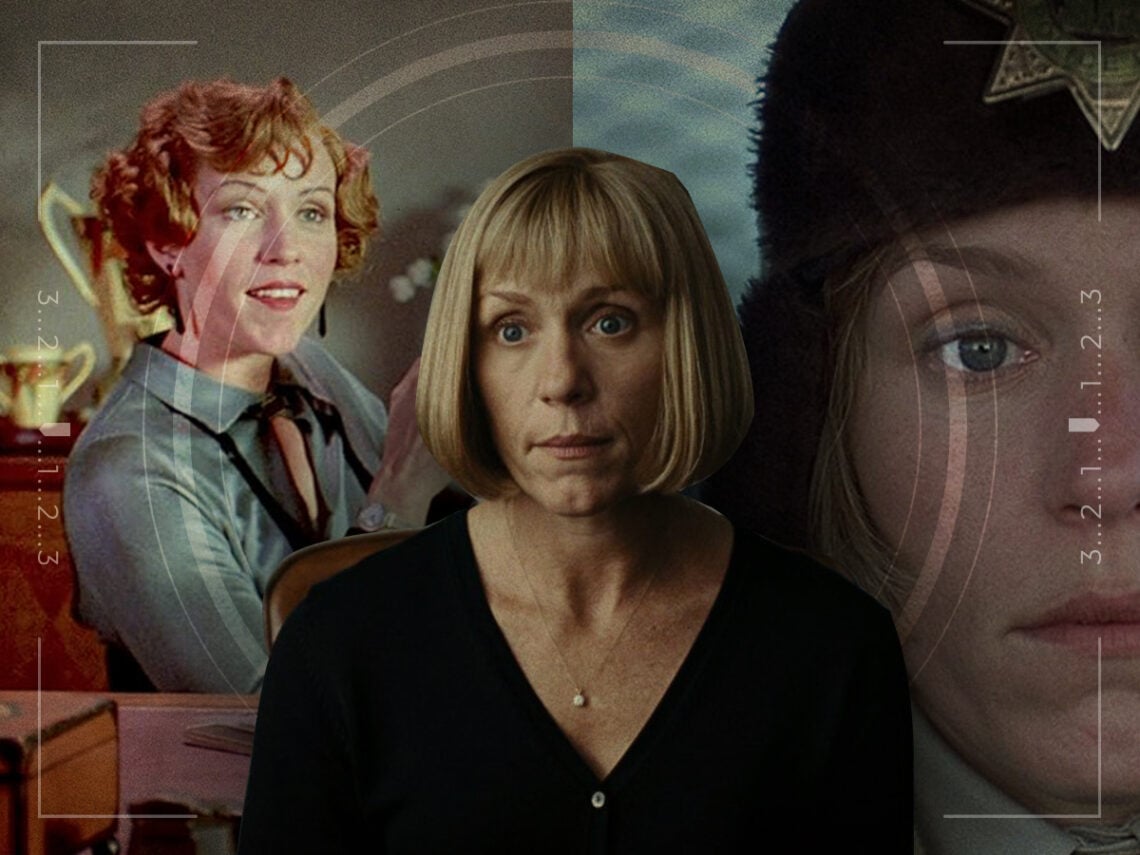
Ranking every Frances McDormand collaboration with the Coen brothers

There are some creative partnerships that have become the bread and butter of the film industry, whether it be Greta Gerwig and Saoirse Ronan, Martin Scorsese and Robert de Niro or more importantly, Frances McDormand and the Coen brothers, building a reputation as the chameleonic misfits of Hollywood as a result of their ever-evolving body of work.
Ever since their first collaboration in 1984 on Blood Simple, their partnership has gone from strength to strength and spun into new and increasingly odd genres, usually with an undercurrent of darkness, satire and nihilism that has become the hallmark of their style.
But after starring in eight of their pictures over the years, McDormand has become a staple within their filmmaking palette, adding colour and depth to each role, whether it be comedic, dramatic or their signature blend of multiple clashing tones.
And so, without further ado, let’s rank all Frances McDormand’s collaborations with the Coen brothers and celebrate the weirdness of all their wonderful endeavours.
Frances McDormand’s Coen collaborations ranked:
‘Fargo’ (The Coen brothers, 1996) <br>

As the pregnant police chief who tries to unspool the plot behind the growing body count, McDormand is full of aw-shucks warmth and folksy charm. People love to talk about how well the Coens write characters and dialogue, but without McDormand, Marge would almost certainly have turned into a semi-offensive stereotype of Midwest banality. Instead, she is one of the greatest law enforcement characters of all time, a calm, quietly skilful police chief who might seem too sheltered to take on such rampant violence but who proves herself to be made of much sterner stuff than all those “you betchas” might have you believe.
Marge Gunderson might not be the most emotionally complex character McDormand has ever played (Lady Macbeth in The Tragedy of Macbeth and Mildred in Three Billboards Outside Ebbing, Missouri certainly have the edge in that regard), but it is, without question, her most endearing and memorable. This most Coen-y of Coen brothers films is set in the frozen climes of the Upper Midwest, where a hapless car salesman (William H Macy) hires the wrong guys to kidnap his wife.
It’s a testament to McDormand’s skill that she earned an Oscar for the performance, even though it fell far outside the bounds of serious melodrama to which the Academy is so susceptible.
‘Burn After Reading’ (The Coen brothers, 2008)

There is sometimes nothing funnier than watching stories about people who are having the worst time of their lives, something that the Coen brothers have mastered throughout the course of their filmmaking career. But Burn After Reading achieves this in a uniquely chaotic way as a result of Frances McDormand’s hilarious performance in this disastrous chain of unfortunate events.
McDormand plays Linda, a woman who works in a gym and joins forces with a colleague after stumbling across a disc containing confidential CIA information, seeing it as an opportunity to earn a bit of money and pay for Linda’s boob job. The earnest yet slightly stupid duo find themselves in increasingly ridiculous situations as their money-making scheme only spirals out of their control, with a pitch-perfect comedic performance from McDormand as she desperately clings to a far-fetched and very flawed plan.
‘Blood Simple’ (The Coen brothers, 1984)<br>

The Coens’ first film was also their first collaboration with McDormand, and they had the good sense to make her a lead character. A neo-noir set in a tumbleweed outpost of West Texas, Blood Simple follows, as many of their films do, ordinary people who dip a toe into a life of crime and fall hopelessly down the rabbit hole. It stars McDormand as a young housewife who is having an affair with the bartender who works at the bar her husband owns. When her husband finds out, he concocts an elaborate plot to have them murdered, but, not surprisingly, it isn’t as simple as that.
This is the closest time McDormand has ever come to playing the final girl in a movie. She might be in over her head at first, but she quickly recalibrates to the circumstances and gives as good as she gets. The Coens didn’t give her as much to go on with the script as they would later with Fargo, but she makes the most of it. Without the brothers’ trademark quirky dialogue, everything rests on the strength of her performance, and she more than rises to the occasion.
‘Raising Arizona’ (The Coen brothers, 1987) <br>

While Raising Arizona is one of the earlier and lesser-known works from the Coen brothers’ filmography, it should not be overlooked, with another riotous story about tangled wires and miscommunications that is marked by McDormand’s presence as the wife of Glen.
With her southern drawl, melodramatic tendencies and never-ending case of verbal diarrhoea, it’s another stellar comedic performance from McDormand that further demonstrates her versatility within the Coen brothers universe, creating a goofy and insanely entertaining picture that remains as an early mark of genius within this iconic creative partnership.
‘The Man Who Wasn’t There’ (The Coen brothers, 2001) <br>

Another underrated foray into neo-noir territory, The Man Who Wasn’t There stars a reserved Billy Bob Thornton as a barber who takes up blackmail when he is given the chance to invest in what he believes to be a promising business opportunity. Frances McDormand plays his wife, who, as he suspects, is having an affair with her boss. Shot in high contrast black and white, the film is highly stylised, taking its cues from classic film noir like Double Indemnity.
Thornton is perfectly cast as the silent, elusive protagonist. His facial expressions do all the talking, highlighted to perfection by the sumptuous light and shadow of the cinematography. However, the human intrigue of the plot would be two-dimensional without McDormand’s performance. What could have been pure melodrama and stereotype is played with exacting restraint. Struggling with alcohol, unhappy in her marriage, yet unwilling to be a victim of her life choices, the character gives McDormand just enough to work with to turn in a fully-realised portrait of a woman who contains multitudes.
‘Hail, Caesar!’ (The Coen brothers, 2016)<br>

Hail, Caesar! could have been a great film. Set in the Golden Age of Hollywood, it marks the Coens’ most concerted effort to make fun of their A-list cast. George Clooney plays a preening, bumbling matinee idol named Baird Whitlock. Ralph Fiennes plays an urbane English theatre director attempting to bring some sophistication to Hollywood’s soundstages, and Channing Tatum is perfectly cast as a version of Gene Kelly. However, all that glitz and parody fail to amount to a memorable film. The communist plot is too convoluted and outlandish to hit home, and the whole thing ends up feeling like a string of loosely related sketches.
Again, McDormand’s role is limited to the colourful ensemble of side characters. She plays CC Calhoun, a formidably capable film editor in the mould of countless forty-something female character actors in the 1950s who usually played wisecracking housekeepers. Cigarette permanently jammed at the corner of her mouth, she represents the women behind the scenes in Old Hollywood who made the movies tick but who never held positions of authority.
‘Miller’s Crossing’ (The Coen brothers, 1990)<br>

Miller’s Crossing is the Coen brothers’ third film and is regularly overlooked in favour of other early gems like Raising Arizona and Blood Simple. Maybe people just weren’t ready for a period gangster movie from the oddball filmmakers. Whatever the reason, it remains one of their most underrated. McDormand doesn’t get the meatiest female role. That distinction goes to Marcia Gay Harden, who plays the brassy two-timing moll to Albert Finney’s mob boss. The story concerns a war between rival gangs and centres on Gabriel Byrne’s Leo O’Bannon, the cool-headed right-hand man to Finney’s character.
The film was a beginning of sorts for the Coens, as it marked their first collaboration with John Torturro and Steve Buscemi, as well as their first moment of bringing their trademark contrasts — poetic, occasionally goofy dialogue with in-your-face violence, the intricate, urban intrigue of gang alliances with the haunting, quiet beauty of the forest. They were firing on all cylinders with this one, and the only reason it falls so low in the McDormand ranking is because she’s hardly in it. In one scene, she plays the mayor’s secretary, bright and magnetic as ever, but only fleeting.
‘Barton Fink’ (The Coen brothers, 1991) <br>

Although McDormand doesn’t have a substantial on-screen presence in Barton Fink, it’s still important to mention as a byproduct of her partnership with the filmmaking duo. The story follows a New York playwright who heads to California to write his first Hollywood screenplay, slowly becoming plagued by the truth of the industry and unable to discern between truth and reality.
It’s a nightmarish fever dream of a film, with the nihilistic tendencies of the directors coming through in full force as Barton wrestles with his creative purpose as it slowly loses all meaning. More than anything, it’s a film about asking questions, with no clear answer as to what is happening and whether it’s entirely in Barton’s head. But in typical Coen Brothers fashion, his plight highlights the absurdity of life itself, with McDormand’s voice making a brief appearance (although uncredited) and adding to the strange surrealism of a murky and evasive film.
