


10 overlong movies that desperately needed an intermission

The intermission is a largely forgotten but crucial part of film history. In the days when movies were stored on multiple reels of film, it became necessary to introduce a break in the middle so the projectionist could change them over.
Even when this was no longer the case, audiences liked having a little break in the middle of their entertainment. It gave them a chance to spread their legs, digest what they’d seen, and, crucially, buy more snacks. This was already commonplace at the theatre, so why shouldn’t the cinema keep it up?
Sadly, the intermission is now firmly a thing of the past in most countries. With the notable exception of The Brutalist, no modern Western movies have one anymore. But what if this were to change? What movies would be the perfect candidate for an intermission revival?
We’ve picked some films, both recent and historical, that are all butt-numbingly long. They’re not all bad (although some definitely are), but they would all certainly benefit from a short interlude to help break things up.
10 films that definitely needed a break:
‘Killers of the Flower Moon’ – Martin Scorsese (2023)

Martin Scorsese has never shied away from long runtimes. His movies regularly run past the two and a half hour mark, but things got much, much worse when he started making films for streaming services. Enter Killers of the Flower Moon, his 206-minute collaboration with Apple TV+.
There’s a lot to like about this tale of murder, oil, and the Osage nation, but receiving it all in one go really dulls the experience. While there is no intermission in the official release, some cinemas took it upon themselves to put one in of their own accord. This caused a massive uproar, as Apple and Paramount deemed this to be a breach of contract.
‘The Irishman’ – Martin Scorsese (2019)

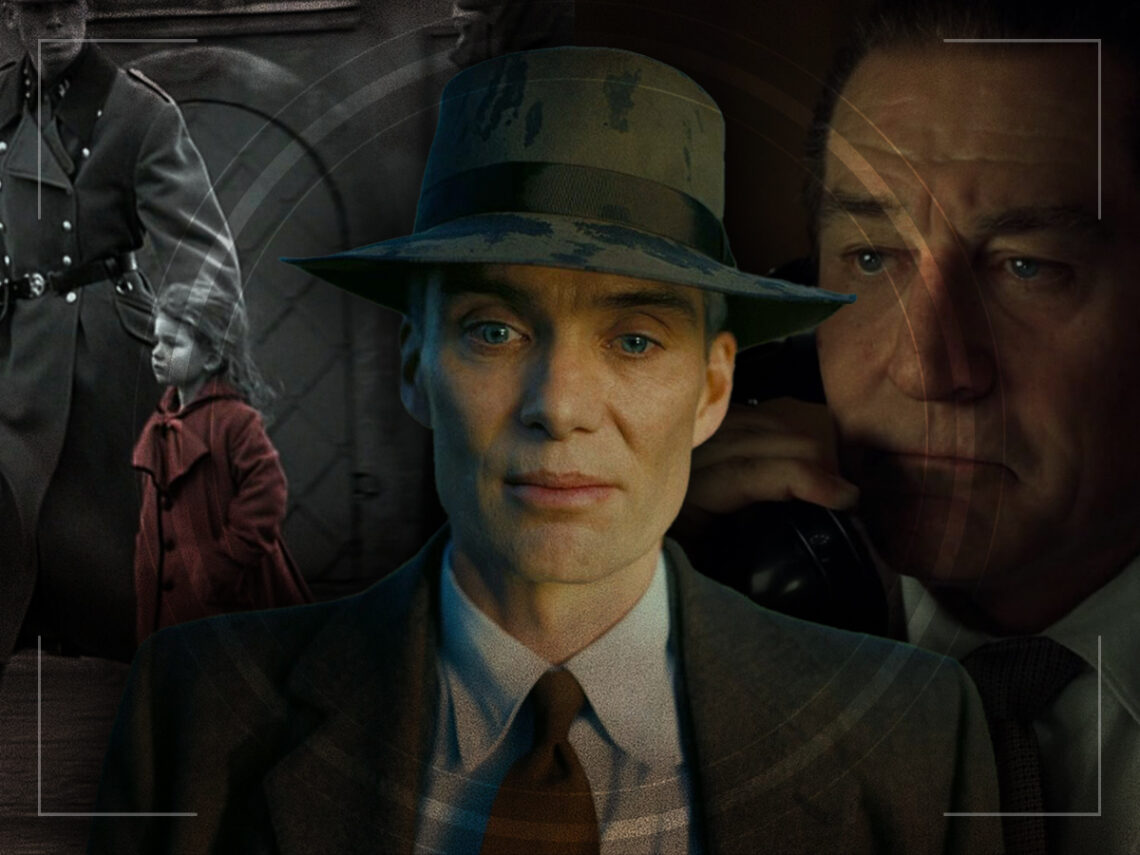
Prior to Killers of the Flower Moon, Scorsese put out another epic for a streamer: Netflix’s The Irishman. It marked the first feature-length collaboration between the director and Robert De Niro in over a decade, and grabbed headlines with its use of controversial de-ageing technology.
At 209 minutes, this is the longest narrative movie Scorsese has ever made, and oh boy, can you tell. Very few viewers made it through the runtime in one sitting, as the curse of the aching bottom or bladder hit them hard. Even though it’s easy enough to put in your own breaks while watching at home, a director-approved one would have been nice.
‘Schindler’s List’ – Steven Spielberg (1993)

Oskar Schindler is one subject who earned a long runtime. Spielberg’s stunning retelling of the factory owner’s efforts to save Jewish children from the Nazi regime is one of his greatest career highlights. Audiences across the country wept at his bravery, but the emotions could have been even higher with a little bit of tweaking.
Everything about Schindler’s List screams ‘retro’. From the camerawork to the performances to the black and white colour grading, it feels a lot older than it actually is. So, why not lean into the Golden Age feel and stick in a good old-fashioned intermission? Maybe around the moment Schindler first fully commits to his humanitarian cause?
‘JFK’ – Oliver Stone (1991)

There’s a lot to talk about when it comes to the assassination of President John F Kennedy. Countless books, TV shows, documentaries, and articles have been written on the subject, totalling hundreds of hours of content on the deceased Democrat. Yet, somehow, Oliver Stone’s 188-minute movie on the subject feels like it’s taking the mick.
It’s already hard enough to invest in some of the more outlandish theories explored in the film, but sitting there for over three hours? Or almost three-and-a-half in the director’s cut? That’s way too much.
‘Giant’ – George Stevens (1956)

Giant is best known as being one of the three feature films to star James Dean, as well as being the final one he worked on before his tragic death. It also lives up to its name, clocking in at an eye-watering 201 minutes. Needless to say, it’s also the longest film of Dean’s sadly brief career.
This tale of love and wealth in the Texan desert is undeniably a classic, but its mammoth length can be a little off-putting. Some sources claim that there was originally meant to be an intermission, but market research indicated that audiences didn’t want one. Wonder what markets they were researching because they were dead wrong.
‘Australia’ – Baz Luhrmann (2008)

On the surface, Baz Luhrmann’s Australia isn’t that long. At 165 minutes, it’s shorter than most movies on this list as well as blockbusters in the Avengers and Pirates of the Caribbean franchises. The problem is that it feels way longer. The fact that it isn’t over three hours long is genuinely shocking to anyone who has had to sit through this dreary affair.
Much like Schindler’s List, this film clearly draws inspiration from the epics of yesteryear. The story of a nervous Englishwoman moving to a foreign land and falling in love with a handsome native could have fit right in in the 1930s, when intermissions were at their peak. Baz really missed a trick with this one.
‘Oppenheimer’ – Christopher Nolan (2023)

An intermission usually comes at a key moment in the story, when something happens that changes the plot or one of the characters forever. In Oppenheimer, there is just such a perfect moment, the detonation of the atomic bomb.
The stunning explosion sequence in Christopher Nolan’s Oscar-winning milestone is the perfect place to leave the audience on tenterhooks. Imagine walking into the lobby having just witnessed one of the most important moments in world history on the big screen? It comes about two hours into the 180-minute runtime, which might be a little deep, but it feels like the most natural place to take a breather.
‘The Right Stuff’ – Philip Kaufman (1983)

Similarly to Oppenheimer, Philip Kaufman’s The Right Stuff focuses on a spectacular achievement in engineering. Over 192 minutes, it details the lives of the Mercury Seven, a group of men chosen to become America’s first astronauts. It’s an inspiring tale of mind over matter and how science can solve any problem… especially if it means beating those damn commies.
The movie failed to make a significant splash at the box office in 1983, possibly because audiences were absolutely terrified by its runtime. There’s no way of proving that an intermission would have made it a bigger hit, but surely a three-hour up movie broken into two chunks is a much more palatable prospect.
‘Children of Paradise’ – Marcel Carné (1945)

Intermissions were still very much in vogue when French film Les Enfants du Paradis (Children of Paradise in English) was released. The movie, which was produced over a number of years in Nazi-occupied France, clocked in at a staggering 190 minutes and was split into two parts anyway. Surely it would get an interval? Nope.
In fact, director Marcel Carné fought tooth and nail not to have the film released with an intermission. Cinema owners relented, but only if they could charge double the price. This turned out not to be a problem, as the movie became one of the most popular of the year.
‘Boyhood’ – Richard Linklater (2014)

Once again, we have a movie that doesn’t breach the three-hour mark (165 minutes, for those wondering). Intervals aren’t just for avoiding DVT; they can also mark the passage of time, especially for a film all about the literal passage of time, AKA Richard Linklater’s Boyhood.
Famously filmed in real time, Boyhood features several time jumps, as protagonist Mason (Ellar Coltrane) ages from six to 18. Imagine how impactful one of these jumps would be if audiences had a chance to refresh their perspective. It might have even enhanced the immersion of an already immersive film, and hey, maybe it would have won Linklater that Oscar. Who’s to say?
