


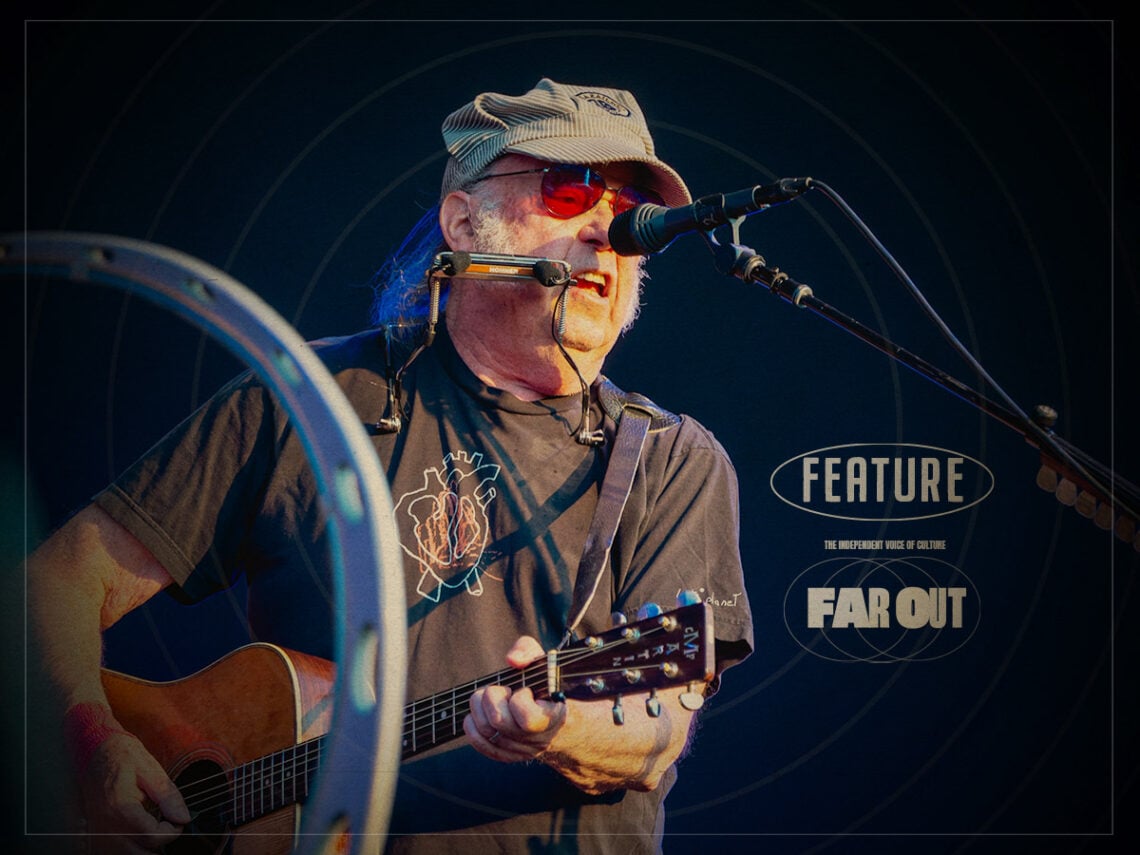
As Neil Young pulls no punches, are the days of musical revolution behind us?

Neil Young and Donald Trump continue to butt heads, as Young has released a new song which pulls no punches in his unrelenting critique of the president.
This isn’t the first time that Young has been critical of Trump. In fact, it isn’t the first time Young has been critical about politics in general. Throughout his career, he has always been willing to vocalise what he finds so frustrating about politics through his music, and in the modern age, those frustrations are aimed towards Trump. As notoriously left-wing, Young’s disdain for the proudly Republican president shouldn’t surprise anyone.
When Bruce Springsteen was travelling around Europe on his Land of Hope and Dreams Tour, he was very outspoken about his political views. Young came to the singer’s aid when Springsteen’s messages were received with a great deal of backlash. “Bruce and thousands of musicians think you are ruining America,” said Young, candidly directing his anger towards the president, “You worry about that instead of the dyin’ kids in Gaza. That’s your problem. I am not scared of you. Neither are the rest of us […] STOP THINKING ABOUT WHAT ROCKERS ARE SAYING. Think about saving America from the mess you made.”
Young is unrelenting in his critique of Donald Trump, as he has recently released a diss track called ‘Big Crime’ which once again makes his opinion of the president pretty clear. He played the song live in Chicago with his band the Chrome Hearts, where he sang, “Don’t need no fascist rules, don’t want no fascist school, don’t want soldiers on our streets, there’s big crime in DC at the White House”.
It’s not unusual for us to hear musicians openly criticise politicians. In the modern world, politics seems to be the most divisive it has ever been, as artists are constantly using social media to share stories about global conflict and government policy that they disagree with. Social media is beneficial for artists as it breaks down the barriers between them and their fans. They have a constant stream of communication between them, and while this seems to be a good thing for branding and sharing opinions, it seems to have gotten in the way of writing protest music. People discuss their disdain towards politics online rather than write songs about it because their comments have more relevancy when they’re shared immediately rather than released as a track you can’t bop to.

The roll-out for a song, and the wait time in between writing a track and it hitting the airwaves has never been longer. Bands wait over a year at times to release a song that is already written and recorded, which means writing an effective protest song is really difficult. Politics moves on quickly, and that means what someone writes about one week might not be relevant (or the story surrounding it may have evolved) a week later. It means political bands would rather write bland music that doesn’t address issues head-on and make their opinions clear online and at a gig, rather than add any meaning to their actual music.
While mainstream artists are persistently criticising modern politics, it doesn’t feed into their music as much, and it’s the nature of releasing music that stops them from doing this. During an interview with the band Within Temptation, the protest group spoke about how going independent was the only effective way that they could put out political music in a timely manner.
“Record companies take things very traditionally, and that’s for a reason that works for them, it’s so they can say ‘we’ll release the album then, you’ll have to finish the album between that day and that day because then we can release it after another band we have signed’,” lead singer Sharon del Adel explained, “So, you’re being pushed in a schedule that sometimes is too short, or too long, and, they want to always only release an album. We felt like at certain times we just want to release a single, but it has certain urgency to it.”
She continued on band dynamics, vis-à-vis the company ruling, “A record company will always try to hold on to their own schedule, which is perfectly normal, but for a band, we want to do something different. Dance music has been doing this for many years, which is releasing in the moment, singles every time. In a band, or with more traditional kind of music, it’s much more difficult because record companies are just going to hold onto the idea of an album.”
Adel commented that a band that has a platform should use that platform to publicise their views. A lot of news comes and goes, but discussing it in a song gives it longevity, meaning people are less likely to glance over an isolated issue.
“It depends, of course, on what point of view you’re standing and how people will see it. For me, it’s important to raise my voice because we have a platform, and a lot of news which is important, which is happening right now, is forgotten. The next day, you’ve read the news, it becomes like, how you say, litterbox filling. One day it was news, and the next day no one talks about it anymore,” she noted.
Adel further highlighted the heart of protest music, adding, “I think by storytellers telling the story again through music, people start releasing, ‘Oh no, that war is still going on, that fight in Iran for women’s rights or the whole generation still goes on today, it’s not won yet’.”
Of course, there are other reasons why people might hesitate to write political music, on top of the scheduling problems that record labels impose on their artists. Graham Nash mentioned in an exclusive interview with Far Out that he thinks artists are hesitant to speak up because of current censorship problems, which affect artists in the USA.
“A lot of people that write songs are really scared of retribution from the Trump administration about expressing your voices,” said Nash, “You know, America was a place where you could raise your voice, and you could criticise the government for what they were doing in their name. You could praise a country for its natural beauty and the beauty of the majority of people, which is that they have good hearts, and they want their children to come up in a better world than they had.”
Nash added, though, that while there may be retribution, artists have a duty to speak up and make their opinion on political leanings clear: “We have to speak out. I really still think every day about a quote by Nina Simone, who said ‘Every artist, whether you’re a songwriter or a piano player or a sculptor or a painter, you have to reflect the times in which we live’.”
Regarding the flip-side, however, he added, “Unfortunately, the Trump administration is trying to destroy that ability to be able to reflect the times in which we live, because the times in which we live now, politically, is a huge part of our lives, and is gunna rule our lives for a long, long time.”
The two major problems with potential censorship and strict release schedules mean that while Neil Young still releases protest music that deals with a specific issue, we may not get much more of it. It makes more sense for bands to embrace their politics in other ways, and not through their music. In the age of social media and constant connection, the face of music is changing, and that means songs directed straight at specific politicians, movements or policies likely won’t be made as much.
