


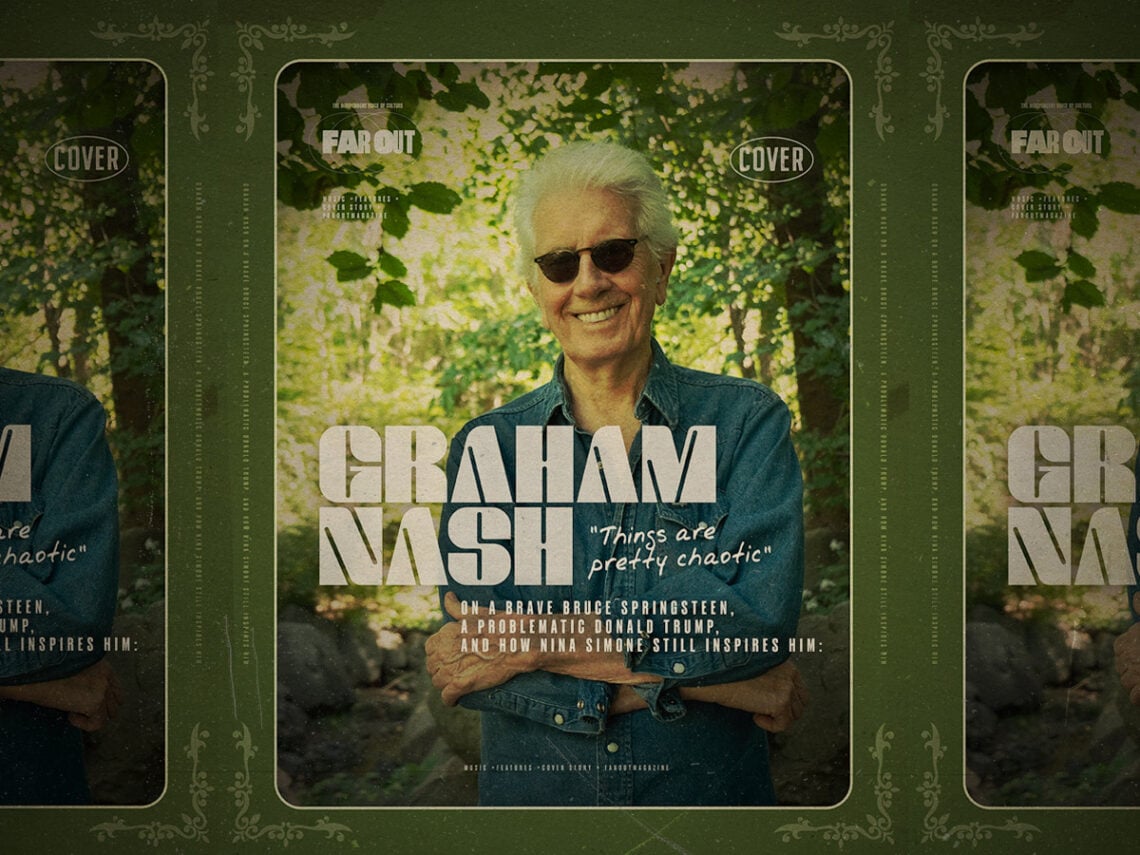
Graham Nash on a brave Bruce Springsteen, a problematic Donald Trump, and how Nina Simone still inspires him: “Things are pretty chaotic”

Graham Nash is returning to the UK in a few months for a run of shows up and down the country. In the build-up to the tour, I was given the chance to interview him. No new album or anything like that, just his entire discography and a string of dates in October 2025. Where do you even begin putting together a decent set of questions when you have such a vast career and discography to talk about?
Ever since he started making music, Nash has had a knack for rhythm, melody and a gorgeous vocal tone. His talent has seen him write songs that straddle various themes, from fun to love tracks to escapism and politics. It’s worth noting that our conversation on June 12th was the morning of the ICE protests in the US, and it seems that politics is on the tip of Nash’s tongue, as the opening question “How are you?” (which wasn’t difficult to think of) is met with:
“Politically, things are pretty chaotic here in the United States, as you probably realise,” his strange Salford-American accent rang through Zoom as he spoke from his Manhattan home, “The re-election of Donald Trump has been, like I said, very chaotic, and I must tell you that I completely agree with everything that Bruce Springsteen said.”
My eyes dart to question four: “Ask for his opinion on Springsteen”. I question how many interviews he’s had that morning and how many people have already asked him about ‘The Boss’. “Ha, no, you’re my first,” he laughs.
Given the political themes that surround some of his songs, it’s hardly a surprise that people would be interested in asking him about the current Trump administration. However, it’s worth noting that he didn’t start his music career with the intention of making protest songs.

Nash was born in Blackpool and raised in the English town of Salford. A city I know for rugby league chants was once filled with the sweet singing voice of Graham Nash and his first band, The Hollies. There wasn’t a political track in sight, as the band only intended on doing one thing and one thing only: getting people dancing.
“I’m realising more and more as I get older just how good The Hollies were,” he admitted, “They were a band, even though I was part of the band, we wanted to have as much fun on stage as possible, and we wanted our audience to feel the same thing. We wanted them to shake their ass and dance and sing. That’s fine with me. Even today, I love it when people sing my songs back to me.”
So, why leave? Well, there were a few factors that contributed to Nash crossing the pond to the United States. One was Joni Mitchell, whom he was dating at the time; the other two were David Crosby and Stephen Stills, whom he met while having dinner with Mitchell. Once the three of them started singing, it became clear to Nash that they had a sound he had to pursue.
“I was born and raised on the outskirts of Manchester, and I heard a magical sound when me and David and Stephen put our three voices together to try and make one voice,” he said, “And when I heard that I had to go back to England, leave The Hollies and instead go back to that magical sound that we had created.”
Leaving home led to Nash writing about different topics as opposed to just making music that people wanted to dance to. He wound up manoeuvring a number of different themes, one of which was politics, which means his immediate rant against the current administration, and the backlash Springsteen has received for speaking his mind on his recent tour, isn’t too out of place. Some of his most poignant political numbers include the likes of ‘Military Madness’ and ‘Immigration Man’, both of which, he points out, are still just as relevant today.
“One of the things I realise is just how relevant, even today, even this morning, some of those songs are that I wrote 50 years ago,” he tells me. “I mean immigration, even this morning, they’re still bitching about how Trump is, you know, getting rid of people that aren’t white. [Regarding] ‘Military Madness’, there’s still wars going on, certainly between Ukraine and the Soviet Union, and what’s going on in other parts of the world. You know, even a song like ‘Chicago’ and ‘We Can Change the World’, I still believe we can.”

Nash has a point. In a digital age where things move so quickly and people can voice their opinion about news the second after it breaks, it seems there is a reluctance for artists to write political music at risk of creating something dated before it’s even finished. Artists are still certainly viewed as political, but more for what they say on social media and during their sets as opposed to because of the music they make.
Nash’s music proves that even when the event being written about surpasses, political music finds a new home in current affairs. I raise my theory about artists worrying about creating something outdated to him. “A couple points about that,” he tells me, “A lot of people that write songs are really scared of retribution from the Trump administration about expressing your voices, you know?”
He continued: “America was a place where you could raise your voice, and you could criticise the government for what they were doing in their name. You could praise a country for its natural beauty and the beauty of the majority of people, which is that they have good hearts, and they want their children to come up in a better world than they had.”
Despite fear of retribution, Nash still happily calls out hypocrisy when needed, abandoning notions of metaphor in recent tracks like ‘Golden Idols’, where he opts to call out MAGA by name. “I really still think every day about a quote by Nina Simone, who said ‘Every artist, whether you’re a songwriter or a piano player or a sculptor or a painter, you have to reflect the times in which we live’,” he says, I assume paraphrasing, “Unfortunately, the Trump administration is trying to destroy that ability to be able to reflect the times in which we live, because the times in which we live now, politically, is a huge part of our lives, and is gunna rule our lives for a long, long time. I really believe the Trump administration is gunna try and run for a third time, and I think he will be very hard to get rid of.”
It will be interesting to see how many people continue to make art in line with Simone’s words, given the pushback that Springsteen has had on his recent tour after repeatedly calling out Donald Trump. Having the president criticise you and your music on social media, along with people on the right wing abandoning everything you’ve ever written, has to be daunting for even the most ballsy of protest performers? “It’s one of the problems with the internet, isn’t it? It gives everybody a voice, but one of the sad things is it gives everybody a voice,” Nash laughs wryly.

So, will he remain political on his upcoming tour? “I try and do that two ways: One by talking to my audience about what is going on in the place I live, and second in the music that I wrote,” he says, “We have to, once again, talk about what’s going on in our lives.”
When Nash goes on tour, he will be primed with a hotshot band and his back pocket full of material, young and old. From The Hollies to his most recent record, NOW, there is no song throughout his 60 years of making music that’s off-limits. How do you even begin putting together a setlist in those instances? For Nash, he has some songs he simply must play, but then the rest of the list is up for grabs.
“I realise there are songs that I have written and sing that people definitely want to hear. They definitely want to hear ‘Teach Your Children’ they definitely want to hear ‘Our House’, and so, I have six or seven of those songs that form a skeleton of a setlist,” he explained, “In between all those I have to, you know, change my mind, if I can.”
These shows promise to be an emotional rollercoaster for Nash. While he admits that his more political numbers change meaning over time, his emotional and love-driven songs take him right back to the person they were written about. He previously admitted that all the sad songs on Songs for Beginners and Wild Tales were about his breakup with Joni Mitchell, and he admits to me that he still thinks about her when he plays them, despite the number of relationships he’s had between now and then.
“I want to be taken back to that moment when I wrote it. I want to engage my musical sensibility into the exact moment I did, and that really helps me be able to sing those songs with the same passion as when I wrote them,” he elaborates. “I want to go back there to that moment. And so, in many ways, it’s kind of a musical seesaw. Normally, there are about 24–25 songs in my set, and sometimes emotionally it gets to become quite a struggle to keep going back to when those songs were created.”
Nash embodies two contradicting truths: Music never changes; music has to change. While the theme behind some songs remains rooted to the moment they were written, other numbers adapt to the local climate. It is these factors and more that contribute towards our devotion to the art form, and it is artists like Graham Nash who stirred that devotion in the first place. From Blackpool to Manhattan, from Franklin D Roosevelt to Donald Trump, from Joni Mitchell to Amy Grantham, the only constant is Nash.
