


If forgetting were a superpower: Within Temptation and 21st century protest music

The first is memory. Persistent pitfalls preside over protest. When it comes to creating music or any form of art that highlights atrocities in the modern world and makes a political statement, getting through to your audience in an honest and authentic way is becoming increasingly more complicated. There are three issues, and the first is memory.
In 2021, I interviewed one of my favourite authors of all time, David Keenan. We spoke about his newest book, Xsabeth, and, in doing so, touched upon some of his previous works. The master of first person, a vessel for characters, and a naysayer to creative writing rules, Keenan spoke to me about the ending of his second novel – in my opinion, one of the best books ever written – For The Good Times.
“The whole point of the ending of For The Good Times,” he said, “Which has been misconstrued, but I think it’s so fucking obvious, is that at the end, Sammie has been hinting all the way through the book that he’s been given a superpower… and he says at the very end, ‘Do you want to know what my superpower is? Forgetting’. But then he says, ‘But wait till I tell you’.”
David went on to clarify what he meant when he wrote this closing sentence. “In other words, forgetting genuinely is a superpower…being unable to forget and to keep telling these stories is what keeps the conflict going. It keeps the wounds raw. You cannot reconcile it in any way whatsoever.”
The idea of being able to forget seemed novel when we spoke, like an interesting way to end a compelling story. A few years later, once my dad died, having the ability to forget seemed like a genuine superpower. To forget those last moments, the death rattle, the haunting site of my loved ones gathered round and saying their final goodbyes, there was a moment when I’d have done anything to rid myself of that memory. And now, it feels as though forgetting is not a superpower but a curse inflicted by a cruel world.

In the wake of war, genocide, and another Donald Trump presidency, it seems like the end of the world has been teetering on a knife edge for years, to the point that if you want to continue living a peaceful everyday life, you’re going to have to start forgetting. If you find yourself recounting the horror that surrounds you with each footstep and each breath, even the sanest of minds will go wild within hours. We shouldn’t forget, but the fight-or-flight-paddle-upstream mindset that comes with being a human means we do.
“For me, it’s important to raise my voice because we have a platform, and a lot of news which is important, which is happening right now, is forgotten,” said Sharon den Adel of Within Temptation, one of the biggest protesting metal bands in the world at the moment. She speaks to me after a gym session, preparing for the band’s upcoming tour. Her English is ever so slightly broken, but her message couldn’t be clearer. “The next day, you’ve read the news, and it becomes, like, how you say, litterbox filling… One day, it was news, and the next day, no one talks about it anymore.”
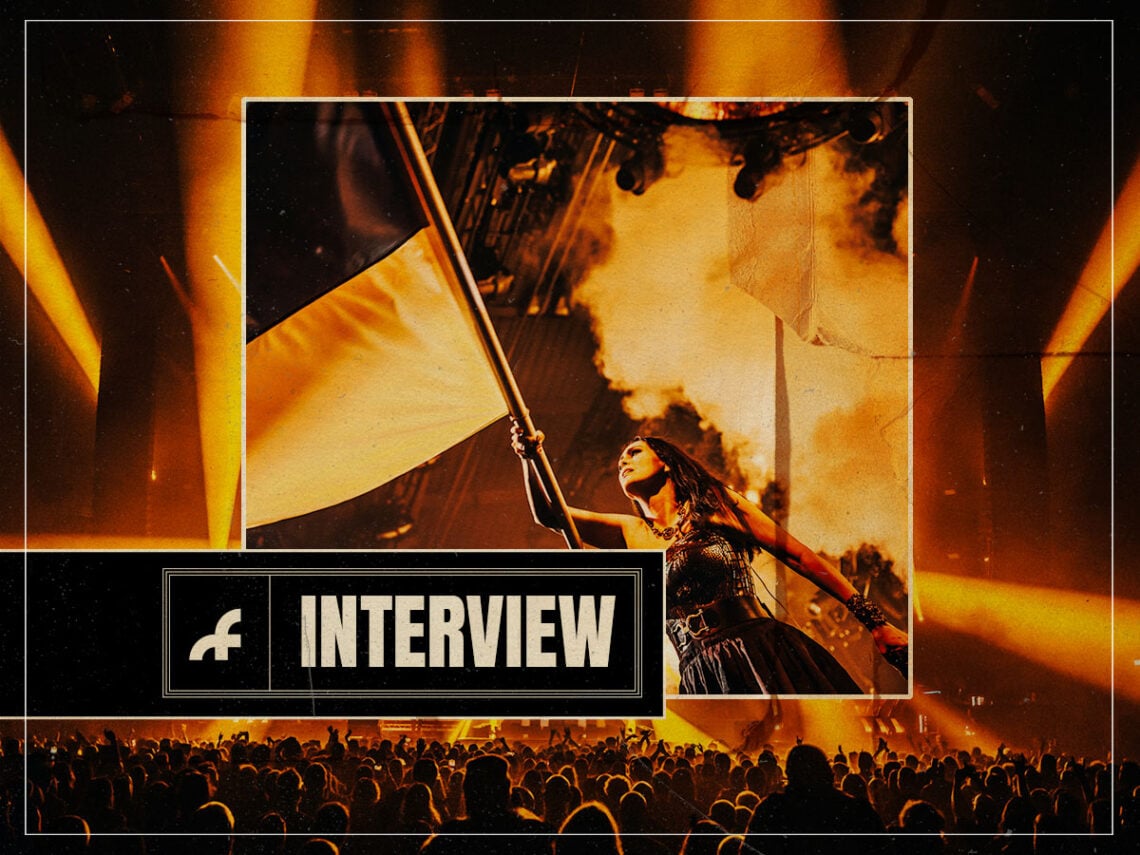
Our problems are unignorable. They’re glaring and horrific and available at our fingertips. What we all argue against is the same. As such, messages conveyed within art can often feel repetitive, and the horror blasé. Within Temptation have never been afraid to make their political voices heard. Waving Ukrainian flags on stage, having visuals that project horror, songs that unify those on the right side of history and lyrics that tell their listeners they should stand their ground, the band look you right in the eye as they shake your hand. Adel stands by the fact that modern music should highlight atrocities, domestic and overseas, because of the repetitive nature of the news we receive. Thus lies the second problem: comprehension.
Memory and comprehension. A dilemma for protest bands in the modern age. Not only do you have to stop the bed of nails effect and have people remember that these horrific things continue, but you equally have to portray them in a way that does the injustice, dare I say, justice.
The Museo Reina Sofia is far too big. Art can be impactful, at times, and if consumed in the right way, but when you visit the Sofia, there is simply too much. Depictions of the holocaust, pain, love, melancholy, racism, sexism, elation, surrealism, and the abstract all merge into one to the point that messages overlap and contort. One piece, which is similar to another, becomes the same thing, and the art is lost entirely. Any attempt by people to discuss what is being said or what the artist is trying to say blends into an imperceptible white noise.
The beauty of Madrid outside is lost, the pigeons gathering along street corners to eat discarded meat and cheese are forgotten, the accent and the sunshine and the architecture mean nothing, as all of time and every feeling ever felt is contained within these four walls, lost entirely, completely pointless.
Replace the Museo Reina Sofia with Spotify. You are no longer dealing with four floors of art; you are dealing with all of music history. While the wounds of the oppressed in the 21st century are fresh, those wounds remain replicas of those that have come before, wounds that have also had songs dedicated to them. Modern protest music doesn’t only have to draw attention to important rebellion, which is necessary now, but it also needs to be harrowing enough that people can separate it from all that has come before. Modern protest music has to remove scabs and expose wounds in a way that emphasises their relevance. There is no right way to do this, but Within Temptation found massive effectiveness when they went independent.

“Well, one of the things is that record companies take things very traditionally,” said Adel, highlighting the positives they’ve experienced since gaining the rights to their music and having the freedom to release whatever they like. “That’s for a reason that works for them. It’s so they can say, ‘We’ll release the album then; you’ll have to finish the album between that day and that day because we can release it after another band we have signed’. So, you’re being pushed in a schedule that sometimes is too short or too long.”
Going independent also allowed the band to release more singles. While labels encourage albums, the single allows bands to write about recent topics and get them out much quicker. “They want to always only release an album,” admitted Adel, “We felt like, at certain times, we just want to release a single because it has an urgency to it. We want to address certain things that are happening now in society, which this song would, you know, it would really fit this time. They would say, ‘You can’t; you have to wait until all these releases are done, and then we can release your single’. It was like, OK, that’s not what we want. We want to release it now, and if you can’t do it, you have to do it on your own.”
Releasing protest music in this modern climate seems to require a modern approach. The methods used in the past by other bands no longer resonate because technology, culture, and how we consume information have changed. Within Temptation addresses this with their independent approach to releasing music.
“A record company will always try to hold on to their own schedule, which is perfectly normal, but for a band, we want to do something different,” she said, “Dance music has been doing this for many years, which is releasing in the moment, singles every time. In a band, or with more traditional kind of music, it’s much more difficult because record companies are just going to hold onto the idea of an album.”
Within Temptation aren’t perverse to the struggles that come with releasing music independently, though. “What works against you is that when you release in the moment, you have to do the production, the recording, the mixing, you have to do the whole ritual that you do to release an album,” she said, “You have to do that every time, and that takes a lot of time. It’s more expensive, more time-consuming, it’s more emotion. So, you use time that you could use on writing, on releasing this particular single.”

The final pitfall of modern protest music is the demand for it. As previously mentioned, our exposure to this kind of trauma and these horrific images not only makes us numb to it but also makes us forget. If music is a form of escapism for some people, why would they want to spend their spare time engaging with it further? For many, it is necessary to do so, but Within Temptation also acknowledges that they have an onus to deliver a fun show that people want to watch.
“You wanna give them some kind of image of hope and something to hold on to,” said Adel, “Let people think for themselves, but they do get the message when we show them the imagery […] Leave it up to people, how deep they want to go in there.”
The band highlight the image of beauty and fragility perfectly on their current tour, as the backdrop resembles a snow globe, which might be the perfect representation of the world right now. We have been shaken; however, within that comes beauty. While in the snow globe, it is in the snow falling; in the real world, it is a human reaction; it is the music of Within Temptation and the chorus of their crowds. However, that beauty has a limit; it protrudes when shaken, but keep shaking, keep shaking vigorously, and everything shatters.
“Every time, you see something different, but then the same surroundings…” said Sharon den Adel. Those images live up to the band’s intention, creating a backdrop of beauty and brutalism, atrocity and artistry, of everything that is both wrong and right with the world. But wait till I tell you…
