


Is camp the new punk?

Queer audiences have been forever lambasted by the media. It may be Pride Month now, but as the first day of July dawns, the LGBTQ+ flag disappears from most logos of capitalist entities looking to up their buyer pool with an empty gesture.
At best, camp aesthetics are a seasonal marketing strategy: when taking your clothes off feels good in the sun and isn’t an anarchic act with dangerous consequences, where vibrancy and flamboyance are a loud, quirky aesthetic strategy rather than a form of self-expression and experimentation under a crippling, oppressive binary. But queer audiences, and by extension camp aesthetics, have all but replaced punk and indie rock rebellion as the dominant language of counterculture.
It’s been a bad year for alternative festivals. While Slam Dunk’s name was tarnished after an unidentified director was forced to step down from operations following unspecified allegations, London’s Wide Awake Festival announced a year off after poor ticket sales in 2025 saw the circulation of an earnest, yet somewhat defeatist, email begging fans to encourage their friends to come along on a reduced ticket scheme.
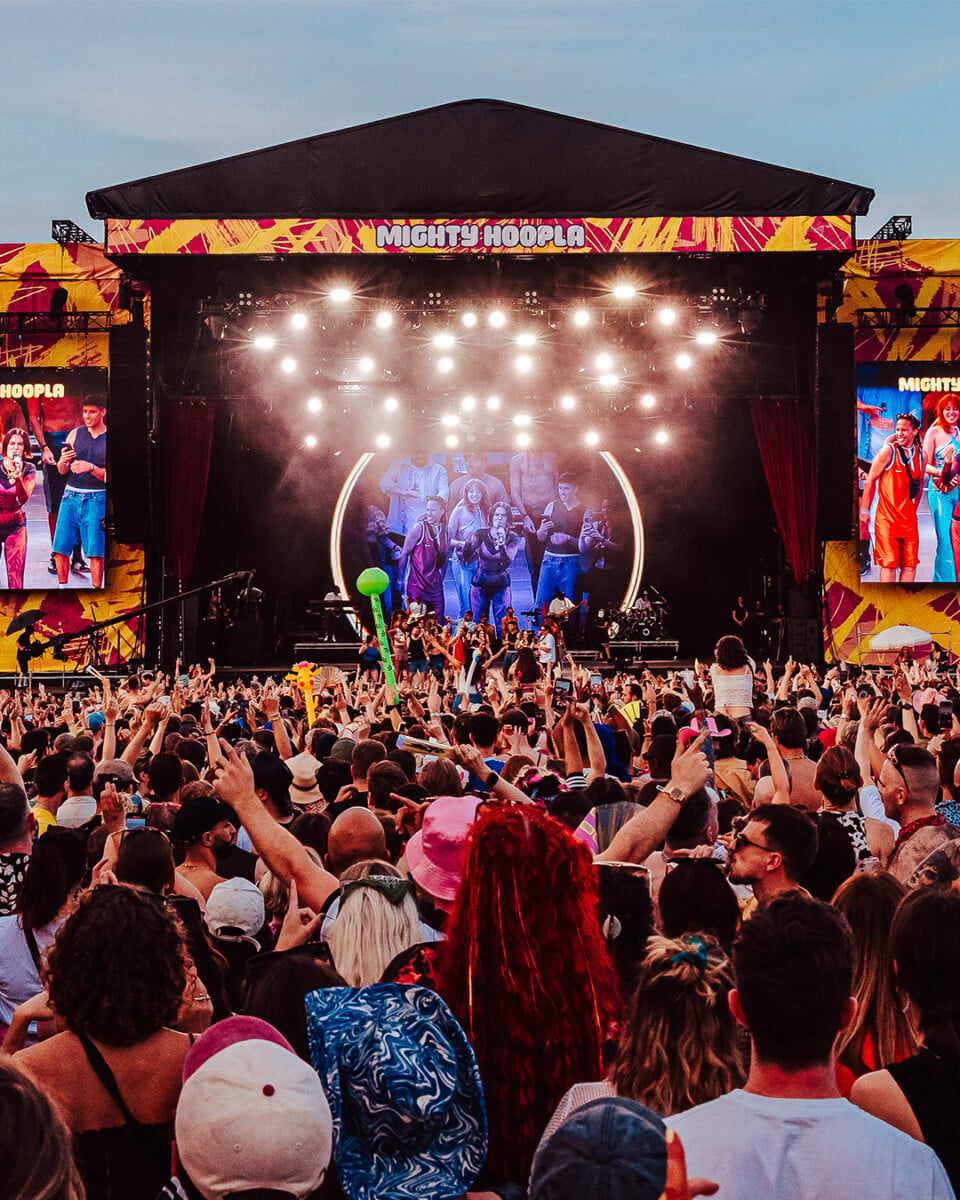
On the other end of the spectrum, mainstream pop is thriving. In the same South London park haunted by the spectre of Wide Awake, this year’s Mighty Hoopla festival bagged 35,000 ticket sales in just 30 minutes in a show of demand bosses deemed “like nothing we’ve ever seen before”. Headliners Scissor Sisters and newly-appointed West End Girl Lily Allen saw the weekend sell out in record time, and getting your hands on a resale ticket felt like Prince Charming trying to find the perfect fit for his glass slipper.
Camp has always been an anti-establishment form of resistance, but considering the very specific, very real problems of today, has camp become punk? Join me on the ground at London’s Mighty Hoopla as I go into the belly of the (beauty and the) beast.
Camp as today’s past, present and future
As I bumbled over to the first stage of the day, my headline essentially wrote itself: beneath a beaming sun, television personality and Vanderpump Rules star Scheana Shay performed several of her hits alongside The 27’s, including ‘Good as Gold’, fit with screamo verses, a pop-punk chorus yanked straight from an early Blink 182 record, and an abrasive lyric video with bubble-lettering last found in the late 2000s. During the emo display, a festival goer turned to me and, noting my open mouth, laughed, “If they continue with this screamo shit, we’re going to have to pretend to start hitting each other”.
Had I found it? The answer to punk’s pitfalls, an amalgamation of anti-establishment ethos, abrasive aesthetic, rebellious communal spirit, with all the danger and disrespect removed? The man’s comment gestured towards an unspoken intelligence, a recognition that violence was usually the start and end point of punk’s theoretical weight in the cultural discussion. Idea formation can only go so far when the conversation is halted by a swinging left hook.
A sizable chunk of (British) punk ideology centres around nihilist realism, birthed out of the “No Future” slogan lifted from the Sex Pistols song ‘God Save the Queen’. But, on the ground at Mighty Hoopla, it was obvious this cultural subsect embraced a reinvigorated idea of futurism, as the cultural debris of the 2000s was repackaged as an optimistic trope for trying times. X-Factor stars from the 2000s had redeemed their respect in the cultural eye; performers were allowed to try, and try again, a public redemption arc, a way of forging a path into a more accepting future.
Simultaneously, the power of nostalgia became a way for audiences to express their desire to return to pre-algorithm fandoms. Today’s camp has found a way into the past, present, and future. Which begs the question: Where is punk?
Camp as art(ifice), exaggeration, love of the unnatural
In today’s landscape, it’s uncouth to discuss aesthetic modes without considering their stance on AI. It’s everywhere, and household names are adopting the technology at an alarming rate. Today, it seems that camp has a greater resistance technique than punk.
American philosopher Susan Sontag once wrote, “The essence of camp is its love of the unnatural: of artifice and exaggeration”. Is this, perhaps, where camp is excelling beyond its measure today? Not as a rejection of the general AI product: outlandish, grandiose statements and images, over-accentuated features and hyperbolic depictions, but as a human re-interpretation of them. Notably, the only AI usage across the weekend was Navi Lens technology, which helps blind and partially sighted festival goers navigate the grounds independently.
While punk aims to resist, detract from, fragment and alienate its audience from the reality of fast-depreciating art in a market zipping with AI sharks, camp is attempting to re-anthropomorphise the results. Isn’t that braver, bolder, and ultimately more rebellious?
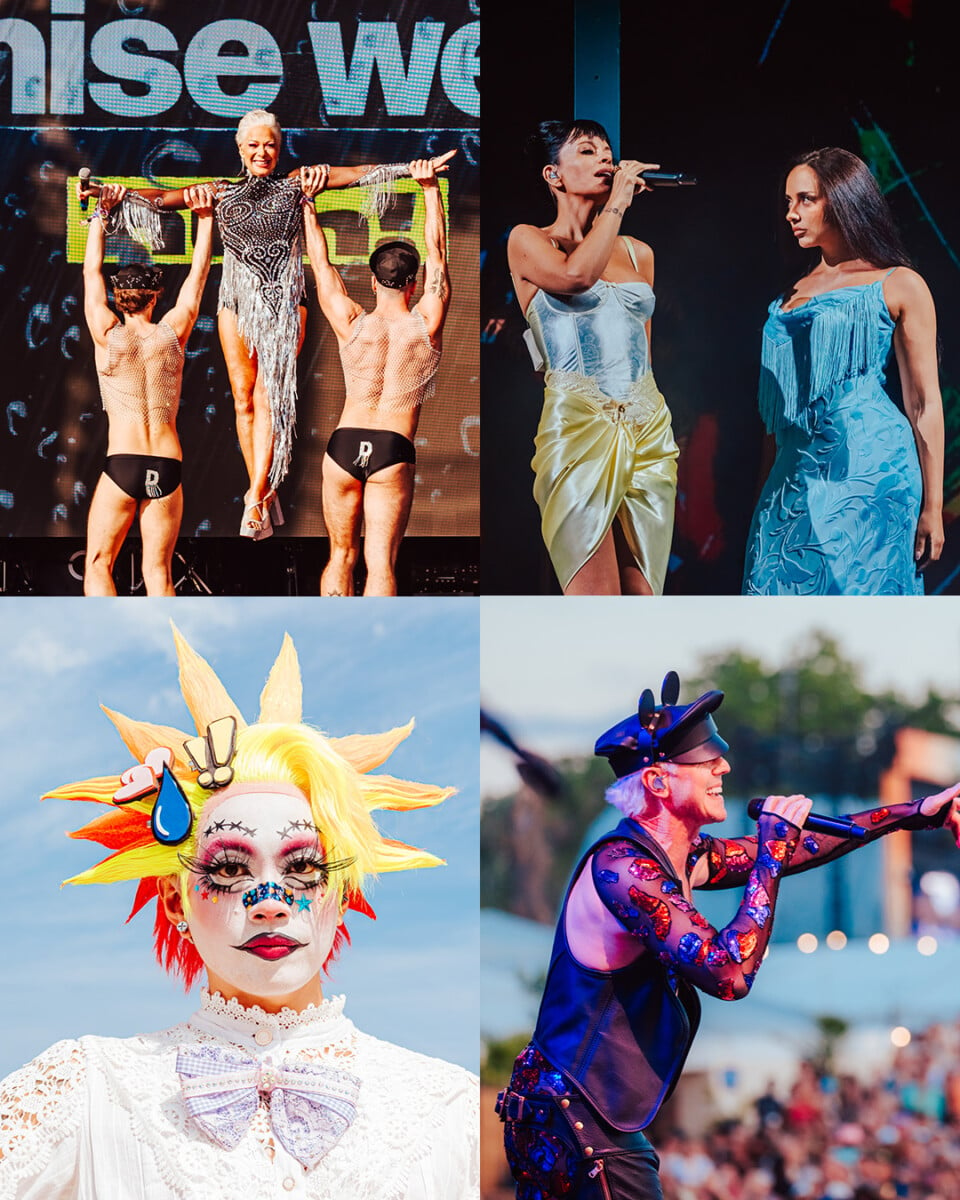
Further still, when, as it did at Mighty Hoopla, style comes out victorious over content, the means of delivery becomes more of a notable phenomenon than the thing being delivered (think JLS twirling into toplessness); content matters less. This is surely only a win in our content-obsessed society.
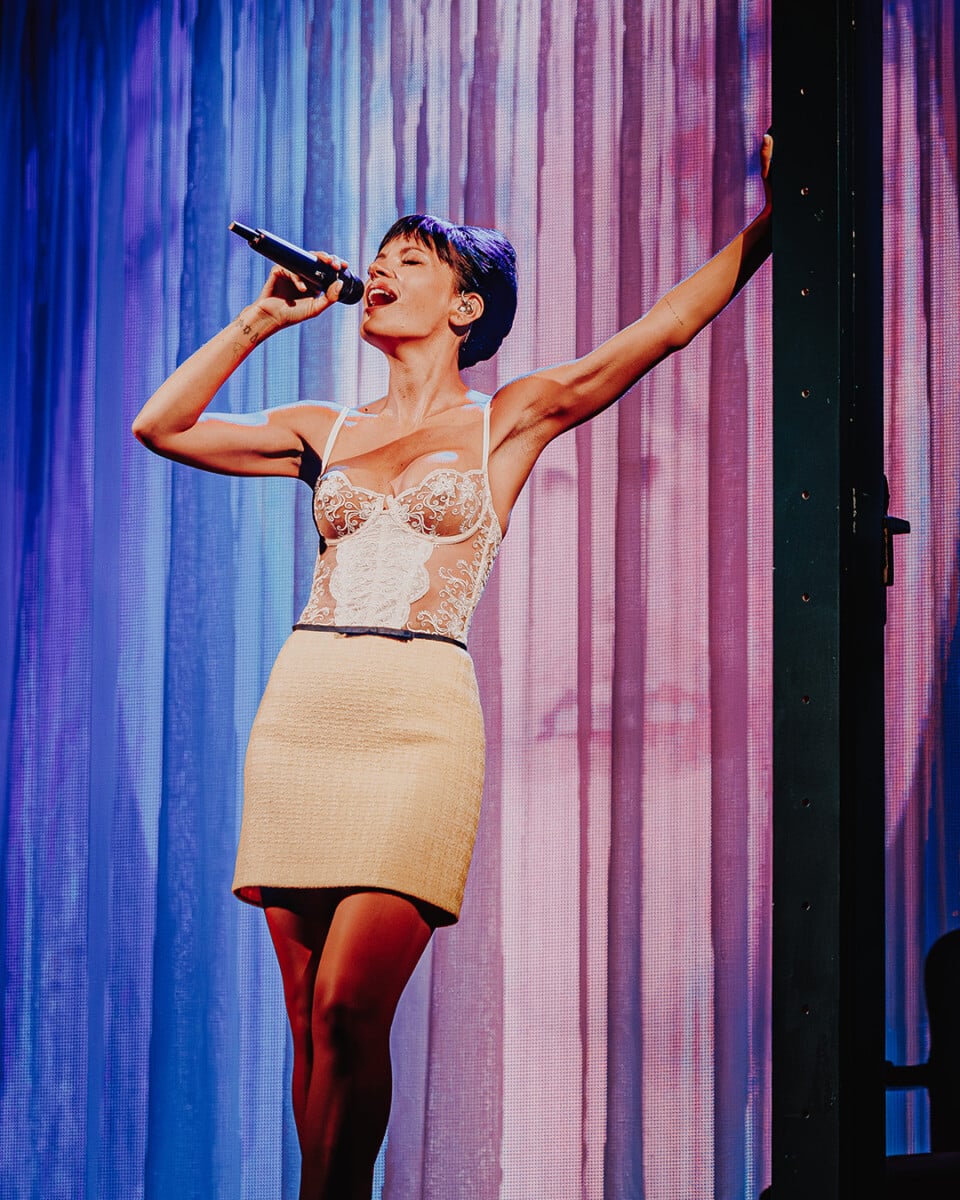
Exaggeration and flamboyance were found in every corner of the festival. During a gripping, impressive headline set, Lily Allen momentarily adorned an apron emblazoned with the word “cuck” as she sang about her cheating husband, or dismembered papier-mâché legs sticking out of her fridge, which she often went to to vape. It’s hard not to think of homosexual poet Frank O’Hara’s self-dramatisation as one of the famous modes of camp aestheticism. Both artists suffer from a similar “catastrophe of personality”, as Allen’s life implodes around her and the crowd hangs on her every word.
Beyond the fact that Allen proved to be a magnificent headline performer while leaning on old-school camp techniques (including, at some points, being slightly cringe), what’s more important is the way this rebels against societal standards. Watching Allen and beyond, these performers reclaimed the loud and obvious parts of themselves as a way to reclaim the self under the manipulation of reductive iterations of capitalism: Another anarchist way to refuse oppression into a box due to the sprawling, uncontainable emotional excesses capitalism seeks to reduce, or profit from.
Earlier in the day, on the main stage in the unforgiving sunshine, hit songwriter MNEK invited a Doctors Without Borders representative to share with the resplendent crowd that “silence is complicity, hesitation costs lives, humanity has no borders”. The British-Nigerian star followed this up with a celebration of his songwriting catalogue, including the raunchy debut of his new gender-euphoric single, ‘Reverse’, which included the lyrics “I can turn a bad boy into a bad bitch in seconds”.
It’s a defiant, euphoric display teamed with a group of fired-up dancers fusing traditionally feminine break-dancing moves into MNEK’s glittery pop coquettishness. While punk spaces are usually defined by male dominance, aggressive machismo, and the toleration of misogyny and homophobia (we need only glance toward Download Festival’s queasy trans toilet policy from last year), camp’s celebration of non-binary performance feels like an astoundingly more inclusive radical act.
Camp as a natural endpoint for culture
Am I wrong? Could the dazzle of the day have skewed my focal point? Despite my filthy clothes and my sore feet, I left Mighty Hoopla feeling as if I’d tapped into a fruitful societal subsection. It took only one Instagram Story to burst my bubble.
Taking to his Instagram Story a day after the weekend celebrated, coveted music journalist Shaad D’Souza deemed the festival “a natural endpoint for culture”, as “every interaction (such as, “the bathhouse sponsored by Hayu”) is self-consciously ‘camp’ in a way that feels designed for people who got all their aesthetic and cultural sensibilities from TikTok AK not camp”.
Fugazi frontman Ian MacKaye once suggested that punk was a “free space” for new ideas outside commercial control. But Hoopla, as highlighted by D’Souza, wasn’t outside of the commercial realm, but rather was trapped within it: Nobody knew this better than I, who waved around a free Greggs fan all day and considered spending valuable hours queueing up for spin-the-wheel shenanigans, where I’d be in for a free hand sanitiser or lip balm. But one of the problems with punk is that it is so niche, so overlooked commercially, that it cannot gain decent traction. All of my favourite punk writers and performers were shunned, trapped in the scuzzy basements and mouldy bed-sits they found anarchy in in the first place.
But if it takes the key of a capitalist to open the door to a more equitable future, then so be it. D’Souza’s primary criticism of the festival is that it remains owned by Superstruct, whose parent company is KKR. In a statement on their website, Mighty Hoopla has reassured concerned parties that this had no creative, organisational, or economic bearing on the running of the event.
However, where camp might not be able to pull the punk punches is in its reckoning with the uncomfortable, the unlikeable: JLS attempted to start a chant of “Love wins! Love wins!” without ever gesturing to what is meant to be losing in that equation (Bigotry? Oppression? Injustice? Evil?). And, to concede to D’Souza’s issue, it appeared to me that KKR wasn’t uttered once, replaced instead by vibrant light shows depicting emoji faces splashed with ejaculation in the rave tent.
This version of camp may be squeamish toward the serious, whereas punk is at its purest form when it aims to dethrone those at the very top, swinging its jaws around the very heart of the matter. But who can stomach the biggest bite?

Never Miss A Beat
The Far Out Punk Newsletter
All the latest Punk content from the independent voice of culture.
Straight to your inbox.