


How New York shaped Kim Gordon into an icon

It’s hard to think of Kim Gordon as anything other than a New York icon, even if she has spent many years throughout her life in Los Angeles, but her long-running ties to ‘The Big Apple’ are ever-present, and it’s here that her life as an artist changed forever.
Born in Rochester, New York, she relocated to Los Angeles as a child, and after some time spent in Hong Kong and Canada, eventually made her way back to where she was born with a thirst for creation, having just studied at California’s Otis Art Institute. She found herself attracted to the grittier urban landscape that the city had to offer, this time immersing herself in New York City at the start of the new decade of the 1980s.
New York has long been associated with groundbreaking musical movements, from the dominance of jazz to the arrival of punk, and despite Gordon’s leanings as a visual artist, she found a strong affinity for the city’s thriving underground no-wave scene. Reacting against punk’s increasingly commercial tendencies and the emergence of new wave artists, no-wave was primarily a movement concerned with dissonant guitars and unusual genre-mixing: punk and atonality merged with funk and noise rock, and visuals soon became a strong element of the scene.
It’s no surprise, then, that Gordon was attracted to this underground landscape, which featured filmmakers like Amos Poe and Richard Kern, as well as visual artists like Barbara Ess, who made music but also published the mixed media project Just Another Asshole.
There was a real mixture of identities working across music and visual art, with people like Lydia Lunch crossing the boundaries of mediums by making music, starring in transgressive films, and writing spoken word, poetry, and plays. Gordon found herself at home here, telling Elle, “When I came to New York, I’d go and see bands downtown playing no-wave music”.
She admired this form of expression, finding it all so freeing, unshackled from convention and expectation. Compared to punk, she argued, “No-wave music [was] more like, ‘No, we’re really destroying rock’. It was very dissonant. I just felt like, ‘Wow, this is really free. I could do that’”.
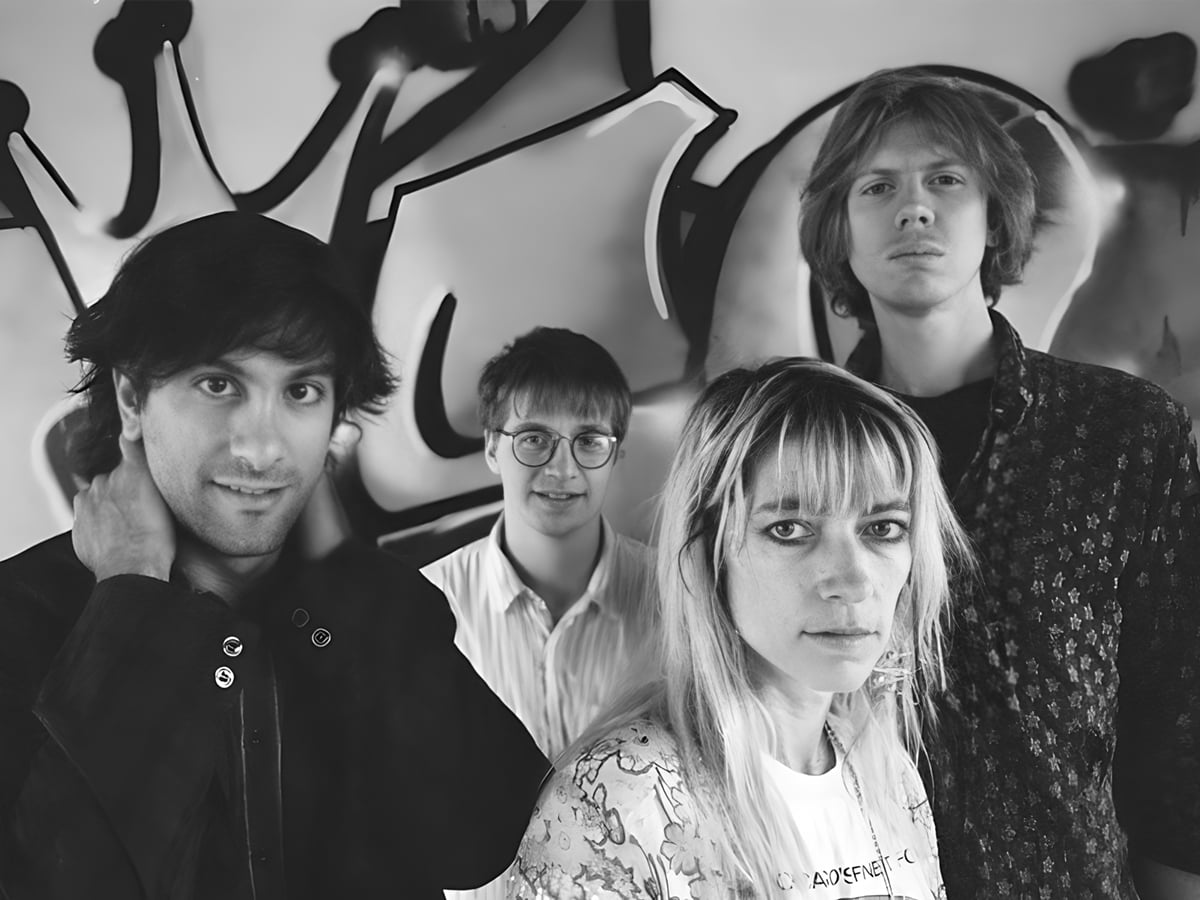
So, she picked up a bass guitar and co-founded Sonic Youth, whose early years in the no-wave scene were vital to shaping the future landscape of alternative rock. Using unconventional tunings and an atonal style, the band often explored some dark themes (who can forget the violent Richard Kern and Judith Barry-directed ‘Death Valley 69’ video starring no-wave cinema icon Lung Leg, as well as featuring vocals from Lunch?), while Gordon brought a welcome feminist element to the band’s lyricism.
Gordon was by no means the best singer, but she wielded such a fearless attitude that she was not to be messed with, simply expressing herself in the most instinctive way. As Sonic Youth became key players in the alt-rock boom of the ‘80s, subsequently inspiring artists like Nirvana, Gordon continued to immerse herself in New York’s artistic landscape, making visual art, clothing, and collaborating with various other musicians in the form of projects like Free Kitten.
The artist loves LA as well as New York, but there are stark differences between the two, she believes. Gordon told The New Yorker, “Somehow everything in LA looks like a stage. It’s the distance—the voyeuristic, out-of-a-car-window experience. I feel like even the proliferation of yoga and pilates studios is more hidden in New York. New York is sexy that way, and mysterious, whereas LA wears its sex on its sleeve.”
It’s the mystery of the place, defined by such a rich network of bustling streets, the grit and the grime, the hidden underground venues and the specific brand of people who occupy the city, hard-wired not to bat an eye towards the strange and the insane, that came to shape Gordon’s approach to music and art.
Listen to the shaky guitars and thundering bass on early Sonic Youth tracks, and you’ll hear the influence of a city so far-removed from the artificiality and the sun and sea that shape Los Angeles. Instead, these prime years of Gordon’s musical awakening were moulded by a city that never quite goes to sleep, thriving late into the early hours within underground venues where the no-wave scene was thriving in all of its nihilistic, atonal glory.
