


“Let me put it to you this way”: How Mike Leigh’s ‘Abigail’s Party’ changed British television forever

“Now, next time, sit down in front of your mirror, and just look at yourself. Relax, and just say, ‘I’ve got very beautiful lips’. Then take your lipstick and apply it, and Ange, you’re gonna see the difference. Because then, you will be applying that lipstick to every single corner of your mouth. Do you know what I mean? Will you try it for me next time?”
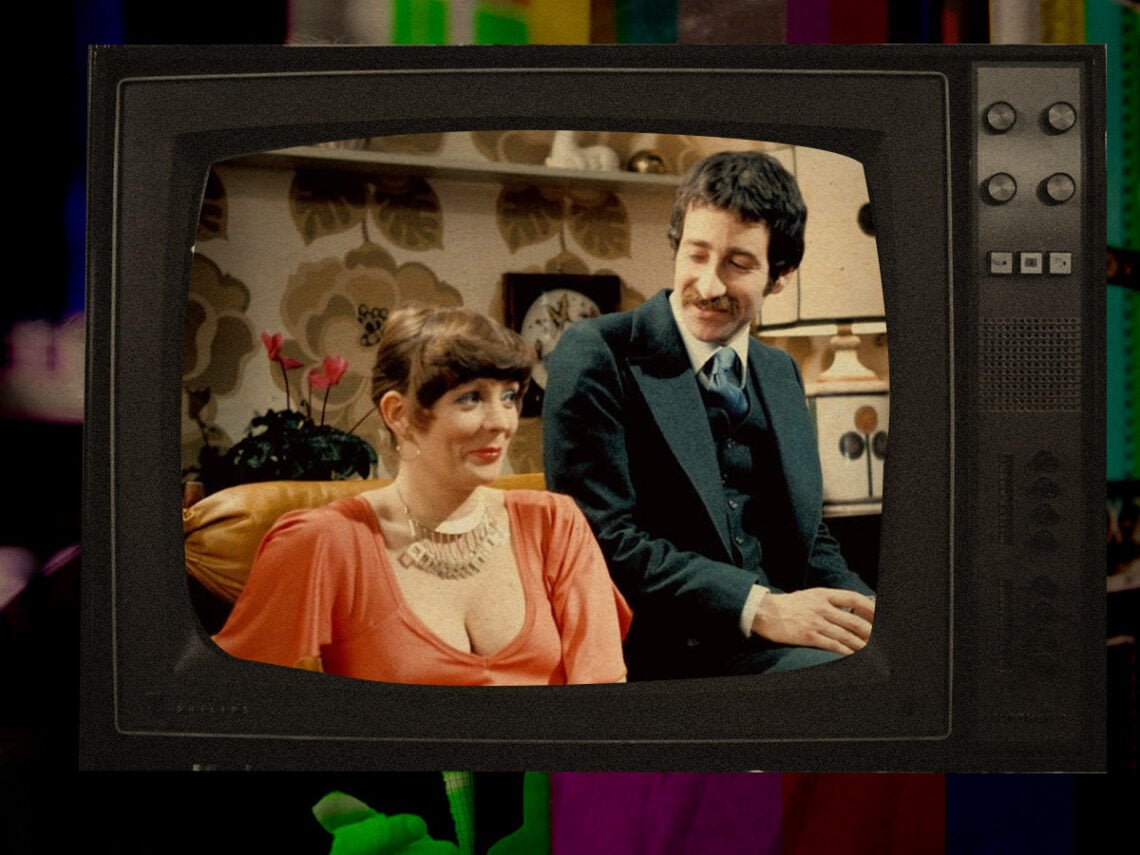
Abigail’s Party is one of the greatest plays of all time. Mike Leigh penned it for the stage, but most of us will have seen it as the BBC Play for Today recording, which features the original cast, too.
Apart from a few changes, like substituting Elvis Presley for Tom Jones due to licensing issues, the play is practically identical, and it’s incredible that it remains just as impactful in this rather unstylish teleplay format. That’s because each and every performance is simply a masterclass, from Janine Duvitski’s rather childlike Angela to Tim Stern’s Laurence, who is like a bomb about to go off, fizzing with angry little man syndrome.
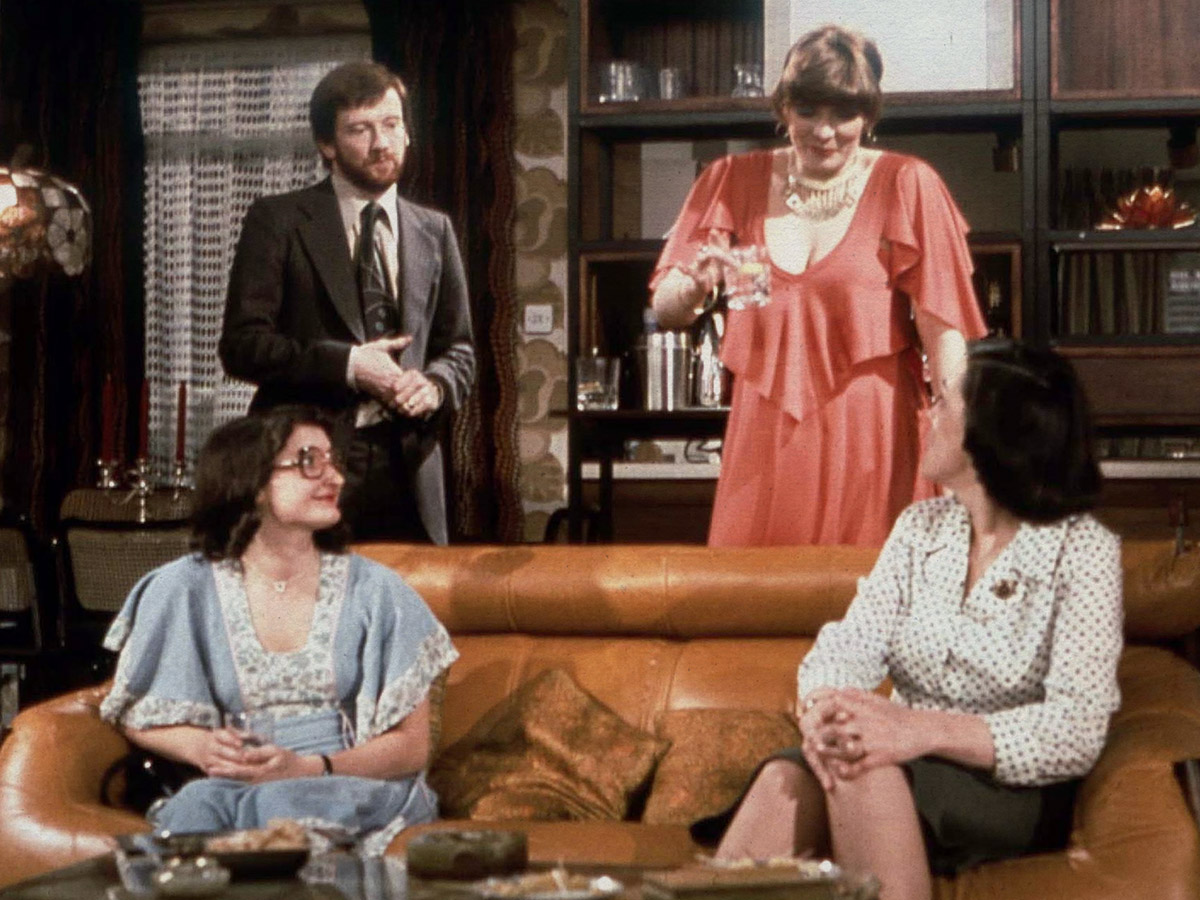
Then, of course, you’ve got the posh and perpetually anxious Sue, played by Harriet Reynolds, who seems to be regretting every moment of agreeing to the party, while Angela’s husband Tony, portrayed by John Salthouse, sits uneasily in the corner, snappy and clearly ill-matched to his naive wife. Yet, it’s Alison Steadman’s Beverly who stands out as the simply unforgettable pretentious host, desperate to prove herself as a member of this new middle class at a time when social mobility was ripe.

She’s above Angela and Tony on the social ladder but just below Sue, and she’s keen to assert herself as in-the-know and on-the-pulse, a figure of incredible sophistication. Yet, there is an endless stream of drinks flowing through her party guests, as though Beverly knows, deep down, that she’ll only be able to impress them if they’re not sober. She forces her guests to listen to music that she considers to be a symbol of good taste, while her love of a kitschy painting further emphasises her poor attempt at ascending the social ladder.
“Let me put it to you this way…,” she often says, repeatedly saying her guests’ names, offering them cheesy pineapple or prying into their personal lives with questions she should know not to ask, but of course she doesn’t, because her whole personality is a façade that even she can’t keep up with, which makes you wonder if she even know she’s doing it. Beverly is so irritating, so obnoxious to watch, but god does Steadman deliver such a captivating performance that leaves you unable to look away.
Airing in 1977, the play has had an indelible impact on playwriting and screenwriting, as clearly seen in shows with loveably selfish and awful women in them, like Absolutely Fabulous and Nighty Night. The latter possesses such clear influence, with its mix of darkness and humour, with Jill Tyrell taking the characterisation of someone lacking in self-awareness to whole new levels.

“When someone pointed out that Nighty Night seemed influenced by Abigail’s Party, I felt almost bad; it wasn’t conscious,” Julia Davis told The Guardian. “Beverly’s not as hideous as Jill in Nighty Night, but she’s relentless and domineering. Moments like when she tells Ang how to put her lipstick on, that cruelty, that sense of one woman being overbearing to another, that’s definitely my sense of humour”.
Jill Tyrell is a rare flash of TV brilliance who is so unashamedly evil, and while, as Davis says, Beverly is nowhere near as bad, it’s that similar characterisation of a woman who really takes up space on screen, who comes in and smashes all pre-existing stereotypes regarding women, that owes itself to Abigail’s Party.
“I’d seen strong female characters like Margot in The Good Life,” Davis added, “But I think it was the first time I’d seen a woman leading a whole piece and being hilariously funny. Before then, female roles on TV seemed to be either posh women in comedies or kitchen-sink characters, whereas Beverly was an aspirational suburban character who Alison clearly loved playing”.
Countless comedians, writers, actors, and filmmakers cite Abigail’s Party as a watershed moment for them. It’s the perfect example of keeping momentum and building tension without any major action-heavy scenes, that is, until the final moment, of course, when Laurence succumbs to a heart attack.
Despite the humour of the narrative, this doesn’t feel like a sudden tonal shift that has come out of nowhere. Rather, the play leads us here from the beginning, and this final act of violence is a physical manifestation of the verbal kind which has been shot back and forth between the characters in the run-up to this climax.
Abigail’s Party was seminal, and while Leigh has gone on to make some incredible feature-length movies since, like the harrowing Naked, it’s this TV play, dark yet quotably hilarious, which stands as his crowning achievement, with its legacy manifested in countless characters ever since, such that it’s hard to imagine what TV would look like today without it.
