Director Gabriel Mascaro on challenging stereotypes in ‘The Blue Trail’: “Sometimes, we associate freedom with young people”

In his new movie, The Blue Trail, which is playing in UK cinemas starting April 17th, Brazilian director Gabriel Mascaro gives audiences a new kind of protagonist.
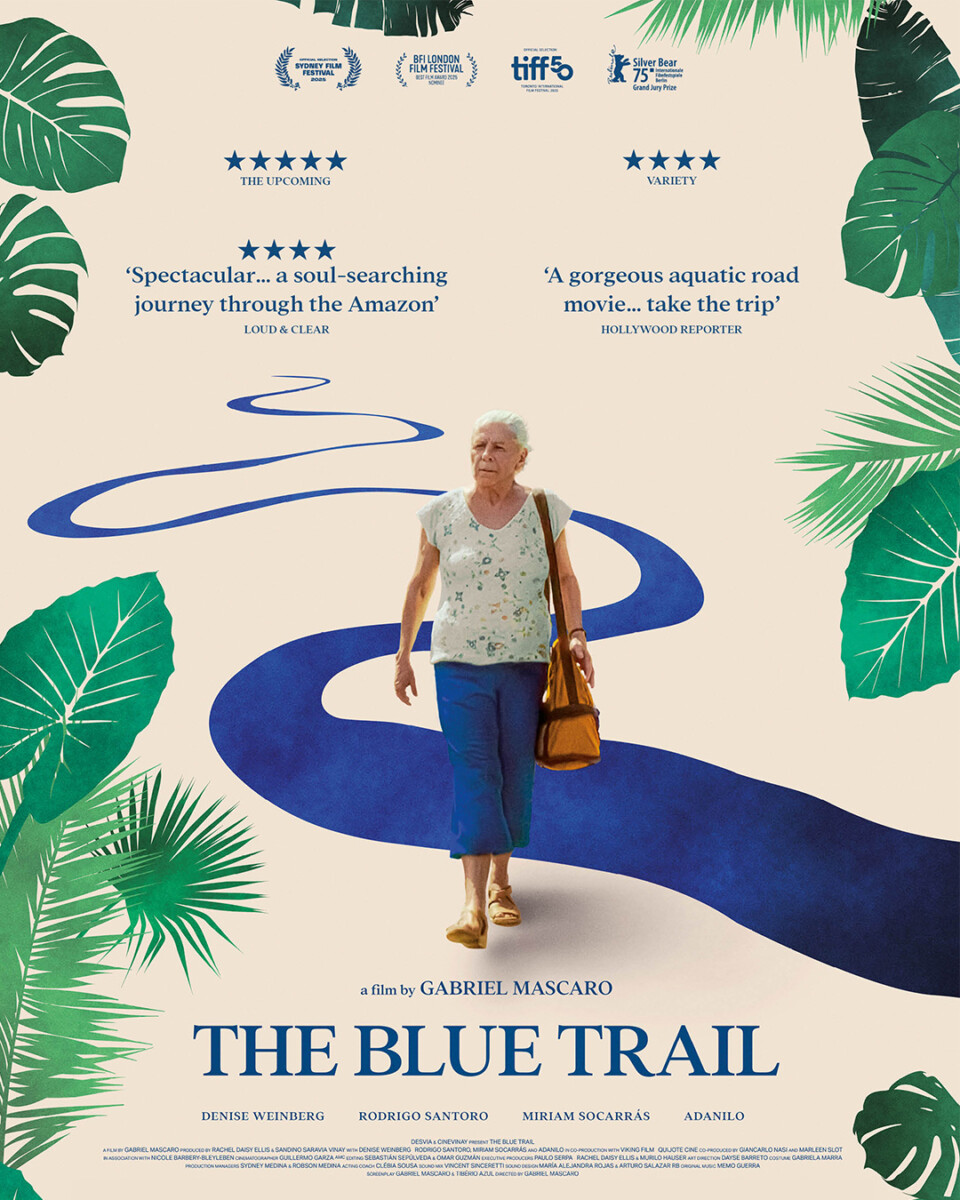
Tereza (Denise Weinberg) works in a meat processing plant in Northern Brazil and seems unconcerned about the alarming political climate swirling around her. She is also 77 years old.
In this near-future version of Brazil, where productivity is prioritised over everything else, that’s the age at which senior citizens are rounded up by the government and placed in a remote colony so that the rest of society can achieve its maximum economic potential. When confronted with this mandate, however, Tereza strikes out into the Amazon by herself and discovers a new beginning.
Mascaro got the idea for the film through his grandmother, who, in her eighties, found a whole new chapter of joy and creativity when she took up painting for the first time. When he began watching movies with elderly protagonists, though, he quickly discovered that portrayals of this age group nearly always revolved around impending death or memories of the past.
“I [realised] that the genres in cinema that offer space for a character to experience life in general are associated with young bodies,” he said in a recent interview with Far Out, “Like coming-of-age or road movies, where you can be surprised by the journey.” He also realised that dystopian movies are equally preoccupied with young people as well, because society has normalised the idea that rebellion is a uniquely youthful pursuit.

“At some point,” Mascaro said, “I decided to make a playful movie where I can make almost a provocation – to provoke the tradition of storytelling, asking why the tradition of genres like coming-of-age, road movies, [and] dystopias only allow young bodies to be protagonists. And at some point, it became almost like a game for me of creation.”
Tereza doesn’t initially want to go on an adventure. She just wants to take a ride in an aeroplane as a last hurrah to her life of relative freedom. She finds someone who will take her on his boat up the Amazon River to a village where there are pilots, and the film morphs from a dystopian drama to a mystical road movie. While on the water, the man introduces Tereza to a type of snail that emits cobalt-blue slime that has psychedelic effects. When they reach the village, she is taken to a local casino where locals drink copious amounts of alcohol and bet on fighting animals.



Mascaro, who is from the Northeastern city of Recife, wanted to make sure that the portrayal of the Amazon region was not romanticised or stereotyped. He populated the cast and crew with locals to ensure accuracy, including in the faces of the characters. “In Brazilian cinema,” he explained, “Sometimes, if you don’t challenge yourself, you reproduce the same faces of São Paulo and Rio de Janeiro.” On a more philosophical level, though, he didn’t want to fall into the trap of portraying the Amazon as a wild, untamed wilderness of natural beauty and mystery. He wanted the audience to view it through Tereza’s journey.
To achieve that sense of subjectivity, he chose to shoot the film in a narrower aspect ratio than the widescreen CinemaScope ratio that is typically used in movies about nature and landscape. As a result, he explained, “we avoid being seduced by the beauty [of the natural environment] and [are forced] to be close to the wrinkles of our protagonist.” Tereza isn’t in awe of her surroundings. In fact, she’s impatient to get off the river and into the nearest plane. As those plans fizzle, however, those scenes on the water take on a mystical quality. Time stretches, and the modest 85-minute running time turns into a meditative reverie punctuated by Tereza’s game of cat-and-mouse with the authorities.
Perhaps the most subversive and moving part of the story comes when Tereza, who is now a fugitive, meets Roberta (Miriam Socarras), an anarchic Bible seller who is several years older. She has bought her freedom from the colonies and is allowed to remain independent as long as she lives on the water, and she has turned her boat into a home and an oasis.
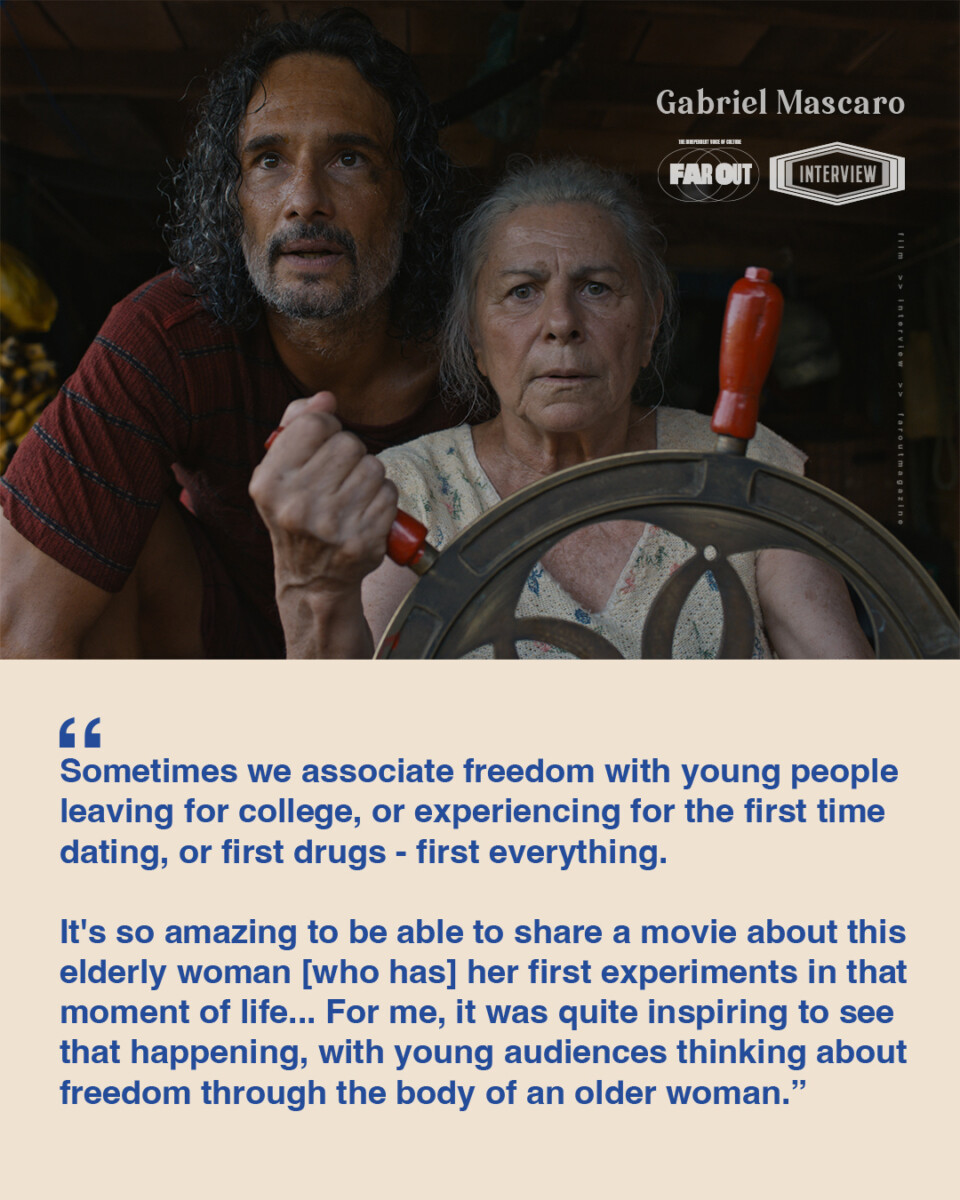
In one of the most beautiful scenes in a film bursting with visual magic, the women sit in Roberta’s boat at sunset, bathing themselves with buckets of fresh water and laughing. It’s a childlike, carefree moment steeped in the tactile pleasure of water and gentle sunlight, and it places these elderly women in the acuteness of the present. They aren’t living in the past or even the future, they are simply basking in a timeless present.
The relationship between the two women was of paramount importance for Mascaro. He didn’t want Tereza’s world to be opened up and renewed by a young person or a man, the way it so often is in movies about older people. “It’s funny,” he said, “Because even when you watch movies about female characters, sometimes the majority of the inspiration comes from a man […] So for me, it was quite nice to be able to to allow this character to find complicity, to find a safety zone, when she [meets] an even older woman than her.”
Mascaro set out to make a coming-of-age movie set in a near-future dystopia, but as Tereza blossoms through her friendship with Roberta, it takes on a utopian quality instead, showing a path that blends surreality and magic with the decidedly real-world fact of mortality. Mascaro said that he’s been struck by how many elderly audience members have thanked him for portraying them in a way that complicates how they are usually viewed. He’s also found that young audience members come away from the film feeling inspired by Tereza’s freedom.
“Sometimes we associate freedom with young people leaving for college, or experiencing for the first time dating, or first drugs – first everything,” Mascaro said. “It’s so amazing to be able to share a movie about this elderly woman [who has] her first experiments in that moment of life… For me, it was quite inspiring to see that happening, with young audiences thinking about freedom through the body of an older woman.”
The Blue Trail is playing in select cinemas in the UK and Ireland beginning April 17th.