


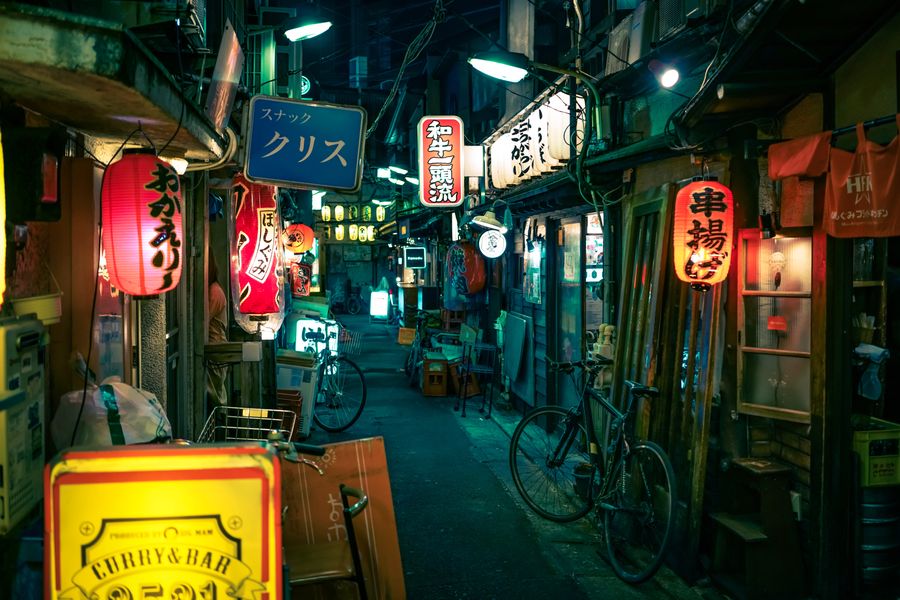
Why does every movie dystopia look like downtown Tokyo?

Whether it’s Blade Runner, an episode of Love, Death & Robots, Brazil or Total Recall, the future is often clothed in the aesthetic of downtown Tokyo, especially if it’s bleak. This well-trodden trope is a touchstone for the future. The next best thing to a flying car to show people that you’re a few decades on from the present is a load of crowded neon lights – ironically, a technology that has been around since 1910. You can wander the streets of present-day downtown Tokyo and feel like you’re in the midst of a Ridley Scott set; why is that the case?
Well, by and large, there are three simple reasons. The first goes back to World War II. In essence, post-colonial theorists observe that when a nation subjects another to a terrible act, the retributions later filter through into the art of the inflicting nation. In other words, if you drop a nuclear bomb on someone, then it is bound to have reverberations in your own cultural output. It is as simple as that. How the hell could it not?
In most cases – like the Opium epidemic that the British inflicted upon China – this filters through decades later when the dust has settled, and the ethics have been assessed. You reconcile your wrongdoing, and a fear of revenge manifests itself. Therefore, the Far East, in fictional works that follow the aftermath of the brutal act that the region was subjected to, is given a sinister, threatening edge.
In modern history, America’s nuclear bombing of Japan in August 1945 is the brutal flashpoint that resulted in the neon world of movie dystopias. Once the discourse of the war settled, the realities of the act sunk in. As America reconciled its own thoughts, the imagined reverberations of revenge seeped into the psyche of future creatives. Perhaps without even knowing it, the cyberpunk dawn was beset by post-colonial orientalism no matter where the creative act was set.
You see, even beyond the nuclear bombing of Japan, President Franklin D. Roosevelt also set up Japanese internment camps whereby people of Japanese descent, including those of full US citizenship, were incarnated in isolated facilities between 1942 and 1945. This dark practice cast a shadow over America afterwards in impacted the uniform aesthetic of the world in fictional years to come.
Even in Lost in Translation, a film where the make-up of Tokyo is left untouched and presented in the present, this theory is still detectable. Essentially, the film chooses the region to depict a culturally alien place; a land unknowable to the western eyes as if to project upon the place a distinct separation from the American way of life.
Beyond this subconscious post-colonial theory, the second major factor is linked to Japan’s response to the war itself. While the country already had a longstanding history of embracing technological development, having invented the first dry-battery during the Meiji Era in 1887, after the destruction of World War II, they amplified their efforts on this front. With the structural economy meaning that a few huge companies held massive sway, money was pumped into the likes of Fujifilm, Samsung, Casio, Hitachi, Nikon and more.
This made the country synonymous with the future. In a way, this was only natural. It had to rebuild large parts of itself from scratch, and with a billowing tech industry hurling the economy forward, the place simply developed a more futuristic look to the rest of the world. When you combine this with the notion of post-colonial theory, you have an established concept of what the future will look like colliding with the psyche thinking that it would be sprung upon the rest of the world and all of a sudden, the Blade Runner facade, began to feed into forward-thinking fiction.
Lastly, the ubiquity of this look is simply tied to the language of film. Now, downtown Tokyo’s aesthetic is a shortcut for directors to instantly inform the audience about what is happening and when it is taking place. It’s an alluring shorthand to help the viewer place themselves. What’s more, given the amount of fiction that has followed this angle, it is also weirdly an aesthetic with fans.
