


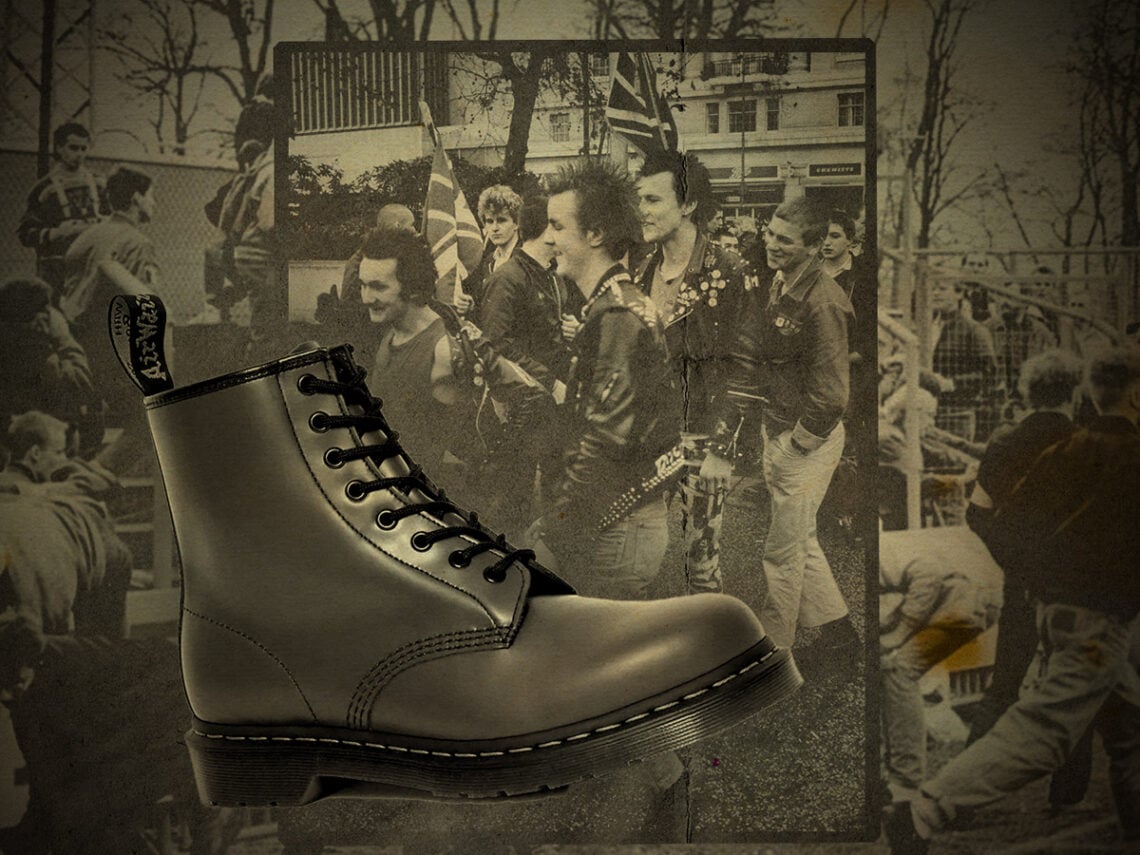
Boots, braces, and away days: How football terraces carved out the skinhead subculture

Perhaps the most misunderstood subculture ever to stomp through British youth culture, the skinhead movement was born from myriad factors, ranging from post-war immigration to rising unemployment. One key aspect of skinheadism, however, was invariably rooted in the football terraces.
Finding its origin story in the tail-end of the mod subculture of the 1960s, skinheads opted for a harder, more utilitarian dress sense. Gone were the suave Italian suits and parkas, replaced by Levi’s jeans, Ben Sherman shirts, and, of course, Dr Martens boots, but the two subcultures did share an appreciation for Jamaican ska and rocksteady music, which had travelled across to British shores with the arrival of the post-war Windrush generation.
That fashion sense, along with the music adopted by the subculture, was rooted in class. Skinhead has always been a working-class movement, and its exposure to ska and boss reggae came largely from the fact that white working-class communities in cities like London, Leeds, and Birmingham were living side-by-side with the newly established Caribbean communities in England. What’s more, the uniform adopted by the skinheads tended to be much more affordable than the tailored designs of their mod forefathers.
Going hand-in-hand with that working-class nature was the skinheads’ devotion to football. By the time the 1970s rolled around, gangs of skinhead youths were a regular sight on football terraces across the UK, coinciding with a sharp rise in football hooliganism. More than simply being a place for skinheads to exercise their aggression, though, football was intrinsic to the widespread exposure of the subculture.
When teams with skinhead contingents within their supporters, typically London teams like Chelsea, West Ham, or Spurs, travelled to away games in the north and the midlands, they brought with them the attitude, sound, and appearance of the skinhead subculture… As such, young, working-class football fans across the nation started taking note of this emerging movement, many of them adopting it themselves.
To gain an understanding of just how powerful the skinhead movement was within football culture during the 1970s, you only need to look at ‘The Liquidator’, the Harry J Allstars ska track that was a key anthem within the skinhead subculture. Soon after its release in 1969, via Trojan Records, the song had been adopted as a walk-out song by a multitude of teams, most famously Chelsea and West Bromwich Albion – two teams with sizeable skinhead followings.
Eventually, and somewhat inevitably, the hooligan tendencies of these skinhead football followings were soon picked up on by the press and the government, who tarred the entire skinhead subculture with the brush of being mindless and violent. In turn, that reputation naturally bred more football hooligans who embraced the skinhead subculture while completely ignorant of its origins in the music and fashion of the late 1960s.

Skinheads, like most subcultures, decreased in number as the 1970s went on, with the original wave of skinheads from 1969 either growing out of the style or deliberately distancing themselves from the far-right nationalism that had so successfully infiltrated the scene, often through National Front recruitment drives within groups of football supporters.
Nevertheless, the distant heritage of the skinhead subculture can still be seen on the football terraces to this day, within the football casual culture, even if they place more of an importance on fashion than music or violence.
