


Five Easy Masterpieces: an introduction to ambient music

Today, we’re diving into the universally accessible world of ambient music. When scaling the oppressive slopes of heavy metal or, God forbid, death metal, listeners are easily alienated. In fact, it often seems to be the point. In stark contrast, ambient music is a soft pillow or a welcoming tent on the quiet side of Glastonbury. It might not be central to everyone’s musical knowledge, but very few are offended by its calming nature.
Ambient music has its roots in prehistorical incantation and, more palpably, the meditative sounds of Indian classical and drone music. However, as we know it today, the genre relies primarily on electronic production tools, chiefly the synthesiser. Raymond Scott’s Soothing Sounds For Baby, released in 1962, is sometimes regarded as an early ambient release, but the term was coined by the ‘Godfather of Ambient’, Brian Eno.
In the mid-1970s, around the time of his first wholly ambient album, Discreet Music, Eno defined ambient music for the first time. “Ambient music is intended to induce calm and a space to think,” he noted. “Ambient music must be able to accommodate many levels of listening attention without enforcing one in particular; it must be as ignorable as it is interesting.”
Accordingly, ambient music is one of the most versatile forms of music. It can soundtrack GCSE revision, provide calming music for stressful airports, relax the hammies in an intense yoga session, and provide an emotionally steering focal point for a meditative record-spinning session on a rainy Sunday afternoon.
As far as I’m concerned, ambient music deserves a place in everyone’s listening regimen. Thus, I have swept together five of my favourite ambient albums as an introduction to the genre. While there are some truly remarkable records in the various subgenres, such as ambient techno, I have decided to focus on the purer stuff for now.
Five essential ambient albums:
Brian Eno – Apollo: Atmospheres and Soundtracks (1983)
This list would be incomplete without an entry from the genre’s originator, Brian Eno. If I successfully vaulted that hurdle, I am afraid I may have fallen at the next as far as many readers are concerned. Most Eno fans seem to endorse Ambient 1: Music for Airports as the ultimate ambient product of all time, let alone within Eno’s catalogue.
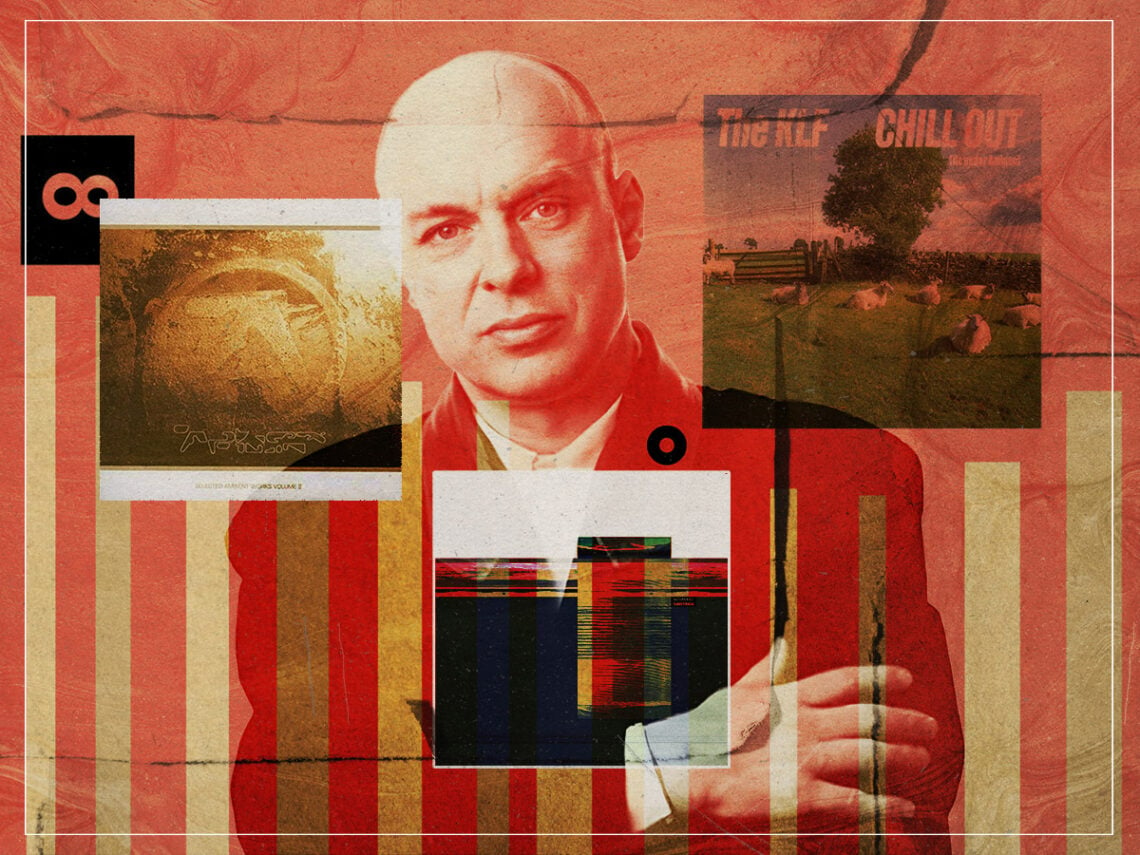
All the same, I avert your attention to my personal favourite from Eno’s ambient files, Apollo: Atmospheres and Soundtracks. Released in 1983 on EG Records, the album contains music initially composed for For All Mankind, a documentary movie by Al Reinert about NASA’s Apollo programme. Thanks to their country-infused cinematic scapes, some of these songs have resurfaced in subsequent soundtracks, including those for Trainspotting, 28 Days Later and The Lovely Bones.
The KLF – Chill Out (1990)
Just as Aphex Twin set out in the early 1990s, the Liverpool-born electronic collective The KLF made a rather deep notch on the ambient bedpost. The group has scaled various rungs on the electronic ladder but may well have released their apical masterpiece in 1990. As the title suggests, Chill Out is a collection of interwoven chapters that subdue the burdened soul with soothing vibrations laden with familiar samples.
The continuous sound collage uses discerning samples taken from the oeuvres of Fleetwood Mac, Elvis Presley, Acker Bilk, 808 State, Van Halen and more in an ethereal flow of distant vocals and hazy instrumentation. With help from the farmland scene on the record sleeve, Chill Out evokes a carefree day in the sun far from the madding crowd.
Aphex Twin – Aphex Twin: Selected Ambient Works Volume II (1992)
After Brian Eno, Aphex Twin is the next heaviest of the ambient heavyweights. The Cornwall-based artist’s utter disdain for lyrically-led music put him in good stead to dominate the electronic music playing field in the 1990s, and that he bloody well did. Richard D. James, as his parents know him, is veritably experimental and has blessed our ears with various styles over the years, from whatever ‘Ventolin’ was to drum and bass.
Before he trudged through various aliases and styles, James popularised Aphex Twin with the seminal debut of 1992, Selected Ambient Works 85–92. It is a tour de force of ambient techno and could easily have ended up on this list. However, since this second volume was a purer product of ambient, sans big beats, it feels more apt for an introduction to the genre.
Biosphere – Substrata (1997)
In its infancy, ambient music’s anchor rested deep in the electronic pastures of the British Isles. Brian Eno, Aphex Twin, The Orb, Boards of Canada and Autechre are just some of our stars in that realm. But behind such phenomena was a health of ingenuity from mainland Europe, led by krautrock groups like Kraftwerk and Tangerine Dream.
Today, mainland Europe remains a trove of electronic music, including several unmissable masterpieces in the ambient genre. Another of my favourites, which I regard as an essential starting point, is Substrata, the 1997 third studio album by Norwegian producer Geir Jenssen under the Biosphere alias. He wields the sounds of vast mountainous terrain to create a tense and emotional hour of transportive listening.
Stars of the Lid – And Their Refinement of the Decline (2007)
At our final stop on this swift tour of ambient music, we alight in Austin, Texas, where Brian McBride and Adam Wiltzie formed Stars of the Lid in 1993. Throughout three decades of activity, Stars of the Lid honed synthesisers and orchestral samples to shape a markedly scenic plot on the musical landscape. Their primary influences lay in post-rock artists like Talk Talk, ambient legends like Brian Eno and classical composers like Arvo Pärt.
The Stars of a Lid oeuvre is awash with essentials, from the tranquil highs of Avec Laudinum to the double disc epic The Tired Sounds of Stars of the Lid. It is all fantastic and all worth a listen, but for me, the 2007 album And Their Refinement of the Decline is the best starting point as the duo’s most enjoyable product from start to finish. It was also the final studio album the duo released before McBride’s death, aged 53, in August 2023.
