


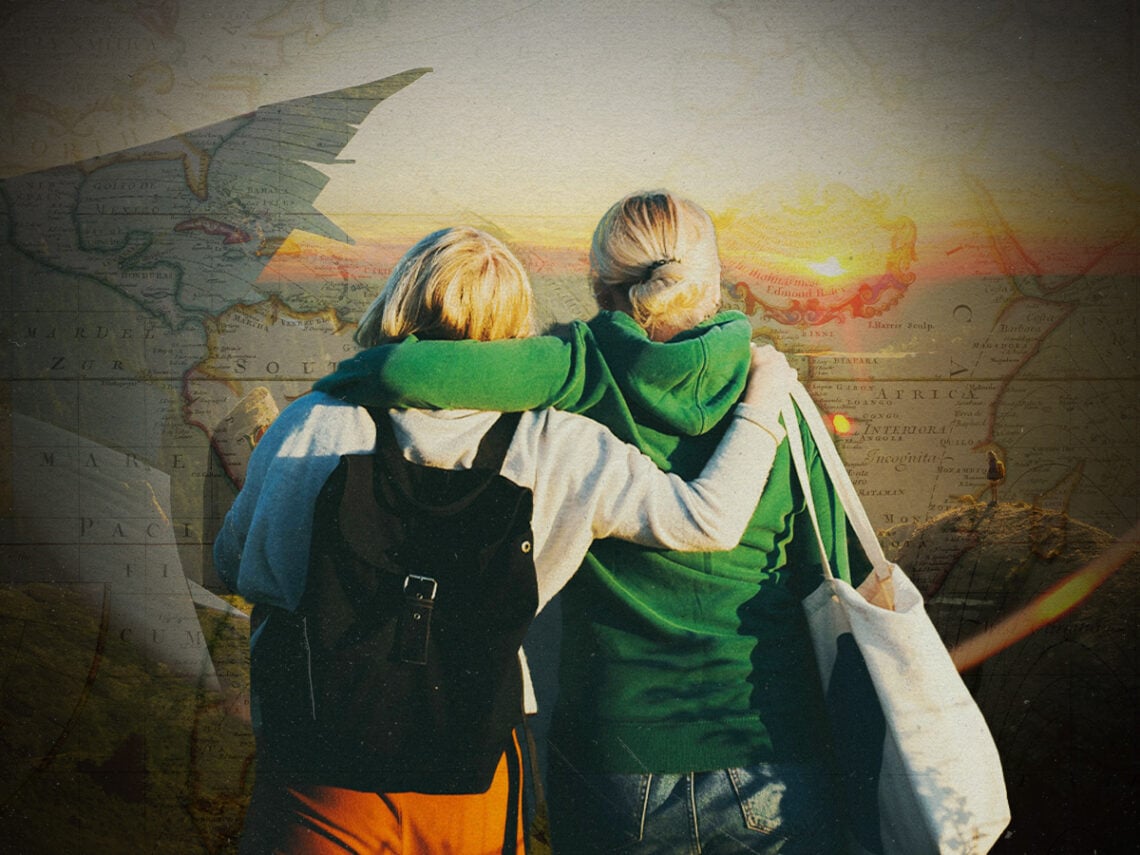
Does travel tackle homophily?

There are a lot of clichés associated with travel, but perhaps the number one is that it opens the door to self-discovery, and while there’s certainly truth to that, its greatest attribute is possibly how it can disrupt homophily.
Look around your friendship group; for most people, the majority of their closest friends and the people they spend time with look or sound like them. Further education and work can diversify the pool of people that you associate with, but there’s largely a limit to that, and most people you engage with on a day-to-day basis are similar to you.
This is where travel excels, as by experiencing life in a different location, you’re forced beyond your comfort zone, beyond your cultural norms and language, and exposed to people who live and think in different ways from you. Homophily isn’t in and of itself a bad thing, and it’s natural to gravitate towards people who have things in common with us, which could be language, worldview, religion or class.
This is likely an evolutionary thing, something which has kept people safe across thousands of years, and in many ways, it’s comfortable. While my friends and I differ in many ways, and have varied salaries or political beliefs, there’s a lot of crossover, with pints, football and music, there is a shared culture, one that brings us together, reduces friction, makes communication easy and keeps us happy. However, there are obviously drawbacks, and spending your time reminiscing over 1990s Premier League footballers, ranking the best lagers and naming your all-time England XI, probably isn’t the optimum environment for personal development.
The online world has only made homophily more entrenched in our day-to-day lives. From a Plymouth Argyle message board, through the Soviet architecture Instagram accounts to coffee subreddits, my online time, and yours, are full of people who share our interests and/or backgrounds, and travel, as long as you stay out of Briton-filled Irish bars, manages to interrupt this. You’re no longer in a familiar social environment, chatting with people in the same language, and whether it’s ordering food or navigating public transport, you’re forced into really thinking, like some sort of 24/7 puzzle.
In our media landscape, we’re fed a lot of information about people in different countries, some of which is true, some clichés, and some undoubtedly coming from a bad place, but once you go out into the real world and meet these people, your preconceived notions are bound to wash away. Life isn’t black and white, and people and their cultures aren’t either, so the best way to learn is to be exposed to them, so you can see and appreciate the nuance, and tackle the assumptions that you might hold.
Without wanting to sound like a hemp-wearing crusty, travel allows you to feel like an outsider, which is a necessary feeling, wherein, from spending your days in a familiar environment, you’re suddenly thrust into a role reversal, and you can truly be open and vulnerable, ultimately realising that despite huge differences between us all, most people are, at their base level, kind.



While a place’s local traditions, art, history and certainly the food, can be very alien to us, it all tells us the story of how those societies have developed and are the way that they are now; unfamiliarity can show you that other places and people share the same universal concerns. Back home, we’re stuck in a repeating rhythm of homophily, where our educations and our algorithms reinforce the same narratives and perspectives, so opening yourself up to voices and views from an alternate angle can help you better understand your own history and life as well.
This isn’t to say that all travel reduces homophily, like, for instance, if you’re eating a chicken curry instead of a Yorkshire pudding in Benidorm or having ten pints of Carling in the Red Lion in Doha, you’re unlikely to be fully immersing yourself in the local culture and language, and likewise, hitting up the same international fast-food chains or travelling in large groups can keep you in a cultural bubble.
This globalised world is only getting smaller, hence by turning away from homophily and engaging with people and cultures beyond your background, you’re doing yourself a huge personal service by understanding the role shared culture and identity play in human life. Ultimately, through making the unfamiliar become familiar, we’re doing our bit to tackle homophily, replacing stereotypes and opinions with understanding and nuanced knowledge, rendering ourselves capable of recognising our differences as well as all that we share.
