


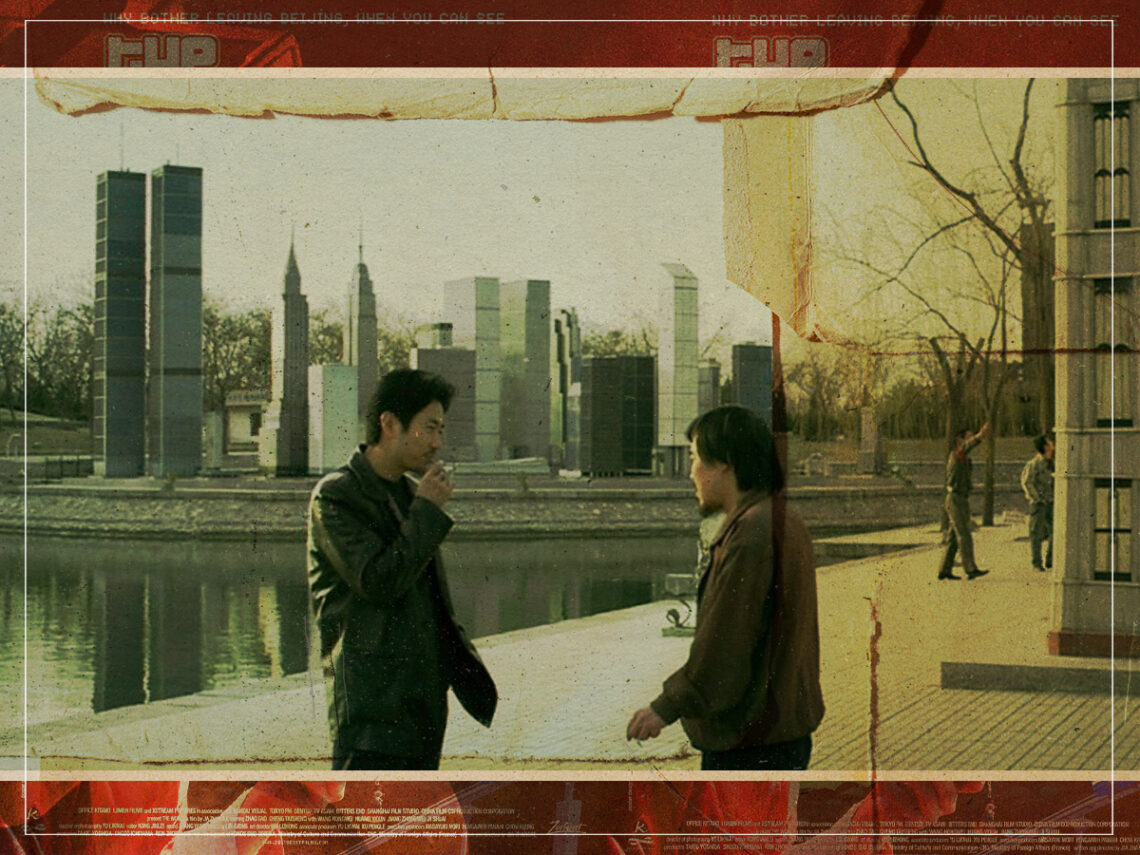
‘The World’: Jia Zhangke’s critique of Chinese globalisation

Many of the works of Chinese filmmaker Jia Zhangke document the realities of life in China in the most unflinching of terms. A departure from the kind of films made in the decades prior to Jia’s arrival on the Chinese cinema scene in the 1990s, his movies serve as a form of contemporary neorealism, dissecting the personal and political facets of Chinese government and society.
While the likes of Platform and Still Life have earned Jia the most acclaim, many of his films have played an important role in providing an authentic account of China as the Asian country made the move from the Cultural Revolution in the 1960s and 1970s to becoming a free market reform state in the early 1990s.
Following that piece of Chinese modern history, China has become a globalised international power in economic, industrial and military terms. As far as globalisation goes, Jia’s most powerful indictment of China’s newfound socio-political position came in his 2004 drama The World, starring his muse and frequent collaborator Zhao Tao, plus Cheng Taishen.
The World tells the stories of a number of Chinese migrant workers in a Beijing theme park that showcases miniature replicas of famous global landmarks. Shot on location at the Beijing World Park, which was built with the idea of showing Chinese tourists the entire world without them ever having to leave Beijing, The World primarily focuses on a dancer at the theme park, Tao, and her security guard boyfriend, Taisheng, who are both from rural China and have come to Beijing for better prospects.
However, the harsh realities of Chinese urban life are documented alongside a number of other workers at the theme park, who are all also struggling with their failed aspirations and working conditions. The park itself is, after all, a false promise of the allure of a globalised economy and the inherent failure of a localised system to allow its individual citizens to achieve their dreams.
As China began to progress rapidly from an economic perspective, it was the rural and migrant workers who had to suffer the burden of its expenses, showcasing that despite China’s growth, the transition to a market-oriented economy was not a smooth one for the working class. The park itself finds a moving analogue in this light. Sure, the park’s attractions are beautiful to look at and undoubtedly appealing, but at their core, they are false and hollow, much like the promises of the Chinese government to the Chinese people.
A globalised China serves only to empower the wealthy, and Jia’s The World shows in desperation the exploitation and instability suffered by the working-class individuals who prop the entire system up. The poor wages and living conditions met with minimal job security documented in the film show that while the Chinese government was seeking financial growth, the real consequences were happening on the ground to everyday people.
In classic Marxist terms, even the safety valve of the family and religion have also been eroded. The workers of the theme park in The World are alienated from the traditional means of happiness, and their overreliance on technology, often communicating via text message, further reinforces their isolation and serves as a striking premonition as what would come in the following years as technology strengthened its grip on the individual even more, at the cost of interpersonal face-to-face communication.
Jia’s The World is a striking portrait of the abandonment of one’s hope and ambition when faced with the ugly and cruel realities of the world, particularly in the face of an increasingly modernised, industrialised and globalised world. A stunning film once again from Jia, The World serves as the Chinese director’s critique of the Chinese government and the kind of economic inequality their political ambitions cause.
